
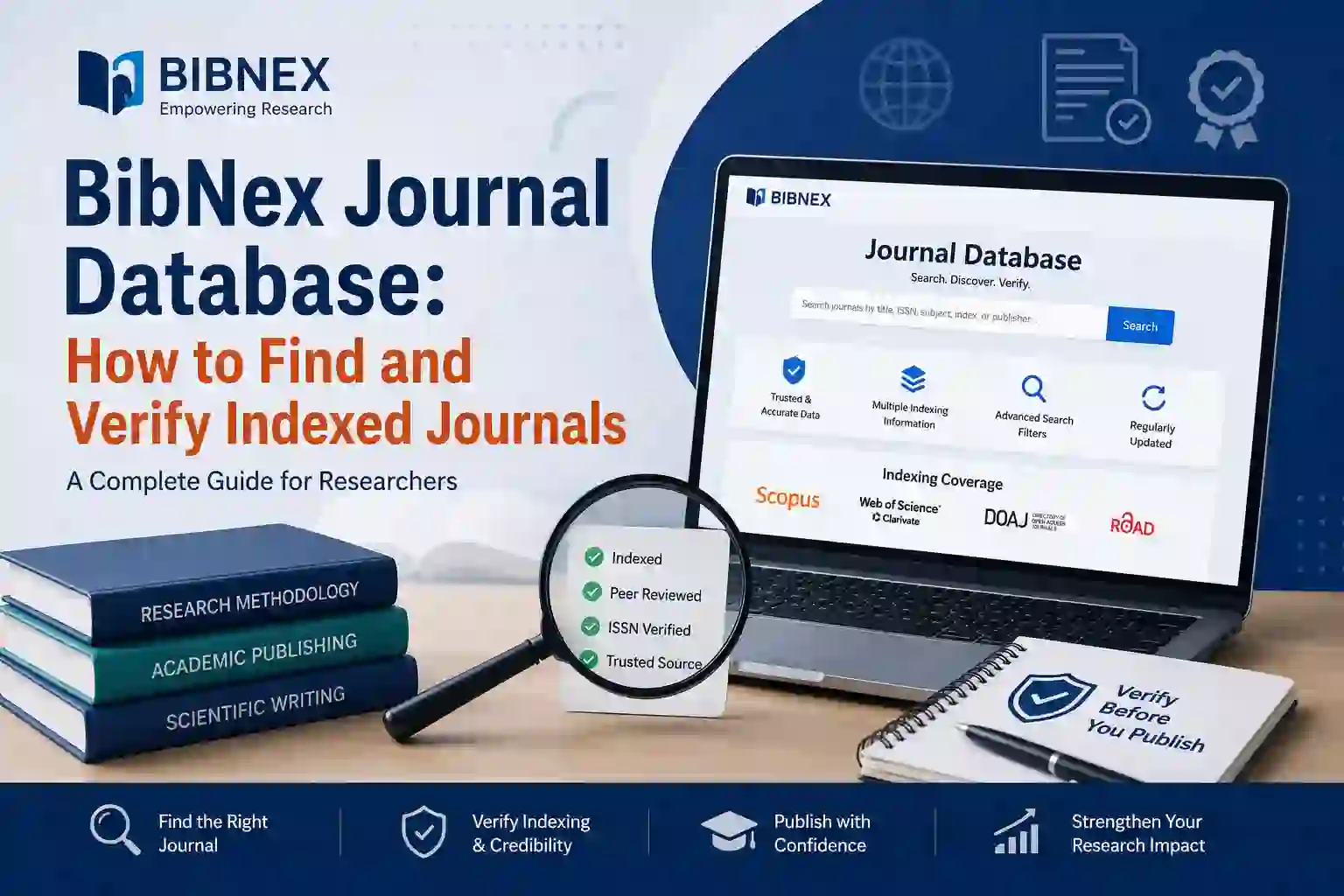
Choosing the right academic journal is one of the most important decisions a researcher makes before submitting a manuscript. A journal may appear relevant, professional, and active, but that does not automatically mean its indexing information is accurate, current, or suitable for a particular research goal. This is why researchers increasingly need reliable ways to find indexed journals, verify journal information, compare publication options, and understand journal status.
A journal database can make this process easier by bringing journal information into one searchable environment. For researchers, such a database can simplify journal discovery and verification. For publishers, it can provide a way to improve journal visibility and keep journal information discoverable.
BibNex is designed around this broader research workflow. The BibNex journal database brings together journal discovery, journal verification, article discovery, and journal monitoring concepts so that researchers and publishers can find and work with journal information more efficiently.
This comprehensive guide explains what an indexed journal is, how journal databases work, how to verify indexing information, what researchers should evaluate before submission, and how a platform such as BibNex can fit into the journal discovery and verification process.
A journal database is an organized collection of information about academic and scholarly journals. Depending on the platform, a journal database may include journal titles, ISSNs, publishers, subject areas, publication information, indexing information, journal websites, article records, and other metadata.
The main purpose of a journal database is to make journal discovery more efficient. Instead of searching across hundreds or thousands of individual publisher websites, researchers can use a centralized database to discover journals that may be relevant to their research.
A well-structured journal database can support several activities:
- Finding journals by title or keyword.
- Discovering journals by subject or discipline.
- Searching for journals associated with specific publishers.
- Checking journal identifiers such as ISSN where available.
- Reviewing available indexing information.
- Finding articles associated with journals.
- Comparing journals before selecting a publication venue.
- Monitoring changes in journal information.
For researchers, the value of a journal database is not simply the number of journals listed. The quality, organization, transparency, freshness, and usefulness of the information are equally important.
This is one reason BibNex approaches journal discovery as more than a simple directory. Its broader ecosystem connects journal search, journal verification, indexed journal discovery, article search, and journal monitoring.
An indexed journal is a journal whose records are included in a particular indexing service or database according to that service's policies and selection criteria.
The word "indexed" should therefore always be understood in context. A journal can be indexed in one database while not being indexed in another. Researchers should avoid treating the word "indexed" as a universal quality label.
For example, when evaluating a journal, you may encounter references to different scholarly discovery or indexing systems. Each system can have its own:
- Selection criteria.
- Coverage policies.
- Subject scope.
- Review procedures.
- Update schedules.
- Journal eligibility requirements.
Therefore, a researcher should ask a more specific question:
Indexed where, according to which database or service, and is the information current?
This distinction is essential when using an indexed journals database. A database can help you discover and organize journal information, but the researcher should still understand what each indexing claim means.
Journal indexing can influence how easily scholarly content is discovered and how researchers identify journals relevant to their work. For authors, discoverability is an important part of the publishing journey because research has greater practical value when other researchers can find and engage with it.
1. Improved Discoverability
Indexed journals can be easier to discover through academic search and database environments. This can help researchers identify publications within a particular field.
2. Better Journal Discovery
Researchers often begin with a topic rather than a specific journal. A journal indexing database can help them move from a broad research topic toward potentially relevant journals.
3. Easier Journal Comparison
Centralized journal information makes it easier to compare journals based on subject area, publisher, indexing information, publication scope, and other relevant characteristics.
4. More Informed Publication Decisions
Before submitting a manuscript, authors should evaluate whether a journal aligns with their research topic, audience, publication requirements, and academic objectives.
5. Better Information Awareness for Publishers
Publishers can also benefit from journal databases because discoverability can help researchers find their journals. Maintaining accurate journal information is particularly important when journal records are used by researchers during journal selection.
However, indexing should never be treated as the only factor in journal selection. Researchers should consider the entire journal profile.
The terms journal database and journal indexing are related but not identical.
| Concept | Meaning | Why It Matters |
|---|---|---|
| Journal database | An organized collection of journal information and records. | Helps users discover and research journals. |
| Journal indexing | The inclusion of journal or article records in a particular indexing service. | Can improve scholarly discoverability within that service. |
| Journal verification | The process of checking whether journal information or claims can be confirmed. | Helps researchers make better-informed decisions. |
| Journal monitoring | Ongoing observation of changes to journal information or status. | Helps users avoid relying on outdated information. |
A platform can combine these functions. BibNex, for example, connects journal discovery with verification and monitoring concepts rather than treating a journal record as a static listing.
Finding indexed journals should begin with your research requirements rather than with a random list of journal names.
Step 1: Define Your Research Topic
Start by identifying your subject, discipline, research question, and intended audience. A journal should have a meaningful connection to the subject of your manuscript.
For example, a paper about machine learning in healthcare may need a different journal discovery strategy from a paper about educational psychology.
Step 2: Identify Relevant Journals
Use a reliable journal database or academic discovery resource to create an initial list of potentially relevant journals.
At this stage, avoid selecting a journal simply because its name sounds appropriate. Review its scope, publisher, publication history, indexing information, and other available details.
Step 3: Review Indexing Information
Once you have identified potential journals, examine their stated indexing information. Record the relevant database or service rather than simply writing "indexed."
Step 4: Verify Important Details
Use journal verification methods to cross-check important information such as title, ISSN, publisher, website, indexing claims, and publication status.
Step 5: Evaluate Journal Suitability
A journal can be indexed and still be unsuitable for your manuscript. Check the aims and scope, article types, subject coverage, audience, submission requirements, publication model, and other factors relevant to your research.
Step 6: Check Information Freshness
Journal information can change. A journal's publisher, website, scope, indexing status, or publication activity may change over time. This makes current information important.
Step 7: Make Your Final Decision
After evaluating the journal, compare it with other suitable options. Choose the publication venue based on your research objectives rather than relying on a single metric.
Journal verification is one of the most important steps before manuscript submission. A journal's website may contain useful information, but researchers should still evaluate important claims carefully.
1. Check the Exact Journal Title
Make sure the title you are researching is the same journal you are considering for publication. Similar journal names can create confusion.
2. Check the ISSN
Where available, compare the journal's ISSN information with reliable records. An ISSN can help distinguish between journals with similar titles.
3. Check the Publisher
Identify who publishes the journal. Review the publisher's website and available publication information.
4. Review Indexing Claims
Do not stop at a statement such as "indexed in major databases." Identify the specific database or indexing service being referenced.
5. Check the Journal's Scope
Read the aims and scope. A journal should have a clear relationship with your research topic.
6. Review Recent Articles
Look at recently published articles. This can help you understand whether the journal is actively publishing material related to your field.
7. Review Editorial Information
Examine the editorial board, contact information, publication policies, peer-review information, and other transparency signals.
8. Check Publication Information
Look for information about publication frequency, article types, submission procedures, and author guidelines.
9. Check for Consistency
Journal title, ISSN, publisher, website, and other identifiers should be reasonably consistent across the information you review.
10. Recheck Before Submission
Verification should not necessarily be a one-time activity. If considerable time has passed since your initial journal search, check important information again before submitting.
Finding an indexed journal is only the beginning. A strong journal selection process considers multiple factors.
| Factor | Questions to Ask |
|---|---|
| Subject relevance | Does the journal publish research in your field? |
| Aims and scope | Does your manuscript fit the journal's stated scope? |
| Indexing | Which indexing services include the journal? |
| Publisher | Who publishes the journal? |
| ISSN | Can the journal's identifier be verified? |
| Publication history | Does the journal show consistent publication activity? |
| Peer review | Are the peer-review policies clearly described? |
| Editorial board | Is editorial information available and transparent? |
| Author guidelines | Are manuscript requirements clearly explained? |
| Publication model | Are publication fees and policies clearly communicated? |
The best journal for one researcher may not be the best journal for another. Your decision should reflect the purpose, subject, audience, and requirements of your research.
A powerful journal database should help users move from a broad search to a focused shortlist.
Search by Journal Title
If you already know the journal name, title-based search is the fastest approach. This is particularly useful when you want to verify a specific journal.
Search by Subject
Subject-based searching is useful when you know your research area but do not yet have a specific journal in mind.
Search by Discipline
Discipline-based discovery can help researchers narrow a broad field into more relevant journal categories.
Search by Publisher
Researchers who frequently work with a particular publisher may want to discover other journals associated with that publisher.
Search by Country
Country-based journal discovery can help users explore journals published in a particular geographic market or academic community.
Search by Article
Article-level search can be especially useful when you want to discover existing research before selecting a journal. Searching by article title, author, journal, subject, or other available metadata can help identify relevant literature.
This is where BibNex's broader approach becomes useful. Instead of thinking about journal discovery and article discovery as completely separate activities, researchers can use both to understand a research area and identify potentially relevant journals.
Journal indexing status should be treated as information that requires context and, where appropriate, verification.
When evaluating a journal, consider the following questions:
- Which indexing database is being referenced?
- What is the journal's exact title?
- What is the journal's ISSN?
- Who is the publisher?
- Is the journal currently active?
- When was the indexing information last checked?
- Does the available information appear consistent?
- Can the indexing claim be independently confirmed?
These questions are more useful than treating "indexed" as a simple yes-or-no quality label.
Current Status vs Historical Status
One of the most important concepts in journal verification is the difference between historical information and current information.
A journal may have been included in a database at one point in time, while its current status may require separate verification. Researchers should therefore pay attention to the date and context of the information they are using.
This is also why journal monitoring can complement journal verification. Monitoring helps users stay aware of changes rather than relying permanently on an old search result.
Mistake 1: Choosing a Journal Only Because It Is Indexed
Indexing is important, but it is not the only selection criterion. Your manuscript still needs to fit the journal.
Mistake 2: Trusting a Badge Without Checking Details
A logo or indexing statement on a website should not automatically be treated as sufficient verification. Look for specific information and verify it where appropriate.
Mistake 3: Ignoring Journal Scope
An indexed journal may still reject your paper because the manuscript does not fit its scope.
Mistake 4: Using Outdated Lists
Static lists can become outdated. Researchers should consider the freshness of the information when evaluating journal status.
Mistake 5: Confusing Similar Journal Titles
Always check identifying information such as ISSN and publisher when multiple journals have similar names.
Mistake 6: Looking Only at Journal Metrics
Metrics can be useful in context, but they should not replace a complete journal evaluation.
Mistake 7: Ignoring the Publisher
The publisher is an important part of understanding a journal's identity and publication infrastructure.
Mistake 8: Failing to Recheck Before Submission
If you identified a journal months ago, recheck its important information before submitting your manuscript.
Journal databases are not only useful for authors. Publishers can also benefit from journal indexing and discovery platforms.
A publisher may want researchers to discover its journal when searching by subject, title, publisher, country, or other characteristics. Accurate and well-organized journal information can make that discovery process easier.
Why Publishers Should Care About Journal Discoverability
- Researchers need to discover suitable journals.
- Accurate journal records improve information clarity.
- Journal information can help researchers evaluate publication options.
- Better discoverability can increase awareness of a journal.
- Monitoring can help publishers keep information current.
Submitting a Journal to a Database
Publishers should prepare accurate journal information before submitting a journal to a database. Depending on the platform, useful information may include:
- Journal title.
- ISSN and other identifiers.
- Publisher information.
- Journal website.
- Aims and scope.
- Subject or discipline.
- Publication frequency.
- Editorial information.
- Publication policies.
- Article information and metadata.
BibNex provides a publisher-oriented pathway for journal discovery and indexing. Publishers can use the platform's ecosystem to make their journals more discoverable while researchers can use journal information to support their discovery and verification workflow.
Journal information is not necessarily static. A journal can change its publisher, website, title information, editorial information, publication activity, or other characteristics over time.
This creates a need for journal monitoring.
Journal monitoring means keeping track of relevant changes to a journal and its available information. For publishers, monitoring can help maintain accurate records. For researchers, monitoring can help reduce reliance on outdated information.
What Can Be Monitored?
- Journal title information.
- Publisher information.
- Website information.
- Indexing information.
- Publication activity.
- Article records.
- Other available journal metadata.
The concept of monitoring is particularly important when a researcher is considering a journal for a future publication. Information checked today may need to be reviewed again when the manuscript is ready for submission.
This is an area where BibNex journal monitoring can become an important part of the platform's brand identity: not simply helping users find journals, but helping them remain informed about journal information over time.
BibNex is built around the idea that researchers and publishers need more than a static list of journal names. They need a practical environment for discovering, researching, verifying, and monitoring journal information.
The BibNex ecosystem can be understood through four connected functions.
1. Journal Discovery
Researchers can use the BibNex journal database concept to discover journals that may be relevant to their research. Searching by available journal information can help users move from a broad research requirement toward a more focused journal shortlist.
2. Journal Verification
Finding a journal is not enough. Researchers also need to evaluate the information associated with it. BibNex's focus on journal verification supports the broader goal of helping researchers investigate journal records before making publication decisions.
3. Article Discovery
Journal selection and literature discovery are closely related. Before choosing a journal, researchers often need to understand what research has already been published in a particular area. BibNex's article discovery functionality connects journal research with academic content discovery.
4. Journal Monitoring
A journal record should not necessarily be considered permanently unchanged. BibNex's journal monitoring focus addresses the need to keep track of relevant journal information over time.
BibNex for Researchers
For researchers and authors, BibNex can support a workflow such as:
- Define your research topic.
- Search for relevant journals.
- Review journal information.
- Check available indexing information.
- Verify important journal details.
- Search related articles.
- Compare potential journals.
- Recheck important information before submission.
BibNex for Publishers
For publishers, the workflow can be different:
- Prepare accurate journal information.
- Submit or register the journal where appropriate.
- Improve journal discoverability.
- Maintain accurate metadata.
- Monitor journal information.
- Help researchers discover the journal.
This distinction is important because BibNex serves two connected audiences: the researchers searching for journals and the publishers responsible for journals.
If you are an author, researcher, student, editor, or publisher, the following recommendations can make your journal research more effective.
Recommendation 1: Start With Research Fit
Do not start with a journal's perceived prestige alone. Start by understanding where your research fits.
Recommendation 2: Verify Before You Submit
Always review important journal information before submitting your manuscript. This is particularly important when the information was collected a long time ago.
Recommendation 3: Use Multiple Signals
Consider indexing, scope, publisher, editorial information, publication history, policies, and other relevant factors together.
Recommendation 4: Distinguish Discovery From Verification
Finding a journal in a database is a discovery step. Verification is a separate step. A good workflow includes both.
Recommendation 5: Keep Records
When you shortlist journals, record the date you checked them and the information you used. This makes it easier to recheck the journal later.
Recommendation 6: Search Articles Before Choosing a Journal
Reviewing related articles can help you understand the type of research a journal publishes and whether its audience is relevant to your work.
Recommendation 7: Don't Chase Keywords or Metrics
A journal should be evaluated according to your research objectives, not simply because it appears for a particular search term or displays a particular metric.
Recommendation 8: Recheck Important Information
Journal selection is time-sensitive. If months pass between your initial research and manuscript submission, perform another verification step.
Recommendation 9: Use a Structured Checklist
A consistent journal selection checklist reduces the risk of overlooking important information.
Recommendation 10: Treat BibNex as Part of a Broader Research Workflow
Use BibNex for journal discovery, verification, article discovery, and monitoring, while independently evaluating the information and requirements that matter to your specific publication decision.
The process of finding an indexed journal connects with several broader academic publishing topics. Researchers can explore these areas to build a more complete understanding of journal selection.
Journal Verification
Learn how to verify a journal, check indexing information, compare journal identifiers, and evaluate publisher information.
Journal Selection
Journal selection involves comparing subject relevance, scope, audience, publication policies, indexing information, and other factors.
Journal Indexing
Understanding how journal indexing works can help authors interpret indexing claims and make better publication decisions.
Academic Article Search
Searching academic articles helps researchers discover existing literature, identify research trends, and understand the publication landscape.
Journal Monitoring
Monitoring can help researchers and publishers remain aware of changes to journal information over time.
Publisher Discoverability
Publishers can use journal databases and discovery platforms to make accurate information about their journals easier for researchers to find.
What is an indexed journal?
An indexed journal is a journal whose records are included in a particular indexing or scholarly database according to that service's policies and criteria. Researchers should identify the specific database rather than treating "indexed" as a universal status.
What is a journal indexing database?
A journal indexing database is a structured resource containing information about journals and, depending on the platform, their indexing or discovery status. It can help researchers find, compare, and investigate journals.
How can I check if a journal is indexed?
Start by identifying the exact journal title and ISSN, then determine which indexing service the journal claims to be included in. Review the available information and verify the claim using reliable sources or journal verification resources. BibNex can be used as part of the journal discovery and verification workflow.
Why should I verify a journal before submitting a paper?
Journal verification helps researchers evaluate whether the journal information they are relying on is accurate and relevant to their publication decision. It can also help identify inconsistencies in journal title, publisher, ISSN, indexing claims, or other information.
Is an indexed journal automatically a good journal?
No. Indexing is one factor in journal evaluation. Researchers should also consider subject relevance, aims and scope, editorial information, publisher, publication policies, peer-review information, article quality, and other factors relevant to their research.
What information should I check when verifying a journal?
Important information can include the exact journal title, ISSN, publisher, journal website, subject scope, indexing information, editorial details, publication history, author guidelines, peer-review information, and publication policies.
What is the difference between a journal database and a journal directory?
A journal directory generally focuses on listing journals, while a broader journal database may provide more structured information, search functionality, metadata, article records, indexing information, and other discovery features. The exact capabilities depend on the platform.
How can I find indexed journals for my research?
Start with your research topic and discipline, then search a suitable journal database for relevant journals. Shortlist journals based on subject fit and review their indexing and publication information before making a final decision.
Can publishers submit journals to a journal database?
Some journal databases and indexing platforms provide submission or registration processes for publishers. Publishers should review the specific requirements of the platform and provide accurate journal information.
Why is journal monitoring important?
Journal information can change over time. Monitoring helps researchers and publishers remain aware of relevant changes instead of relying indefinitely on information that may have become outdated.
Can I use BibNex to search for journals?
Yes. BibNex is designed as a journal discovery and indexing database environment where researchers can search and explore journal information. Its broader ecosystem also connects journal verification, article discovery, and journal monitoring.
How does BibNex help researchers verify journals?
BibNex connects journal discovery with verification-oriented information so researchers can investigate journal records before making publication decisions. Users should still evaluate important information and follow the requirements of the relevant indexing services and publishers.
How can publishers benefit from BibNex?
Publishers can use BibNex as a journal discovery and visibility platform to make journal information more discoverable to researchers. The publisher-oriented workflow also supports journal submission, indexing visibility, and monitoring concepts.