
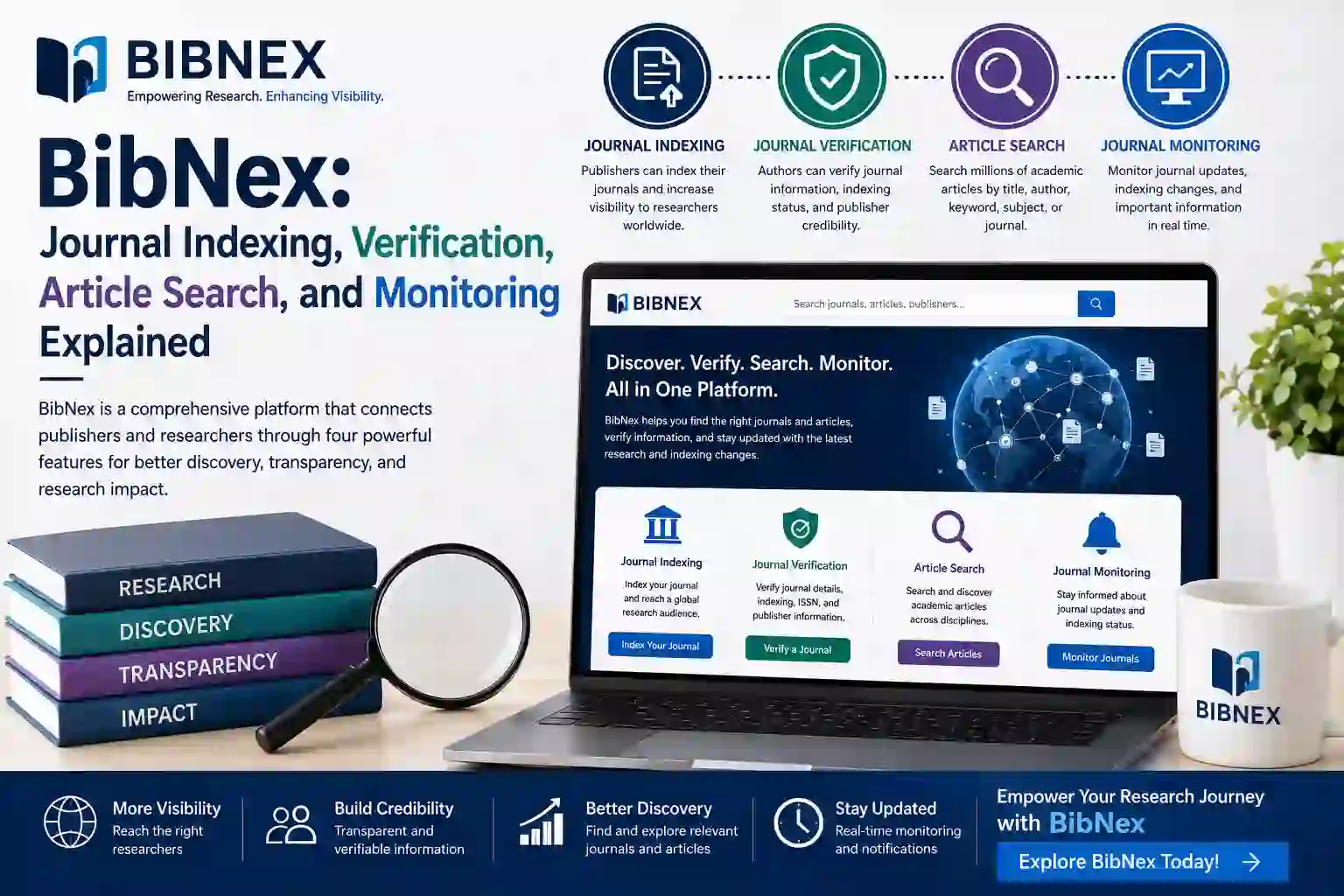
BibNex: Journal Indexing, Verification, Article Search, and Monitoring Explained
Finding the right academic journal is an important part of the research and publication process. Researchers want to know whether a journal is relevant to their subject, whether its information can be verified, where it is indexed, and whether it provides useful opportunities for publishing and discovering research.
At the same time, journal publishers need effective ways to make their journals more discoverable to researchers and authors. Simply publishing articles is not always enough. Researchers need to be able to find journals, understand their information, discover published articles, and evaluate potential publication venues.
BibNex is designed around these needs. It brings together four important activities in the academic publishing workflow: journal indexing, journal verification, article search, and journal monitoring.
This guide explains what BibNex is, how each feature works, who can benefit from the platform, and how researchers and publishers can use it as part of their academic publishing workflow.
What Is BibNex?
BibNex is a journal indexing and discovery platform that connects publishers, authors, researchers, journals, and academic articles.
The platform is designed to make journal information more discoverable and useful. Publishers can index their journals, while authors and researchers can search for journals, investigate available information, discover articles, and monitor journal-related information.
You can think of BibNex as a platform that brings several parts of the journal discovery process together instead of treating them as completely separate activities.
Its core areas include:
- Journal indexing for publishers
- Journal verification for authors and researchers
- Academic article search for research discovery
- Journal monitoring for ongoing information tracking
This combination is important because journal discovery does not end after finding a journal. A researcher may need to verify it, explore its articles, compare it with other journals, and continue monitoring relevant information before making a publication decision.
Why Is a Journal Discovery Platform Important?
The academic publishing environment contains thousands of journals covering different subjects, disciplines, regions, publishers, and research areas.
For a researcher, this creates a practical problem: How do you find the right journal?
A researcher may search Google, browse publisher websites, look through journal directories, search academic databases, or ask colleagues for recommendations. While these approaches can be useful, information may be spread across multiple sources.
Researchers may need to answer questions such as:
- Is this journal relevant to my research?
- Is the journal indexed?
- Who publishes it?
- What subjects does it cover?
- Can I verify the journal information?
- What articles has the journal published?
- Can I find articles by a particular author?
- Has important journal information changed?
A platform such as BibNex journal database can help bring these activities into a more organized workflow.
1. BibNex Journal Indexing Explained
One of the main features of BibNex is journal indexing.
For publishers, visibility is an important part of building a journal. A publisher can produce valuable academic content, but researchers still need a way to discover the journal.
Journal indexing helps organize journal information in a searchable environment so that researchers have another place to discover relevant publications.
Why Is Journal Indexing Important for Publishers?
Imagine a publisher manages a journal covering environmental science. The journal has a clear scope, qualified editors, and regularly publishes research. However, researchers who are unfamiliar with the journal may have difficulty finding it.
Creating a structured presence in a journal indexing and discovery platform can provide another route through which researchers can discover the publication.
Publishers should consider indexing as part of a broader visibility strategy rather than treating it as a replacement for quality publishing or SEO.
A strong journal visibility strategy can include:
- Maintaining a professional journal website
- Providing accurate journal metadata
- Keeping ISSN information consistent
- Publishing useful and relevant research
- Improving article discoverability
- Using appropriate indexing and discovery platforms
- Building internal links between journal and article pages
- Monitoring journal information regularly
How Publishers Can Use BibNex
Publishers can use BibNex to create a discoverable presence for their journals.
The basic process should begin with preparing accurate journal information. Publishers should review the journal title, ISSN, publisher details, subject area, aims and scope, website, and other relevant information before submitting the journal.
Once the information is organized, the publisher can use the platform's journal indexing functionality to make the journal available for discovery.
This connects BibNex with an important publisher goal: making legitimate and relevant journal information easier for researchers to find.
2. BibNex Journal Verification Explained
Finding a journal is only the first step. Before submitting a manuscript, researchers should verify important information about the journal.
Journal verification means checking available information about a journal before relying on it for research or publication.
A basic verification process can include checking:
- Journal title
- ISSN
- Publisher
- Subject and discipline
- Aims and scope
- Indexing information
- Published articles
- Editorial information
- Author guidelines
- Publication policies
BibNex supports this part of the research workflow by giving authors and researchers a place to search and investigate journal information.
Why Should Authors Verify a Journal?
Choosing a journal is a significant decision. Submitting a paper to an unsuitable journal can waste time and may result in unnecessary delays.
For example, a researcher may discover a journal through a search engine and immediately assume it is the best option because the journal title appears relevant.
A better approach is to investigate the journal first.
The researcher can check the journal's subject area, publisher, available indexing information, articles, publication policies, and other relevant details before making a final decision.
This is where journal verification becomes part of a responsible publication workflow.
Important: Verification Is Not the Same as Quality Ranking
It is important to understand that verifying a journal does not automatically mean that the journal is the best choice for every researcher.
Researchers should still evaluate the journal according to their own requirements.
For example, an author may need a journal that:
- Matches a specific research discipline
- Accepts a particular article type
- Has a suitable geographic or international audience
- Uses a particular peer-review process
- Meets institutional publication requirements
- Has appropriate publication fees
Journal verification should therefore be viewed as an information-gathering step, not as a substitute for independent academic judgment.
3. BibNex Article Search Explained
Journal discovery and article discovery are closely connected.
Researchers often begin with an article rather than a journal. For example, a researcher studying artificial intelligence may search for research papers on a specific topic. After discovering useful articles, they may explore the journals that published those articles.
This makes academic article search an important part of the research workflow.
BibNex supports article discovery so that researchers can search and explore academic content alongside journal information.
What Can Researchers Search For?
Depending on the available information, researchers may want to search for articles using different approaches, such as:
- Article title
- Author
- Journal
- Research topic
- Subject
- Keywords
This is useful because researchers do not always know the exact title of the journal they need.
For example, suppose a researcher is working on "machine learning applications in healthcare." Instead of searching only for a journal name, they can begin by looking for relevant research articles and then explore the journals publishing related work.
Why Article Discovery Matters for Publishers
For publishers, article discovery creates another opportunity to increase journal visibility.
Every published article represents a potential entry point to the journal. A researcher may discover an article, read the abstract, explore the journal, and eventually consider the journal for future research or publication.
Therefore, publishers should think about both journal-level discoverability and article-level discoverability.
This is one of the reasons BibNex connects its journal database with article search. The relationship between journals and articles is central to academic research.
4. BibNex Journal Monitoring Explained
Journal information can change over time.
A journal may update its website, publisher information, editorial team, publication schedule, scope, or other details. Researchers who evaluated a journal several months ago may therefore need to check the information again before submitting a new manuscript.
This is where journal monitoring becomes useful.
Journal monitoring means keeping track of relevant journal information over time rather than treating a journal record as permanently unchanged.
Why Is Journal Monitoring Useful?
Consider an author who identifies a suitable journal today but plans to submit a paper several months later.
Instead of assuming that nothing will change, the researcher can make journal monitoring part of their publication workflow.
Publishers can also benefit from monitoring because they can identify outdated information and maintain a more accurate journal presence.
BibNex connects journal monitoring with its other features to create a more complete approach to journal information management.
How the Four BibNex Features Work Together
The real value of BibNex comes from seeing these features as connected rather than isolated.
The workflow can be understood as:
- Index: Publishers make their journals discoverable.
- Search: Researchers discover journals and articles.
- Verify: Authors investigate journal information before making publication decisions.
- Monitor: Relevant journal information can be followed over time.
This creates a simple ecosystem connecting publishers and researchers.
Example: A Researcher's Workflow
Suppose an author has completed a research paper about renewable energy.
The author can start by searching for relevant journals. After finding several options, the author can investigate each journal's subject area, publisher, indexing information, and other available details.
The author can then explore articles published by those journals to understand whether the publication is relevant to their research.
After comparing the available options, the author can select a journal that best matches the research and their publication requirements.
If the author plans to submit later, monitoring relevant journal information can help them avoid relying on outdated information.
How Publishers Can Improve Their BibNex Journal Presence
Simply adding a journal to a database should not be the end of the process. Publishers should focus on maintaining accurate and useful information.
Keep Journal Information Consistent
Make sure the journal title, ISSN, publisher name, website, and other important information are consistent across your website and external platforms.
Provide Clear Aims and Scope
Researchers should be able to quickly understand what your journal publishes. A clear scope also helps the journal reach the right audience.
Maintain Article Information
Use clear article titles, author information, abstracts, keywords, publication dates, volume and issue information, and identifiers such as DOIs where applicable.
Update Information Regularly
Do not allow an old journal record to remain unchanged for years. Review important information periodically.
Build Your Overall Digital Presence
BibNex should complement—not replace—your journal's website, technical SEO, content strategy, academic outreach, and other appropriate discovery channels.
Benefits of BibNex for Publishers
For publishers, the platform can support several important goals.
- Journal discoverability: Give researchers another place to find your journal.
- Structured journal information: Present important journal details in an organized environment.
- Researcher reach: Connect journal information with an audience searching for academic publications.
- Article discovery: Connect individual research articles with journal information.
- Ongoing monitoring: Support the idea of keeping journal information current.
These benefits should be viewed as part of a broader visibility strategy rather than as guaranteed rankings, citations, or publication outcomes.
Benefits of BibNex for Authors and Researchers
Researchers can also benefit from having journal and article information connected within one discovery environment.
Key benefits include:
- Searching for relevant journals
- Investigating journal information
- Exploring indexed journal records
- Searching academic articles
- Discovering research through journal and article connections
- Supporting a more organized journal-selection process
For new researchers, this can be especially helpful because choosing a journal can initially feel overwhelming.
Common Mistakes to Avoid When Choosing a Journal
1. Choosing Only by Journal Name
A journal title can sound relevant without actually being a good fit. Always read the aims and scope.
2. Assuming Every "Indexed" Claim Means the Same Thing
Always identify the specific indexing or discovery service being referenced. Different databases have different purposes.
3. Ignoring Recent Articles
Review recent publications to determine whether the journal is actually publishing research related to your topic.
4. Forgetting to Check Publisher Information
Publisher information helps distinguish between journals with similar titles and provides useful context when evaluating a publication.
5. Relying on Old Information
Journal information can change. Recheck important details before submitting your manuscript.
6. Treating Indexing as a Guarantee
Being discoverable through an indexing platform does not guarantee article acceptance, citations, rankings, or research impact.
Expert Tips for Using a Journal Database Effectively
Tip 1: Start with your research topic. Do not begin by choosing a journal simply because its name is familiar. Identify journals that genuinely publish work in your field.
Tip 2: Compare several journals. Create a shortlist instead of immediately submitting to the first relevant journal you find.
Tip 3: Verify important information. Check journal identifiers, publisher information, scope, indexing details, and publication policies.
Tip 4: Read recent articles. Published articles can tell you a great deal about a journal's actual subject coverage.
Tip 5: Think beyond the journal homepage. Article discovery can introduce researchers to journals they did not previously know about.
Tip 6: Recheck before submission. Journal information is not necessarily permanent. Verify important details again when you are ready to submit.
BibNex and the Future of Journal Discovery
Academic publishing continues to become more digital and interconnected. Researchers expect to find information quickly, while publishers need effective ways to present their journals to a wider research audience.
This makes discoverability increasingly important.
The future of journal discovery is not simply about creating larger lists of journals. It is about connecting journals, publishers, authors, articles, subjects, and research information in ways that are useful to real researchers.
BibNex is built around this broader idea. Its combination of journal indexing, verification, article search, and monitoring creates a platform focused on different stages of the research publishing journey.
For publishers, this means an opportunity to improve the discoverability of their journals. For authors, it provides another resource for investigating publication options. For researchers, article search creates another path toward relevant academic literature.
Frequently Asked Questions
What is BibNex?
BibNex is a journal indexing and discovery platform designed to connect publishers, journals, authors, and academic articles. Its core features include journal indexing, journal verification, article search, and journal monitoring.
Can publishers index journals on BibNex?
Yes. BibNex is designed to allow publishers to index their journals and make journal information more discoverable to researchers and authors.
How does BibNex help authors verify journals?
BibNex provides a searchable environment where authors can discover and investigate available journal information. Authors should still independently evaluate journals according to their institutional, academic, and publication requirements.
Can I search for academic articles on BibNex?
BibNex supports academic article discovery as part of its broader journal and research search ecosystem. Researchers can use article information to discover relevant research and explore associated journals.
Why is journal monitoring important?
Journal information can change over time. Monitoring helps researchers and publishers stay aware of relevant updates and reduces the risk of relying on outdated information.
Does BibNex indexing guarantee journal quality?
No. Indexing or listing in a database should not be interpreted as an automatic guarantee of journal quality, acceptance, citations, ranking, or research impact. Researchers should evaluate journals using multiple relevant criteria.
How should I choose a journal for my research paper?
Start by checking whether the journal's aims and scope match your research. Then investigate its publisher, indexing information, recent articles, editorial policies, peer-review process, publication fees, author guidelines, and other requirements relevant to your research.
Conclusion
Journal discovery can be complicated when researchers need to search for journals, verify information, find relevant articles, and keep track of changes across different sources.
BibNex brings these activities together through four core areas: journal indexing, journal verification, article search, and journal monitoring.
For publishers, BibNex provides an opportunity to make journal information more discoverable. For authors, it can support the process of finding and investigating potential journals. For researchers, article search can provide another route to discovering academic literature.
However, the best results come from using BibNex as part of a wider research and publishing workflow. Publishers should continue to focus on journal quality, accurate information, strong editorial practices, useful content, technical SEO, and researcher needs. Authors should independently evaluate journals before submitting their work.
The goal is simple: make reliable journal and research information easier to discover, understand, verify, and follow.
Explore BibNex
Whether you are a publisher looking to improve journal discoverability or a researcher searching for journals and academic articles, BibNex is designed to support the modern research publishing workflow.
Explore the journal indexing and verification platform and discover how BibNex connects journal indexing, journal search, article discovery, verification, and monitoring.