
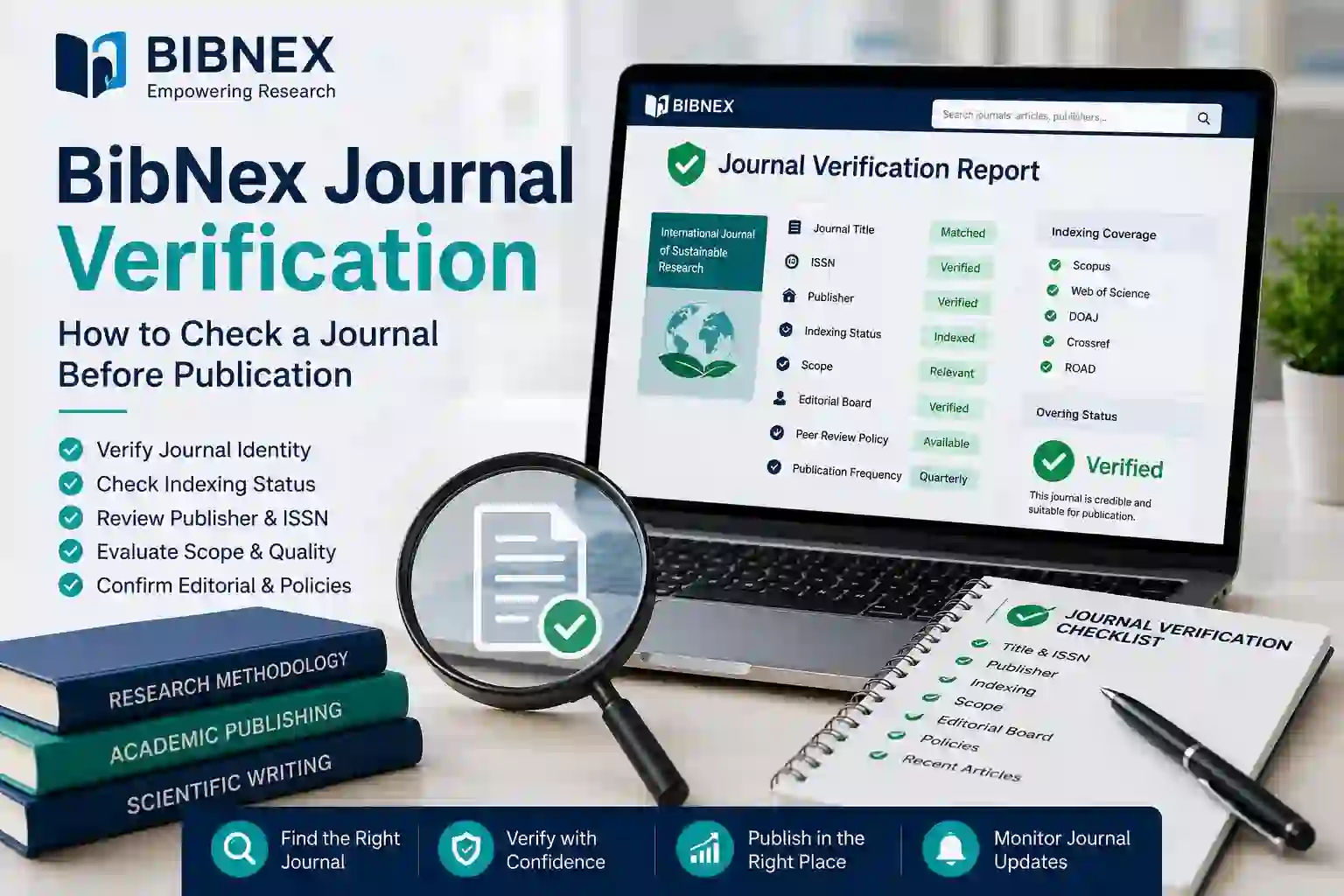
BibNex Journal Verification: How to Check a Journal Before Publication
Choosing a journal for your research paper is an important decision. Before submitting a manuscript, authors should make sure the journal is relevant to their research, has reliable publication information, and makes clear claims about its indexing and publishing practices.
A journal may look legitimate at first glance, but researchers should not rely only on a journal's website or a single indexing claim. A careful journal verification process can help authors identify important information and make a more informed publication decision.
BibNex journal verification is designed around this need. BibNex connects journal discovery, indexing information, verification, article discovery, and journal monitoring to help researchers investigate journals before choosing where to publish.
In this guide, you will learn how to verify a journal step by step, what information to check, common mistakes to avoid, and how a journal indexing database such as BibNex can become part of your research workflow.
Why Should You Verify a Journal Before Publication?
Submitting a research paper takes significant time and effort. Researchers spend months or even years conducting research, analyzing results, writing manuscripts, and preparing references. Selecting an unsuitable journal can create unnecessary delays or other publication problems.
Journal verification helps you answer basic but important questions:
- Is this the correct journal?
- Does the journal publish research in my subject area?
- Who publishes the journal?
- What is the journal's ISSN?
- What indexing services are associated with the journal?
- Is the available journal information consistent?
- Does the journal provide clear author and publication policies?
- Is the journal currently relevant to my publication requirements?
Verification does not mean that a journal must meet every possible criterion. Instead, it gives authors the information needed to evaluate a journal objectively.
What Is Journal Verification?
Journal verification is the process of checking important information about an academic or scholarly journal before relying on it for research or publication.
A verification process can include checking the journal title, ISSN, publisher, website, subject scope, indexing information, editorial information, publication history, and other available details.
It is important to understand that journal verification and journal selection are not exactly the same thing. Verification helps you establish whether the information about a journal appears consistent and useful. Selection is the next step: deciding whether that journal is appropriate for your particular manuscript.
How to Verify a Journal Before Publication
Use the following checklist before submitting your research paper.
1. Check the Exact Journal Title
Start by confirming the journal's exact title. This sounds simple, but similar journal names can cause confusion.
When searching for a journal, compare the title shown on the journal website with the title appearing in journal databases, indexing information, article records, and other relevant sources.
If two journals have very similar names, do not assume they are the same publication. Continue your verification using the journal's ISSN and publisher information.
2. Verify the ISSN
An ISSN, or International Standard Serial Number, is an important identifier used for serial publications such as academic journals.
Where an ISSN is provided, check whether the journal's information consistently refers to the same publication. Some journals may have separate identifiers for print and electronic editions.
For example, if you find a journal on one website with one title and ISSN but another database contains a different title or identifier, investigate the difference before submitting your paper.
3. Check the Publisher
Identify the organization responsible for publishing the journal. A journal should provide clear information about its publisher and contact details.
Look for:
- Publisher name
- Official website
- Contact information
- Editorial information
- Publication policies
- Author guidelines
Publisher information is particularly useful when several journals have similar names.
4. Check the Journal's Indexing Information
One of the most important parts of journal verification is understanding the journal's indexing claims.
Do not simply look for the word "indexed." Find out what the journal means by that statement.
Ask:
- Which indexing database is being mentioned?
- Is the journal title listed consistently?
- Does the indexing information correspond to the correct journal?
- Is the information current?
A journal can be included in one database and not another. Therefore, "indexed" should always be understood in context.
A useful journal indexing checker or journal database can make the initial research process easier, but authors should still evaluate important claims carefully.
5. Review the Journal's Aims and Scope
Indexing alone does not mean that a journal is suitable for your paper.
Read the journal's aims and scope carefully. Your manuscript should have a clear connection with the topics the journal publishes.
For example, imagine that you have written a paper about artificial intelligence in medical diagnosis. A general technology journal may seem relevant, but a medical informatics, healthcare technology, or artificial intelligence journal may provide a better subject fit.
The best journal is not necessarily the one with the most impressive-looking website. It is the one that fits your research and publication objectives.
6. Examine Recent Articles
Read several recently published articles from the journal.
This gives you practical information that a journal description may not provide. Look at the topics, methodologies, disciplines, article types, and overall research quality.
If recent articles are completely unrelated to your manuscript, the journal may not be the right publication venue even if its subject description appears broad enough.
7. Review the Editorial Board
Check whether the journal provides information about its editorial team.
Look for clearly presented names, affiliations, editorial roles, and other available information. Do not judge a journal solely by the number of people listed, but transparency can be a useful part of your overall evaluation.
8. Read the Peer-Review Policy
A journal should provide understandable information about how manuscripts are evaluated.
Look for information about:
- Peer-review process
- Manuscript evaluation
- Reviewer responsibilities
- Editorial decisions
- Research ethics
- Corrections and retractions
If important publishing policies are difficult to find or poorly explained, investigate the journal further before submission.
9. Check Author Guidelines
Before choosing a journal, read its author guidelines.
Check whether the journal explains manuscript formatting, references, article types, submission procedures, ethics requirements, and other relevant policies.
This step can also prevent wasted time. There is little benefit in preparing a manuscript for a journal if the journal does not accept your article type or research subject.
10. Review Publication Fees and Policies
If the journal charges article processing fees or other publication charges, look for clear information about them.
Authors should understand potential costs before submission rather than discovering them late in the publication process.
Also review information about waivers, refunds, licensing, copyright, and open-access policies where applicable.
How BibNex Supports Journal Verification
Researchers often use multiple websites and sources when investigating a journal. This can make the process slow, especially when they are comparing several publication options.
BibNex approaches journal discovery and verification as connected activities.
Through the BibNex platform, researchers can explore journal information, discover indexed journals, investigate journal records, and search academic articles. This makes BibNex relevant to the broader workflow of finding, checking, and evaluating journals.
For example, an author can begin with a research topic, discover potentially relevant journals, review available journal information, investigate indexing details, and then compare suitable publication options.
The value of BibNex is not simply having another list of journals. Its brand focus is built around helping researchers make journal information more discoverable and easier to investigate through journal search, journal verification, article discovery, and journal monitoring.
A Practical Journal Verification Example
Imagine that a researcher has completed a paper on renewable energy and finds a journal that appears to be a good match.
Instead of immediately submitting the paper, the researcher can follow this process:
- Search for the exact journal title.
- Record the journal's ISSN.
- Identify the publisher.
- Read the aims and scope.
- Review several recent articles.
- Check the journal's stated indexing information.
- Review editorial and peer-review information.
- Read author guidelines.
- Check publication fees and policies.
- Recheck important information before final submission.
This process may take a little longer than simply clicking "Submit," but it can significantly improve the quality of the publication decision.
Journal Verification Checklist for Authors
Use this quick checklist whenever you are evaluating a new journal:
- Journal title: Is the exact title correct?
- ISSN: Can the journal identifier be confirmed?
- Publisher: Is the publisher clearly identified?
- Website: Does the journal have clear official information?
- Scope: Does your research fit the journal?
- Indexing: Which databases or services are mentioned?
- Articles: Does the journal publish relevant research?
- Editorial board: Is editorial information available?
- Peer review: Is the review process explained?
- Author guidelines: Are submission requirements clear?
- Fees: Are publication charges clearly disclosed?
- Policies: Are ethics, copyright, and publication policies available?
Common Journal Verification Mistakes to Avoid
Relying Only on a Journal's Website
A journal website is an important source of information, but it should not automatically be treated as the only source you need.
Assuming "Indexed" Means "High Quality"
Indexing is one part of journal evaluation. It does not replace checking subject relevance, editorial policies, publisher information, and other important factors.
Ignoring the Journal's Scope
An indexed journal may still be unsuitable for your research. Always read the aims and scope.
Using Old Information
Journal information can change. Indexing information, publishers, websites, editorial teams, and publication policies may be updated over time.
Confusing Similar Journals
Always compare the journal title, ISSN, publisher, and other identifying information when similar journal names appear in search results.
Why Journal Monitoring Matters After Verification
Verification should not always be considered a one-time activity.
Suppose you verify a journal today but plan to submit your manuscript six months later. Important journal information may change during that period.
This is why journal monitoring is a useful extension of journal verification. Monitoring helps researchers remain aware of relevant changes rather than relying permanently on an old record.
BibNex connects this idea to its broader platform by combining journal verification with journal monitoring. The goal is to make journal information more useful throughout the research and publishing journey.
Expert Recommendations for Researchers
If you regularly publish research papers, develop a consistent journal verification process rather than checking journals differently every time.
- Start with research fit. Identify journals that genuinely match your topic.
- Verify the journal identity. Check title, ISSN, and publisher.
- Investigate indexing. Identify the specific indexing services associated with the journal.
- Read recent articles. Confirm that the journal publishes research similar to yours.
- Review policies. Check peer review, ethics, fees, copyright, and author guidelines.
- Compare several journals. Avoid making a decision based on one factor.
- Recheck before submission. Make sure important information is still current.
Using a structured process can make journal selection more consistent and reduce avoidable mistakes.
What Makes a Good Journal Verification Process?
A good verification process should be systematic, transparent, current, and relevant to the researcher's needs.
It should not simply produce a "verified" or "not verified" label without context. Researchers need to understand what information was checked and why it matters.
This is an important principle behind the BIBNEX brand. BibNex is positioned around helping researchers discover and investigate journal information while also supporting publishers with journal visibility and monitoring.
In practical terms, think of BIBNEX as part of a researcher's journal workflow:
- Discover potentially relevant journals.
- Search journal and article information.
- Verify important journal details.
- Evaluate the journal against your research requirements.
- Monitor relevant journal information over time.
Frequently Asked Questions
How can I verify a journal before publication?
Check the journal's exact title, ISSN, publisher, website, aims and scope, indexing information, recent articles, editorial board, peer-review policy, author guidelines, publication fees, and other relevant policies. A journal database such as BibNex can help with the discovery and verification process.
How do I check if a journal is indexed?
First identify the specific indexing service the journal claims to be included in. Then compare the journal title, ISSN, publisher, and available indexing information. Do not rely only on a general statement that a journal is "indexed."
What information should I verify about a journal?
Important information includes the journal title, ISSN, publisher, website, aims and scope, indexing information, editorial board, peer-review process, publication history, author guidelines, publication fees, copyright information, and research ethics policies.
Is an indexed journal automatically a good journal?
No. Indexing is only one factor in journal evaluation. Researchers should also consider subject relevance, aims and scope, publisher information, editorial practices, peer review, publication policies, recent articles, and other factors important to their research.
What is BibNex journal verification?
BibNex journal verification refers to the platform's focus on helping researchers discover and investigate journal information, including available indexing and journal records. BibNex also connects journal verification with article discovery and journal monitoring.
Why should I verify a journal before submitting my paper?
Verification helps you confirm important journal information and determine whether the publication venue is appropriate for your research. It can also help you identify inconsistencies or outdated information before investing time in a submission.
Conclusion
Verifying a journal before publication is a simple step that can make your research publishing process more informed and organized. Instead of choosing a journal based on its name, a single indexing claim, or a search result, take time to evaluate the complete journal profile.
Check the journal title, ISSN, publisher, indexing information, scope, recent articles, editorial information, peer-review process, author guidelines, fees, and publication policies. Most importantly, verify information that matters to your specific research objectives.
For researchers looking for a structured way to discover and investigate journals, BibNex journal verification brings together journal indexing, journal search, article discovery, and monitoring into a broader research workflow.
Whether you are publishing your first research paper or managing publications regularly, the principle remains the same: discover carefully, verify important information, evaluate objectively, and check again before you submit.