
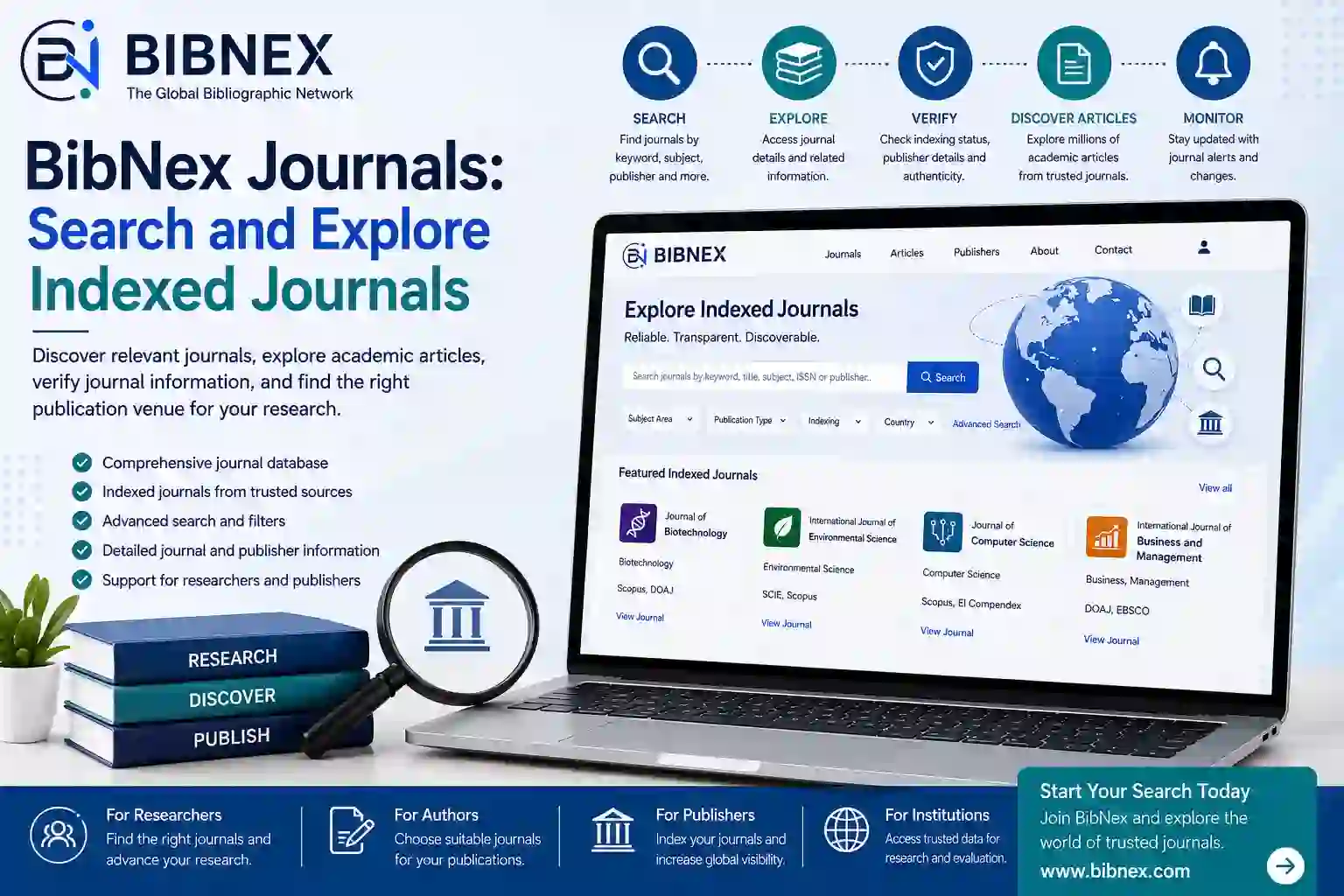
BibNex Journals: Search and Explore Indexed Journals
Finding the right academic journal can be challenging, especially when researchers have to search across different websites, databases, publisher pages, and journal directories. Before submitting a research paper, authors need to know whether a journal is relevant to their subject, whether it publishes similar research, who publishes it, and what indexing information is available.
BibNex journals are part of the BibNex journal discovery and indexing ecosystem, designed to make it easier for researchers and authors to discover journals, explore academic articles, and investigate journal information in one place.
Instead of treating journal discovery as simply finding a journal name, BibNex connects several important activities: journal search, journal indexing, journal verification, article discovery, and journal monitoring.
This guide explains how to search and explore indexed journals, how to evaluate a journal before publication, and how BibNex can fit into a practical research workflow.
Table of Contents
- What Are BibNex Journals?
- Why Researchers Need Journal Search
- How to Search for Journals
- What Are Indexed Journals?
- How to Verify a Journal
- Explore Academic Articles
- Find Journals by Subject
- Explore Journals by Publisher
- Find Journals by Country
- How to Choose the Right Journal
- Using BibNex for Journal Discovery
- How BibNex Helps Publishers
- Common Journal Search Mistakes
- Expert Tips for Researchers
- Journal Evaluation Checklist
- Frequently Asked Questions
- Conclusion
What Are BibNex Journals?
BibNex journals refers to journals available within the BibNex journal indexing and discovery ecosystem. BibNex is designed to help connect publishers, journals, authors, researchers, and academic articles through journal-focused discovery tools.
The platform is built around four important capabilities:
- Journal indexing: Publishers can submit and index their journals in the BibNex ecosystem.
- Journal verification: Authors and researchers can search for journal information and investigate a journal before making publication decisions.
- Article search: Researchers can discover academic articles and explore research connected with journals.
- Journal monitoring: Journal information can be monitored over time rather than checked only once.
This combination makes BibNex different from a simple list of journal names. The goal is to create a more useful environment for journal discovery and academic research.
Researchers can begin exploring the BibNex journal database when they need to discover journals or investigate available journal information.
Why Do Researchers Need a Journal Search Tool?
Researchers often spend significant time trying to identify an appropriate journal for a manuscript.
Consider a researcher who has completed a paper about artificial intelligence in healthcare. Searching only for "AI journals" could produce hundreds of possibilities. Some may focus on computer science, others on medical applications, and others on theoretical machine learning.
The researcher therefore needs to narrow the options based on the actual research.
A structured journal search process can help researchers:
- Discover potentially relevant journals.
- Explore journals within a specific subject area.
- Find journals publishing related research.
- Investigate journal and publisher information.
- Compare potential publication venues.
- Identify journals that deserve further evaluation.
However, a search result should never automatically be treated as a recommendation. Researchers should independently evaluate every journal before submitting a manuscript.
How to Search for Journals on BibNex
An effective journal search begins with a clear understanding of your research.
Step 1: Identify Your Main Research Topic
Start with the central subject of your paper.
For example, instead of using a broad term such as "education," identify a more specific topic such as:
- Online learning
- Artificial intelligence in education
- Student learning analytics
- Educational technology
- Digital assessment
Specific concepts generally make it easier to create a useful journal shortlist.
Step 2: Identify Related Keywords
Prepare several keywords from your title, abstract, research question, and methodology.
For example, a paper about machine learning for crop disease detection could use:
- Machine learning
- Crop disease detection
- Artificial intelligence
- Precision agriculture
- Computer vision
- Agricultural technology
These terms can be used to explore potential journals and related academic articles.
Step 3: Build a Shortlist
Do not choose the first journal you discover.
Create a shortlist of several potentially relevant journals. You can then compare their scope, published research, publisher information, indexing details, and submission requirements.
This approach reduces the chance of choosing a journal based on a single factor.
What Are Indexed Journals?
An indexed journal is a journal that has been included in a particular indexing database or scholarly discovery service according to that service's criteria.
It is important to understand that "indexed" does not mean the same thing in every context. Different databases have different coverage, selection criteria, subject areas, and purposes.
Therefore, when you see a claim that a journal is indexed, ask:
- Which database is indexing the journal?
- What is the exact journal title?
- What is the journal's ISSN?
- Who is the publisher?
- Is the journal currently listed?
- Does the indexing meet the requirements of your institution or research program?
BibNex provides a dedicated environment for indexed journal search, helping researchers discover and investigate journal records.
For important academic or institutional requirements, researchers should also verify specific indexing claims directly with the relevant official database or organization.
How to Verify a Journal Before Publication
Journal verification should be a standard part of the publication process.
Before submitting your paper, review the following information.
1. Journal Title
Make sure the journal title is correct and consistent across its website and available records.
2. ISSN
Check the journal's ISSN information and make sure you are evaluating the correct publication.
3. Publisher
Identify the organization or publisher responsible for the journal. Publisher information should be reasonably clear and accessible.
4. Aims and Scope
Read the journal's aims and scope rather than relying only on keywords in its title.
5. Published Articles
Review recent articles to determine whether the journal actually publishes research similar to yours.
6. Publication Policies
Look for information about peer review, article types, author guidelines, ethics, copyright, and publication charges.
7. Indexing Information
Investigate the specific databases or services in which the journal claims to be indexed.
A journal verification tool can help organize this investigation, but researchers should still use authoritative sources for requirements that are critical to their academic or institutional situation.
Explore Academic Articles Alongside Journals
One of the most useful ways to evaluate a journal is to examine the research it publishes.
Suppose you are researching "renewable energy storage." Instead of looking only for journals with "renewable energy" in their titles, search for relevant articles and investigate where those articles were published.
This creates a useful discovery process:
Research topic → Article search → Relevant articles → Journal discovery → Journal evaluation
Article discovery can reveal journals that you might not have found through a traditional journal-title search.
BibNex connects article search and journal discovery so researchers can explore these relationships more efficiently.
Find Journals by Subject and Discipline
Researchers often need journals within a particular subject or academic discipline.
For example, a study about the environmental impact of electric vehicles could potentially relate to:
- Environmental science
- Transportation research
- Energy studies
- Engineering
- Economics
- Sustainability
This is why subject-based journal discovery is important for interdisciplinary research.
Instead of limiting your search to one discipline, identify the primary research question and explore related subject areas.
Explore Journals by Publisher
Publisher information can also be useful when exploring journals.
A researcher may want to investigate journals associated with a particular publisher or compare different journals within a publisher's portfolio.
However, publisher recognition should not replace journal-level evaluation.
Always investigate the individual journal's:
- Scope
- Editorial information
- Published articles
- Publication policies
- Indexing information
- Author guidelines
Find Journals by Country or Geographic Focus
Geographic information can be particularly useful for regional research.
For example, research focused on Indian higher education may be relevant to journals that publish work about India, South Asia, education policy, or international education.
Similarly, research about African agricultural development may benefit from discovering journals with a strong focus on African agriculture, rural development, or regional economics.
Country-based journal discovery can therefore complement subject-based search.
How to Choose the Right Journal
Finding a journal is only the beginning. The next step is deciding whether it is suitable for your manuscript.
Use these criteria:
Research Scope
Does your research genuinely fit within the journal's aims and scope?
Target Audience
Will the people who are most interested in your research read this journal?
Recent Publications
Are similar topics being published recently?
Article Type
Does the journal accept your manuscript type, such as original research, review articles, case studies, or short communications?
Indexing Requirements
Does the journal satisfy any specific indexing requirement imposed by your university, funder, employer, or research program?
Publication Policies
Are the journal's review process, ethics policies, fees, copyright terms, and author guidelines acceptable to you?
The right journal is not necessarily the most famous journal. It is the journal that provides an appropriate match between your research, audience, publication requirements, and academic objectives.
A Practical BibNex Journal Discovery Workflow
Researchers can use a simple five-stage workflow when exploring journals through BibNex.
Stage 1: Search
Start with your research topic, subject, keywords, or other relevant information to discover potential journals.
Stage 2: Explore
Review journal information and explore related academic articles.
Stage 3: Verify
Check the journal's details, publisher, ISSN, indexing information, and other relevant information.
Stage 4: Compare
Compare several journals instead of selecting one immediately.
Stage 5: Monitor
If you are planning publication later, keep track of important journal information and review it again before submission.
This workflow can be summarized as:
Search → Explore → Verify → Compare → Monitor → Decide
It turns journal selection into a repeatable research process rather than a quick Google search.
Example: Using BibNex to Find a Journal
Imagine that a researcher has completed a paper titled "Machine Learning Applications for Predicting Crop Diseases."
The researcher could follow this process:
- Identify the primary topic: machine learning and agriculture.
- List related keywords such as crop disease, AI, computer vision, and precision agriculture.
- Search for relevant journals.
- Create a shortlist of five potential journals.
- Review the aims and scope of each journal.
- Explore related articles published by those journals.
- Check publisher and journal information.
- Investigate indexing information.
- Review author guidelines and article types.
- Compare the shortlisted journals.
- Select the journal that best matches the research and requirements.
- Perform a final verification before submission.
This process is much more reliable than choosing a journal based solely on its title.
How BibNex Helps Journal Publishers
BibNex is also relevant to publishers.
Publishers can use the platform to index their journals and improve their presence within a journal discovery environment.
For publishers, visibility is important because researchers need to be able to discover journals when searching for publication opportunities.
A journal discovery ecosystem can create a connection between:
Publisher → Journal → Articles → Researchers → Authors
By making journal information more discoverable and connecting journals with article discovery, BibNex aims to support a more connected academic information ecosystem.
Publishers interested in improving their journal presence can explore journal indexing for publishers and learn more about the BibNex platform.
Why Journal Monitoring Matters
Journal research does not always end when you create a shortlist.
If you plan to submit a paper several months later, it is sensible to recheck important information before submission.
Journal information may change over time, including:
- Editorial information
- Publication policies
- Author guidelines
- Publication fees
- Journal scope
- Indexing information
- Publisher information
This makes journal monitoring a useful part of a long-term research workflow.
BibNex includes journal monitoring as one of its core capabilities, extending journal discovery beyond a single search session.
Common Mistakes When Searching for Journals
1. Choosing a Journal Only Because It Is Indexed
Indexing is one factor, not the entire evaluation process.
Better approach: Also examine scope, recent articles, publisher information, policies, and audience.
2. Selecting the First Search Result
The first result is not necessarily the best match.
Better approach: Build and compare a shortlist.
3. Ignoring Recent Articles
A journal's current content may provide a better indication of its research focus than older publications.
Better approach: Review recent articles in your research area.
4. Trusting Unverified Claims
Statements about indexing, impact, or recognition should be investigated carefully.
Better approach: Identify the exact service or organization behind the claim and verify it when necessary.
5. Ignoring Author Guidelines
A journal may be relevant but unsuitable for your manuscript format.
Better approach: Read the current author guidelines before submission.
6. Not Checking the Journal Again Before Submission
Information can change after your initial search.
Better approach: Perform a final check shortly before submission.
Expert Tips for Finding Indexed Journals
Tip 1: Search Broadly, Then Narrow Down
Start with multiple related keywords and gradually create a focused shortlist.
Tip 2: Search for Articles as Well as Journals
Relevant articles can reveal journals that are actively publishing research similar to yours.
Tip 3: Separate Discovery From Verification
Finding a journal and verifying a journal are two different tasks. A discovery platform can help you find candidates, while additional checks help you decide whether they are appropriate.
Tip 4: Keep Your Own Comparison Record
Create a spreadsheet containing journal names, subjects, publisher information, indexing information, article types, fees, and notes.
Tip 5: Check Requirements Specific to You
If your university, employer, funder, or research program has specific journal requirements, verify those requirements independently before submission.
Tip 6: Do Not Focus Only on Journal Prestige
The most useful journal is often the one that reaches the right academic audience and genuinely fits your research.
BibNex Journal Evaluation Checklist
Before choosing a journal, use this checklist:
- ✓ Does the journal match my research topic?
- ✓ Does my research fit the journal's aims and scope?
- ✓ Have I reviewed recent related articles?
- ✓ Is the publisher clearly identified?
- ✓ Have I checked the journal's ISSN?
- ✓ Have I investigated the journal's indexing information?
- ✓ Does the journal accept my article type?
- ✓ Have I read the author guidelines?
- ✓ Are publication fees clearly explained?
- ✓ Does the journal reach my target audience?
- ✓ Have I compared it with other journals?
- ✓ Have I rechecked important information before submission?
Featured Snippet: How Can I Find Indexed Journals?
To find indexed journals, start by identifying your research topic and keywords, use a journal database or discovery platform to create a shortlist, review each journal's scope and recent articles, investigate publisher and indexing information, compare publication requirements, and verify important details before submission.
Featured Snippet: How Do I Check if a Journal Is Suitable for My Research?
Check whether the journal's aims and scope match your research, review recent articles on similar topics, confirm that your article type is accepted, examine the target audience, review publication policies, and verify any indexing requirements relevant to your institution.
Frequently Asked Questions About BibNex Journals
What is BibNex?
BibNex is a journal indexing and discovery database designed to connect journal indexing, journal verification, academic article search, and journal monitoring. It supports researchers and publishers within an academic journal discovery ecosystem.
What are BibNex journals?
BibNex journals are journals available within the BibNex journal indexing and discovery ecosystem. Researchers can explore journal information and related academic articles as part of their journal discovery process.
Can I search for indexed journals on BibNex?
BibNex provides a journal discovery and indexing environment where researchers can search and explore journal information. Important indexing requirements should also be checked against the relevant official database or organization.
Can BibNex help authors find journals for publication?
Yes. BibNex can be used as part of a journal discovery workflow. Authors can explore journals, investigate journal information, search related articles, and compare potential publication options before making a submission decision.
Why should I verify a journal before submitting a paper?
Verification helps researchers check important information about a journal, including its title, ISSN, publisher, scope, indexing information, publication policies, and author guidelines before submitting their work.
Can I search academic articles through BibNex?
BibNex includes academic article search as one of its core capabilities, allowing researchers to discover articles and explore the relationship between academic publications and journals.
Why is journal monitoring useful?
Journal information can change over time. Monitoring can help researchers and publishers keep track of relevant journal information and encourage them to recheck important details before making publication decisions.
Does being indexed automatically mean a journal is suitable?
No. Indexing is only one part of journal evaluation. Researchers should also consider scope, recent publications, publisher information, article types, review policies, fees, audience, and their own institutional requirements.
Conclusion
Finding an academic journal should be a careful research process rather than a quick search for a journal name.
Researchers need to discover potential journals, understand their subject coverage, review published articles, investigate publishers, verify indexing information, compare publication requirements, and recheck important details before submission.
This is where BibNex journals can become part of a practical academic discovery workflow. By bringing together journal indexing, journal search, journal verification, article search, and journal monitoring, BibNex is focused on making journal and publication information easier to discover and explore.
For authors, the recommended approach is simple:
Search → Explore → Verify → Compare → Monitor → Publish.
For publishers, creating a discoverable journal presence can help connect their journals with researchers who are actively searching for academic publications and potential publication venues.
If you are a researcher looking to explore journals or a publisher interested in increasing journal discoverability, visit BibNex and explore the platform.