
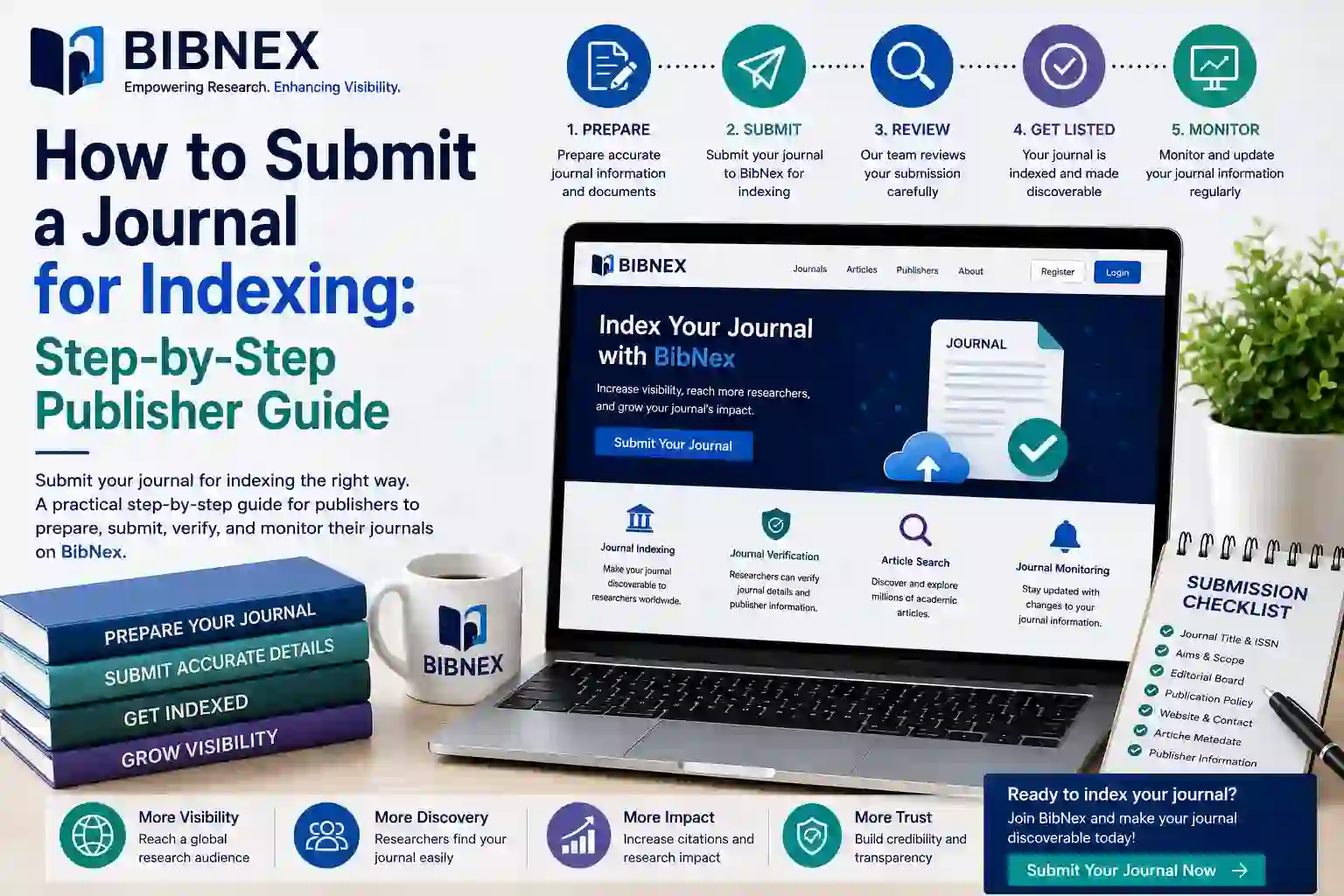
How to Submit a Journal for Indexing: Step-by-Step Publisher Guide
Publishing a journal is a major responsibility, but creating and publishing good academic content is only one part of building a successful publication. Researchers and authors also need to be able to discover your journal, understand what it publishes, verify its information, and find its articles.
This is why journal indexing for publishers has become an important part of a journal's digital visibility strategy.
If you are a publisher wondering how to submit a journal for indexing, the process should not begin with simply filling out an application. A strong submission starts with accurate journal information, organized metadata, a professional journal website, clear publication policies, and an understanding of what the indexing platform actually provides.
BibNex is designed around this publisher and researcher workflow. Publishers can use BibNex to index their journals, while authors and researchers can search and verify journals, discover academic articles, and monitor journal information.
In this guide, we will walk through the journal indexing submission process from preparation to ongoing monitoring, with practical recommendations for publishers.
What Does It Mean to Submit a Journal for Indexing?
Submitting a journal for indexing means providing journal information to an indexing or discovery platform so that the publication can be considered for inclusion or listing according to that platform's process.
Depending on the platform, the information may include:
- Journal title
- ISSN
- Publisher information
- Journal website
- Aims and scope
- Subject or discipline
- Editorial information
- Publication frequency
- Published issues
- Article information
- Publication policies
- Contact information
The exact requirements differ from one indexing service to another. Therefore, publishers should always check the specific requirements of the platform before submitting.
The goal should not simply be to collect as many database listings as possible. Instead, publishers should focus on relevant, accurate, and useful journal discoverability.
Why Should Publishers Index Their Journals?
Consider a new journal that publishes valuable research in environmental science. The publisher may have a professional website and a strong editorial team, but researchers who have never heard of the journal may have difficulty discovering it.
Journal indexing can provide another route through which researchers can find information about the publication.
A well-maintained journal indexing presence can support:
- Journal discoverability
- Researcher awareness
- Author journal discovery
- Article discovery
- Structured journal information
- Publisher visibility
- Long-term journal information management
However, indexing should not be treated as a guarantee of rankings, citations, submissions, acceptance, or academic quality. It is one component of a broader journal publishing and visibility strategy.
How BibNex Fits Into Journal Indexing
BibNex is a journal indexing and discovery database designed to connect publishers, journals, authors, researchers, and academic articles.
Its core functionality can be understood through four connected activities:
- Publishers index journals so journal information can be discovered.
- Authors verify journals before making publication decisions.
- Researchers search articles to discover relevant academic content.
- Journals are monitored so relevant information can be followed over time.
This makes BibNex particularly relevant to publishers who are thinking beyond a one-time journal listing.
Instead of viewing indexing as simply "adding a journal to a database," publishers can think about the complete journey:
Journal → Discovery → Verification → Articles → Ongoing Monitoring
Publishers can explore the journal indexing platform to learn more about building a discoverable journal presence.
Before You Submit Your Journal: Preparation Checklist
One of the most common mistakes publishers make is submitting a journal before checking whether its information is complete and consistent.
Before beginning your journal indexing submission, prepare the following information.
1. Official Journal Title
Confirm the exact official name of the journal.
The title should be consistent across:
- Your journal website
- Article pages
- PDF files
- ISSN-related information
- Publisher records
- Indexing databases
If the journal title appears differently in different places, researchers may have difficulty identifying the correct publication.
2. ISSN Information
Prepare the journal's ISSN information and verify that it is accurate.
If the journal has separate print and electronic editions, make sure the relevant information is clearly presented.
Identifiers are particularly important because different journals can have similar or even confusingly similar names.
3. Publisher Details
Provide clear information about the organization or individual responsible for publishing the journal.
Your website should make it reasonably easy for researchers to understand who operates the publication and how the publisher can be contacted.
4. Aims and Scope
Your journal should clearly explain what it publishes.
A good aims and scope section should answer questions such as:
- What subject does the journal cover?
- Which research areas are included?
- Who is the intended academic audience?
- What types of manuscripts are accepted?
- What topics are outside the journal's scope?
Clear scope information also helps indexing platforms and researchers understand the journal more effectively.
5. Editorial Information
Make relevant editorial information easy to find.
Depending on the journal, this may include:
- Editor-in-Chief
- Editorial board
- Associate editors
- Editorial affiliations
- Publisher contact information
Keep this information current when changes occur.
6. Publication Policies
Researchers should be able to understand how the journal operates.
Depending on the publication, this may include information about:
- Peer review
- Publication ethics
- Copyright
- Open access
- Article processing charges
- Plagiarism policies
- Corrections and retractions
- Conflicts of interest
Transparent publication information can make the journal easier for researchers to evaluate.
Step-by-Step: How to Submit a Journal for Indexing
Step 1: Identify the Right Indexing Platform
Do not begin by submitting your journal everywhere.
First determine which indexing and discovery platforms are relevant to your journal.
Consider:
- Journal subject
- Academic discipline
- Target researchers
- Geographic focus
- Publication type
- Discovery goals
For example, a journal specializing in economics may benefit more from relevant economics and multidisciplinary discovery environments than from unrelated databases.
Relevance is more valuable than quantity.
Step 2: Review the Indexing Requirements
Every indexing service can have different eligibility criteria and submission requirements.
Before applying, carefully review the platform's instructions.
Create a checklist covering:
- Required journal information
- Eligibility requirements
- Publication history requirements
- Website requirements
- Editorial requirements
- Metadata requirements
- Submission format
- Evaluation process
Do not assume that being eligible for one database means that your journal automatically qualifies for another.
Step 3: Audit Your Journal Website
Your journal website is one of the first places researchers will go after discovering your journal.
Before submitting, check whether visitors can easily find:
- About the journal
- Aims and scope
- Editorial board
- Author guidelines
- Publication ethics
- Current issue
- Archive
- Contact details
- Publisher information
Remove broken links and make sure important pages are accessible.
Step 4: Check Your Article Metadata
Article metadata is important for discoverability.
Each article should ideally have clearly structured information such as:
- Article title
- Author names
- Abstract
- Keywords
- Publication date
- Volume and issue
- Page information where applicable
- DOI where applicable
Consistent metadata makes your content easier to understand and organize.
Step 5: Prepare Your Journal Information
Create a single, accurate information sheet for your journal.
This can include:
- Official journal title
- ISSN
- Publisher
- Website
- Email/contact information
- Subject category
- Aims and scope
- Publication frequency
- Editorial information
- Relevant publication details
Having this information ready reduces errors during the submission process.
Step 6: Submit the Journal
Once your journal is prepared and you understand the platform's requirements, complete the indexing submission.
Provide accurate information and avoid unsupported claims.
If a platform asks whether your journal is already indexed elsewhere, provide the information honestly. Do not confuse an application, pending review, or website mention with an actual confirmed listing.
Step 7: Keep a Record of Your Submission
Publishers managing several journals should maintain a record of indexing applications.
Record information such as:
- Database name
- Journal submitted
- Submission date
- Application reference, if provided
- Status
- Last update
- Required follow-up
This simple system can prevent publishers from losing track of applications.
Step 8: Verify the Journal Listing
If your journal is accepted or listed, check the resulting record carefully.
Look for errors in:
- Journal title
- ISSN
- Publisher
- Website URL
- Subject
- Publication information
If something is incorrect, use the platform's correction or update process.
Step 9: Monitor the Journal After Submission
Journal indexing should not be treated as a one-time activity.
Journal information changes over time. Publishers may change editorial teams, update websites, publish new issues, change contact details, or introduce new policies.
Regular monitoring helps publishers identify information that needs to be updated.
This is also one of the areas where BibNex's journal monitoring functionality fits into the broader publishing workflow.
How BibNex Can Support Publishers
BibNex focuses on more than simply creating a list of journals.
Its model connects four activities that are important to modern journal discovery:
Journal Indexing
Publishers can index their journals on BibNex, creating another opportunity for researchers and authors to discover journal information.
Journal Verification
Authors can search for journal information and use available records as part of their journal evaluation process.
This is important because discovering a journal and selecting a journal are not necessarily the same thing.
Article Search
Researchers can search academic articles and use article discovery as another route to finding relevant journals and research.
Journal Monitoring
Monitoring supports the idea that journal information should be maintained and followed over time rather than treated as permanently static.
Together, these capabilities make BibNex journal indexing relevant to publishers who want to build a more connected journal discovery strategy.
Example: A Publisher Preparing a New Journal
Imagine a publisher has launched a new journal called International Journal of Sustainable Technology.
The publisher wants researchers to discover the journal and eventually attract relevant manuscript submissions.
Instead of immediately submitting the journal to multiple databases, the publisher follows a structured process:
- Confirms the journal title and ISSN.
- Reviews the journal website.
- Writes a clear aims and scope statement.
- Adds editorial information.
- Organizes published issues.
- Checks article metadata.
- Identifies relevant indexing platforms.
- Reviews each platform's requirements.
- Submits accurate information.
- Records the submission.
- Checks the resulting listing.
- Continues monitoring the journal.
The important lesson is that journal indexing works best when it is treated as a process rather than a single submission form.
How to Improve Your Journal's Visibility After Indexing
Getting listed is only the beginning of your visibility strategy.
Publishers should also improve the journal's own digital presence.
Optimize Article Pages
Every article should have a dedicated, accessible page with useful metadata.
Use Relevant Internal Links
Connect articles to journal pages, issues, subject pages, and related articles.
A logical structure can look like:
Journal Homepage → Issue → Article → Related Article
Create Useful Journal Content
Publish information that helps researchers understand your journal, such as author guidelines, research topics, editorial policies, and calls for papers where appropriate.
Keep Your Website Updated
Remove outdated announcements and update important information when it changes.
Monitor Search Performance
Use appropriate analytics and search tools to understand how researchers are discovering your journal and articles.
Common Mistakes Publishers Make During Indexing
1. Submitting Incomplete Information
Missing information can make the submission process less efficient.
Better approach: Use a pre-submission checklist.
2. Inconsistent Journal Information
A different title or identifier on different pages can create confusion.
Better approach: Maintain one authoritative journal metadata record.
3. Choosing Indexing Platforms Only for Quantity
Having a long list of irrelevant database listings does not necessarily improve your journal's usefulness to researchers.
Better approach: Prioritize platforms relevant to your audience and discipline.
4. Making Unsupported Claims
Publishers should clearly distinguish between being indexed, being under review, and having submitted an application.
Better approach: Communicate indexing status accurately.
5. Ignoring Article Discoverability
A journal can be discoverable while individual articles remain difficult to find.
Better approach: Optimize article metadata and website structure.
6. Forgetting About Updates
A journal record can become outdated if nobody maintains it.
Better approach: Establish a regular journal monitoring routine.
Expert Tips for Successful Journal Indexing
- Prepare before applying. A complete journal profile reduces avoidable errors.
- Prioritize accuracy. Correct metadata is more valuable than rushing a submission.
- Think about researchers. Ask whether a researcher can quickly understand your journal.
- Optimize individual articles. Articles are often entry points to journal discovery.
- Use multiple discovery channels. Do not depend on one database or search engine.
- Maintain your journal information. Review important information regularly.
- Keep indexing claims transparent. Clearly communicate confirmed status versus applications.
- Use monitoring as an ongoing activity. Visibility requires maintenance after the initial listing.
Journal Indexing Checklist for Publishers
Before submitting your journal, use this quick checklist:
- ✓ Official journal title confirmed
- ✓ ISSN information verified
- ✓ Publisher details available
- ✓ Journal website active
- ✓ Aims and scope clearly explained
- ✓ Editorial information available
- ✓ Author guidelines published
- ✓ Publication policies accessible
- ✓ Journal archive organized
- ✓ Article metadata reviewed
- ✓ Relevant indexing platforms identified
- ✓ Indexing requirements reviewed
- ✓ Submission information checked
- ✓ Submission record maintained
- ✓ Post-submission monitoring planned
Frequently Asked Questions
How do I submit a journal for indexing?
Start by preparing accurate journal information, reviewing the requirements of a relevant indexing platform, checking your website and metadata, and then completing the platform's official submission process. After listing, verify the journal record and keep the information updated.
What information is needed to submit a journal for indexing?
Requirements vary, but publishers may need the journal title, ISSN, publisher details, website, aims and scope, editorial information, publication frequency, article information, and publication policies.
Can a new journal be submitted for indexing?
Some indexing and discovery platforms may accept newer journals, while others may have specific eligibility or publication-history requirements. Publishers should check the requirements of each platform before applying.
How can BibNex help publishers?
BibNex provides a platform where publishers can index their journals and make journal information more discoverable. Its broader ecosystem also includes journal verification, article search, and journal monitoring.
Does indexing guarantee more journal submissions?
No. Indexing can provide an additional discovery channel, but it does not guarantee more submissions, citations, rankings, acceptance, or research impact. Publishers should combine indexing with quality publishing and broader visibility efforts.
Why should publishers monitor a journal after indexing?
Journal information can change over time. Monitoring helps publishers identify information that needs updating and supports a more accurate and consistent journal presence.
Is BibNex a replacement for all other indexing databases?
No. Publishers should evaluate each indexing or discovery platform according to their journal's goals, discipline, audience, and requirements. BibNex can be considered as one component of a broader journal discoverability strategy.
Conclusion
Learning how to submit a journal for indexing is not just about finding a submission form. A successful publisher strategy starts much earlier—with accurate metadata, a professional website, clear publication information, organized articles, and a strong understanding of the journal's target audience.
After submission, publishers should continue checking their journal information, improving article discoverability, maintaining their website, and monitoring important changes.
BibNex brings these activities together through journal indexing, journal verification, article search, and journal monitoring. For publishers, this creates an opportunity to make their journals more discoverable while supporting researchers and authors who are looking for academic publications and articles.
The most effective approach is therefore simple: prepare carefully, submit accurately, communicate transparently, and continue improving after your journal is listed.
Ready to Index Your Journal?
If you are a publisher looking for a dedicated platform to improve your journal's discoverability, explore BibNex journal indexing.
With journal indexing, journal verification, article search, and journal monitoring connected in one ecosystem, BibNex is designed to support the changing needs of academic publishers and researchers.
Explore BibNex and Submit Your Journal for Indexing →
A well-maintained journal indexing database can provide another discovery channel for publishers while helping researchers find journal information more efficiently.
Publishers can explore the journal indexing platform to learn more about building a discoverable journal presence.
For publishers looking to improve their presence in academic discovery, journal indexing for publishers can be an important part of a broader visibility strategy.
Publishers can use journal indexing as one of several channels for making their publications easier for researchers and authors to discover.
Together, these capabilities make BibNex journal indexing relevant to publishers who want to build a more connected journal discovery strategy.
For publishers seeking to improve their presence in academic search and discovery, a journal indexing database can provide an additional route for researchers to discover relevant publications.
If you are preparing a journal for inclusion in a discovery platform, explore submit journal for indexing options that align with your publication's subject, audience, and goals.
If you are a publisher looking for a dedicated platform to improve your journal's discoverability, explore BibNex journal indexing.