
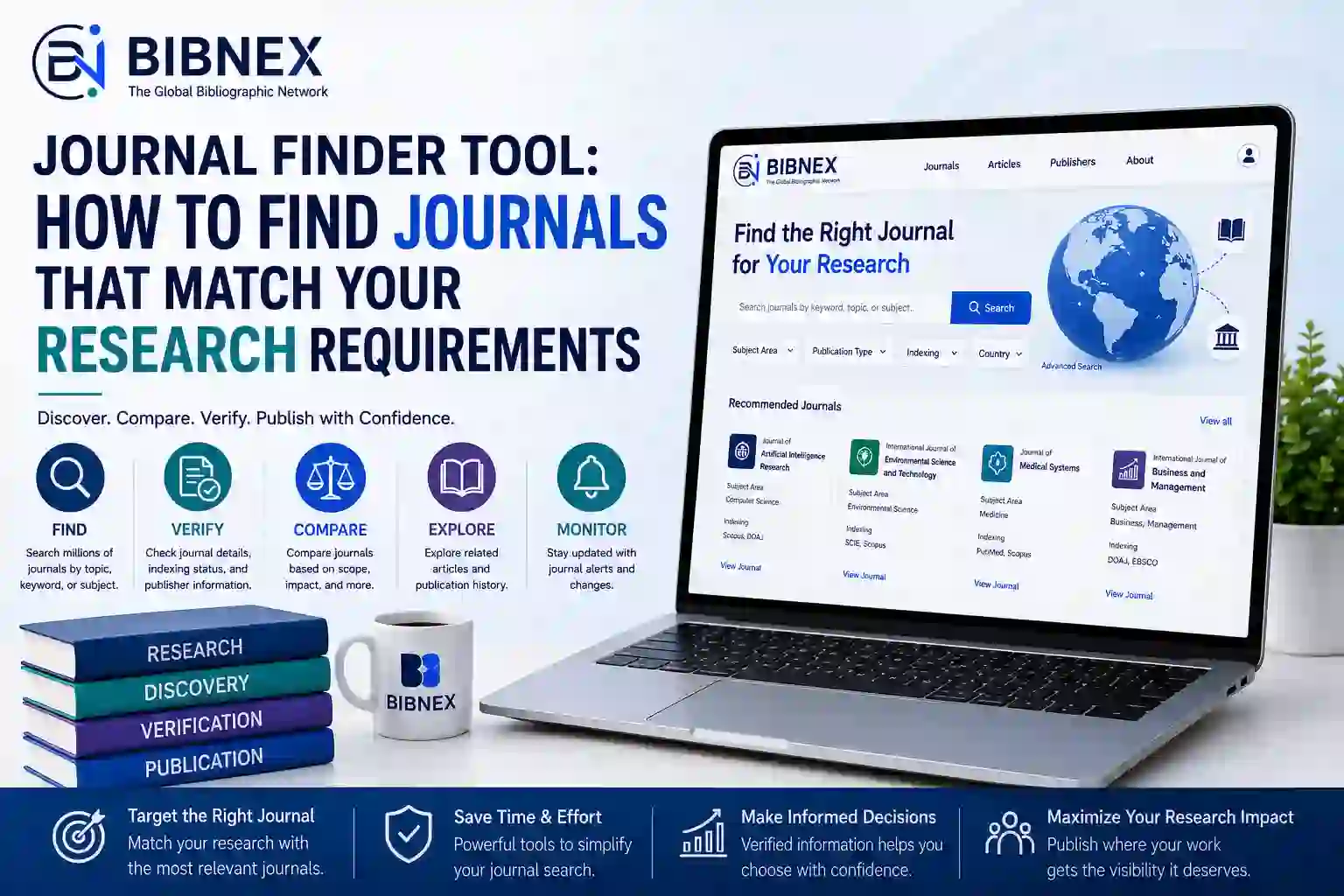
Journal Finder Tool: How to Find Journals That Match Your Research
Choosing the right journal for a research paper can be one of the most important decisions an author makes before submitting a manuscript. A strong research paper can still face unnecessary delays if it is submitted to a journal that does not match its subject, scope, audience, or publication requirements.
This is why many researchers use a journal finder tool to discover journals that may be relevant to their research.
But finding a journal should involve more than entering a few keywords and selecting the first result. Researchers need to understand the journal's subject area, scope, publisher, publication model, indexing information, article history, and other factors before making a final decision.
BibNex is designed to support this broader journal discovery process. As a journal indexing and discovery database, BibNex connects journal search, journal verification, academic article search, journal indexing, and journal monitoring in one ecosystem.
This comprehensive guide explains how to use a journal finder effectively, how to evaluate potential journals, common mistakes to avoid, and how BibNex can become part of a more organized journal-selection workflow.
Table of Contents
- What Is a Journal Finder Tool?
- Why Finding the Right Journal Matters
- What Is BibNex?
- How Does a Journal Finder Tool Work?
- What to Know Before Searching for a Journal
- How to Find a Journal Step by Step
- Start With Your Research Topic
- Check the Journal's Aims and Scope
- Study Previously Published Articles
- Verify Journal Indexing Information
- Check the Publisher
- Evaluate Publication Requirements
- How to Compare Multiple Journals
- Using BibNex in Your Journal Search Workflow
- How Journal Finder Tools Help Publishers
- Common Journal Selection Mistakes
- Expert Recommendations
- Journal Selection Checklist
- Frequently Asked Questions
- Conclusion
What Is a Journal Finder Tool?
A journal finder tool is a search or discovery system that helps researchers identify academic journals that may be relevant to their research.
Depending on the platform, researchers may be able to search journals using information such as:
- Research topic
- Subject
- Discipline
- Keywords
- Journal title
- Publisher
- Country
- Article information
- Indexing information
The purpose of a journal finder is not necessarily to tell an author exactly where they must publish. Instead, it can reduce the time required to discover potential journals and create a shortlist for further evaluation.
A good journal discovery process therefore looks something like this:
Research topic → Journal discovery → Journal verification → Journal comparison → Final selection
This distinction is important. A journal finder can help you discover candidates, but the final publication decision should be based on careful evaluation.
Why Finding the Right Journal Matters
Researchers sometimes underestimate the importance of journal selection.
Imagine that you have written a research paper about artificial intelligence in healthcare. You find a journal containing the words "Artificial Intelligence" in its title and immediately submit your manuscript.
Later, you discover that the journal primarily publishes research about AI hardware and robotics rather than healthcare applications.
Your paper may therefore be outside the journal's preferred scope.
This example illustrates why journal relevance matters.
Choosing a suitable journal can help researchers:
- Reach an appropriate academic audience
- Submit to a journal that covers their research area
- Understand publication requirements before submission
- Reduce the risk of submitting to an unsuitable journal
- Compare potential publication venues
- Identify journals publishing related research
A journal finder tool can make the initial discovery stage easier, but authors should always perform additional verification before submitting.
What Is BibNex?
BibNex is a journal indexing and discovery database designed to connect academic journals, publishers, authors, researchers, and articles.
The platform focuses on four connected areas:
- Journal indexing: Publishers can index their journals.
- Journal verification: Authors and researchers can search and investigate journal information.
- Article search: Researchers can discover academic articles.
- Journal monitoring: Journal information can be followed and monitored over time.
This makes BibNex relevant to the journal-selection process because finding a journal is only one part of choosing a publication venue.
An author may first discover a journal, then verify it, explore its published articles, compare it with other journals, and later monitor relevant information before submission.
Researchers can explore the journal finder and discovery platform to begin investigating potential journals.
How Does a Journal Finder Tool Work?
Most journal finder systems follow a relatively simple concept.
The researcher provides information about their research, and the system helps identify journals that may be relevant.
For example, a researcher working on "renewable energy storage using lithium-ion batteries" might search using terms such as:
- Renewable energy
- Energy storage
- Lithium-ion batteries
- Battery technology
- Sustainable energy
The resulting journal list can then be evaluated based on scope, subject, publisher, articles, indexing information, and publication requirements.
The important point is that search results should be treated as a starting point, not a final recommendation.
What to Know Before Searching for a Journal
You will get better results if you understand your own research before searching for journals.
Before opening a journal finder, write down the following:
- Your research topic
- Main research question
- Academic discipline
- Specific subfield
- Type of manuscript
- Target academic audience
- Geographic focus, if relevant
- Important keywords
For example, "machine learning" is a very broad topic. A more specific description might be "machine learning methods for early disease prediction."
The more accurately you describe your research, the easier it becomes to identify journals with relevant subject coverage.
How to Find a Journal Step by Step
Step 1: Identify Your Research Area
Start with the central subject of your paper.
Ask yourself:
- What is my paper mainly about?
- Which academic discipline does it belong to?
- What specific subfield does it address?
- Which researchers would be interested in this work?
Do not rely only on the title of your manuscript. Read the abstract and identify the main concepts.
Step 2: Extract Research Keywords
Create a list of five to ten important terms from your research.
For example, a paper about the use of artificial intelligence in education might use:
- Artificial intelligence
- AI in education
- Machine learning
- Educational technology
- Personalized learning
- Learning analytics
Use variations of these terms when exploring journal databases and search engines.
Step 3: Build a Preliminary Journal List
Do not immediately select one journal.
Create a shortlist of approximately five to ten potentially relevant journals.
Sources for discovering candidates can include:
- Journal finder tools
- Academic databases
- Journal directories
- Research articles
- References in related papers
- Publisher websites
- Academic recommendations
BibNex can be useful at this stage because its journal database connects journal discovery with article discovery and verification.
Start With Your Research Topic
The strongest journal-selection strategy begins with the research rather than the journal.
For example, suppose your paper is about "the impact of social media on university student learning."
Potential journal categories could include:
- Education
- Educational technology
- Higher education
- Learning sciences
- Communication studies
- Digital education
This shows why a single keyword is not always enough.
Your research may sit between multiple disciplines. A journal finder can help you explore those possibilities.
Check the Journal's Aims and Scope
After finding a potential journal, read its aims and scope carefully.
This is one of the most important steps in journal selection.
The journal's scope should answer questions such as:
- What research does the journal publish?
- Which disciplines does it cover?
- What types of manuscripts does it accept?
- Who is its intended audience?
- Are interdisciplinary studies welcome?
Do not select a journal solely because your keywords appear on its website.
The overall research focus should make sense for the publication.
Study Previously Published Articles
One of the best ways to understand a journal is to examine its published articles.
Look at recent articles and ask:
- Are they related to my research?
- Are the research methods similar?
- Does the journal publish papers at my level of specialization?
- Are articles focused on theoretical, applied, experimental, or interdisciplinary research?
- Would my target readers actually read this journal?
This is where article search becomes especially useful.
Rather than searching only for journal names, researchers can search for related research articles and identify journals that are actively publishing work in their area.
BibNex's article discovery functionality supports this journal-to-article and article-to-journal relationship.
Verify Journal Indexing Information
Another important step is checking the journal's indexing information.
Researchers often encounter statements such as "indexed journal" or "internationally indexed journal." These statements should not be accepted without understanding what they actually mean.
When evaluating a journal, identify:
- The specific database or indexing service
- Whether the journal is currently listed
- The journal's exact title
- Its ISSN
- Publisher information
- Relevant subject coverage
A journal verification tool can help organize this part of the research workflow.
However, researchers should also check official sources when a specific institutional or indexing requirement applies.
For example, if your university requires publication in a particular database, verify that requirement directly with the university and the relevant database rather than relying solely on a third-party listing.
Check the Publisher
The publisher is another important part of journal evaluation.
Check whether the journal clearly identifies its publisher and provides appropriate contact and organizational information.
Look for:
- Publisher name
- Publisher website
- Contact information
- Journal portfolio
- Publication policies
- Editorial information
Be cautious when journal information is difficult to verify or when important publication details are unclear.
Evaluate Publication Requirements
A journal may be academically relevant but still unsuitable for your manuscript.
Before submitting, check its publication requirements.
Article Types
Does the journal accept your manuscript type?
For example, some journals may focus on original research, while others also accept reviews, case studies, short communications, editorials, or other formats.
Peer Review
Understand how the journal describes its peer-review process.
Do not select a journal simply because it promises extremely fast publication. Focus on whether its editorial and review process is appropriate for your research.
Publication Fees
Check whether the journal charges submission fees, article processing charges, subscription-related fees, or other costs.
Make sure you understand when and why a fee is charged.
Author Guidelines
Read the submission guidelines before preparing the final manuscript.
Pay attention to:
- Word limits
- Reference style
- Formatting
- Figures and tables
- Supplementary material
- Ethics requirements
- Data availability
Journal Finder Tool vs. Manual Journal Search
Both approaches can be useful.
| Approach | Advantages | Limitations |
|---|---|---|
| Journal Finder Tool | Faster discovery and easier shortlisting | Results still need verification |
| Search Engines | Broad information coverage | Can produce large amounts of irrelevant information |
| Academic Databases | Useful for structured research discovery | Coverage and functionality vary |
| Publisher Websites | Detailed journal information | Requires checking multiple websites |
| Research Articles | Shows where related research is published | Older articles may not reflect current scope |
The most effective strategy is often to combine several methods.
How to Compare Multiple Journals
Once you have a shortlist, create a simple comparison table.
| Criteria | Journal A | Journal B | Journal C |
|---|---|---|---|
| Research scope match | High | Medium | High |
| Recent related articles | Yes | Some | Yes |
| Publisher information | Clear | Clear | Clear |
| Indexing information | Verified | Needs review | Verified |
| Article type accepted | Yes | No | Yes |
| Publication requirements | Suitable | Suitable | Suitable |
The table does not need to be complicated. Its purpose is to prevent you from making a decision based on one attractive feature.
Using BibNex in Your Journal Search Workflow
BibNex can fit naturally into several stages of journal discovery.
Stage 1: Discover Journals
Start by exploring journals related to your research topic and discipline.
Stage 2: Investigate Journal Information
Review available information about the journal, including its publisher, subject, and other relevant details.
Stage 3: Verify the Journal
Use journal verification as one step in determining whether the publication deserves further consideration.
Stage 4: Explore Articles
Search for published articles to determine whether the journal actually publishes research related to your topic.
Stage 5: Monitor Relevant Information
If you are not ready to submit immediately, monitoring can help you keep track of relevant journal information over time.
This creates a more complete workflow:
Find → Verify → Explore → Compare → Monitor → Decide
Researchers can start this process through the academic journal finder available through the BibNex ecosystem.
Finding Journals by Subject
Subject-based discovery is particularly useful for interdisciplinary researchers.
For example, research about climate change could involve:
- Environmental science
- Climate science
- Geography
- Economics
- Agriculture
- Public policy
- Energy studies
A researcher should therefore consider both the main discipline and the specific application of the research.
This approach can reveal journals that may not appear when searching for a single keyword.
Finding Journals by Publisher
Researchers may also want to explore journals associated with particular publishers.
Publisher-based discovery can be useful when:
- You have previously published with a publisher.
- Your institution has specific publisher relationships.
- You are researching a particular journal portfolio.
- You want to compare journals managed by the same publisher.
However, publisher reputation alone should not determine your selection. The specific journal should still match your research.
Finding Journals by Country or Region
Some research has a strong regional focus.
For example, a paper about agricultural policy in India may be particularly relevant to journals that publish research about Indian agriculture, South Asian development, or regional policy.
Searching journals by country or geographic focus can therefore be useful when location is central to the research.
How to Choose the Right Journal for a Research Paper
There is no universal "best journal" for every paper.
The right journal depends on the research and the author's objectives.
Consider the following criteria:
- Scope: Does the journal publish research like yours?
- Audience: Will the right researchers read your paper?
- Article type: Does the journal accept your manuscript format?
- Indexing: Does it meet your required indexing criteria?
- Publisher: Is the publisher information clear?
- Review process: Is the peer-review process appropriate?
- Fees: Are publication costs acceptable?
- Policies: Do the journal's policies fit your requirements?
- Recent publications: Does the journal actively publish relevant work?
How Publishers Can Benefit From Journal Finder Platforms
Journal finder tools are not only useful for researchers.
They can also help publishers understand how researchers discover journals.
For publishers, being present in a relevant journal discovery environment can create another pathway to journal visibility.
BibNex provides publishers with the ability to index their journals while also connecting journal records with article discovery and verification.
This creates an important connection:
Publisher → Journal → Articles → Researchers → Future Authors
For a publisher, this means that journal visibility should not be considered separately from article visibility.
Why Article Search Is Important for Journal Discovery
Many researchers discover journals indirectly.
They may first find an article through a research search. After reading the article, they may investigate the journal that published it.
This is why article search and journal search can complement one another.
For example:
- A researcher searches for "AI-based crop disease detection."
- The researcher discovers several relevant articles.
- The researcher notices that multiple useful papers come from the same journal.
- The researcher investigates that journal.
- The researcher adds the journal to a publication shortlist.
This article-to-journal discovery path is one reason BibNex combines academic article search with journal discovery.
Journal Monitoring: What Happens After You Find a Journal?
Journal selection does not always happen immediately.
A researcher may identify a promising journal months before submitting a manuscript.
During that period, information can change.
For example:
- The journal may update its editorial team.
- Its website may change.
- Publication policies may be updated.
- New articles may change the journal's visible research focus.
- Publication fees may change.
- Indexing information may need to be rechecked.
This is why journal monitoring can be useful.
BibNex includes journal monitoring as part of its broader journal information ecosystem, helping support the idea that journal discovery is an ongoing process rather than a one-time search.
Common Journal Selection Mistakes
Mistake 1: Choosing a Journal Only Because It Is Popular
A popular journal may not be appropriate for your research.
Better approach: Start with scope and audience.
Mistake 2: Searching Only by One Keyword
A single keyword can produce either too many or too few results.
Better approach: Use several related research terms and concepts.
Mistake 3: Ignoring Recent Articles
A journal's current content is often more useful than its historical reputation.
Better approach: Review recent publications before submitting.
Mistake 4: Assuming an Indexing Claim Is Automatically Verified
Researchers should understand exactly what database or service is being referenced.
Better approach: Verify important indexing information using reliable sources.
Mistake 5: Ignoring Author Guidelines
You may discover that the journal does not accept your article type or has requirements you cannot meet.
Better approach: Read the submission guidelines before preparing your final submission.
Mistake 6: Selecting a Journal Based Only on Speed
Fast publication may sound attractive, but it should not be the only consideration.
Better approach: Balance timing with relevance, editorial standards, audience, and publication requirements.
Mistake 7: Not Rechecking the Journal Before Submission
Information that was correct months ago may have changed.
Better approach: Verify important journal information shortly before submission.
Expert Recommendations for Researchers
1. Build a Shortlist Instead of Choosing Immediately
Start with several candidates. A shortlist allows you to compare journals objectively.
2. Give Scope the Highest Priority
A strong scope match is usually more meaningful than simply recognizing the journal's name.
3. Study Recent Articles
Recent articles show what the journal is actually publishing now.
4. Verify Before You Submit
Check journal information, publisher details, indexing claims, author guidelines, fees, and policies.
5. Use More Than One Discovery Source
A journal finder can help with discovery, while publisher websites and relevant official databases can provide additional verification.
6. Keep a Record of Your Evaluation
For important research projects, maintain a simple spreadsheet containing your shortlisted journals and evaluation criteria.
7. Recheck Before Submission
Do not assume that information remains unchanged. Perform a final verification shortly before submitting.
Journal Selection Checklist
Before submitting your paper, ask yourself:
- ✓ Does the journal's scope match my research?
- ✓ Have I read several recent articles?
- ✓ Does the journal accept my article type?
- ✓ Have I checked the author guidelines?
- ✓ Is the publisher clearly identified?
- ✓ Have I verified important journal information?
- ✓ Have I checked the relevant indexing requirements?
- ✓ Are publication fees clearly explained?
- ✓ Does the journal reach my target academic audience?
- ✓ Have I compared it with other suitable journals?
- ✓ Have I checked the information recently?
Featured Snippet: How Do I Find the Right Journal for My Research?
To find the right journal for your research, identify your research topic and keywords, create a shortlist of relevant journals, compare their aims and scope, review recent articles, verify indexing and publisher information, check author guidelines and publication fees, and select the journal that best matches your research and publication requirements.
Featured Snippet: What Should I Check Before Submitting to a Journal?
Before submitting, check the journal's aims and scope, recent articles, publisher information, indexing status, article types, peer-review process, author guidelines, publication fees, ethics policies, and other requirements relevant to your research.
Featured Snippet: Is a Journal Finder Enough to Choose a Journal?
No. A journal finder is primarily a discovery tool. Researchers should use the results to create a shortlist and then independently evaluate each journal's scope, articles, publisher, indexing information, policies, fees, and submission requirements.
Frequently Asked Questions
What is a journal finder tool?
A journal finder tool helps researchers discover academic journals that may match their research topic, subject, discipline, keywords, or other criteria. The results should be treated as a starting point for further journal evaluation.
How do I find the right journal for my research?
Start by identifying your research topic and keywords. Then create a shortlist of relevant journals, check their aims and scope, review recent articles, verify important journal information, compare publication requirements, and choose the journal that best fits your research.
Can BibNex help me find a journal?
BibNex is a journal indexing and discovery database that connects journal search, journal verification, article search, indexing, and monitoring. Researchers can use its ecosystem as part of the process of discovering and evaluating potential journals.
Should I verify a journal before submitting my paper?
Yes. Before submitting, researchers should verify important information such as the journal's title, ISSN, publisher, aims and scope, indexing information, publication policies, fees, author guidelines, and recent articles.
Why should I read articles published by a journal?
Published articles provide practical evidence about the topics, research methods, article types, and academic audience represented by the journal. Reviewing recent articles can help you determine whether your research is genuinely suitable.
Does journal indexing guarantee journal quality?
No. Indexing and journal quality evaluation are different concepts. Researchers should use multiple criteria to evaluate a journal and should check specific institutional or academic requirements independently.
Why is journal monitoring useful?
Journal information can change over time. Monitoring can help researchers and publishers stay aware of relevant changes and avoid relying on outdated information when making publication decisions.
Can I use article search to find journals?
Yes. Searching for relevant articles can reveal journals that are actively publishing research in your area. This article-to-journal discovery approach can complement traditional journal searching.
Conclusion
Finding the right journal is not simply a matter of searching for a journal title that contains your research keyword. A good journal-selection process starts with understanding your research, identifying relevant subjects, creating a shortlist, checking journal scope, reviewing recent articles, verifying important information, and comparing publication requirements.
A journal finder tool can make the discovery stage faster and more organized, but researchers should always treat search results as potential candidates rather than automatic recommendations.
This is where BibNex can become part of a broader research workflow. By bringing together journal indexing, journal verification, academic article search, and journal monitoring, BibNex is designed to support both the discovery and ongoing evaluation of academic journals.
For researchers, the process can be summarized as:
Find the journal → Verify the information → Explore the articles → Compare your options → Check requirements → Make an informed decision.
For publishers, the same ecosystem highlights an important opportunity: journal visibility is closely connected to article discoverability and researcher access to accurate journal information.
If you are looking for a structured way to explore academic journals and research publications, visit BibNex and explore its journal discovery ecosystem.