
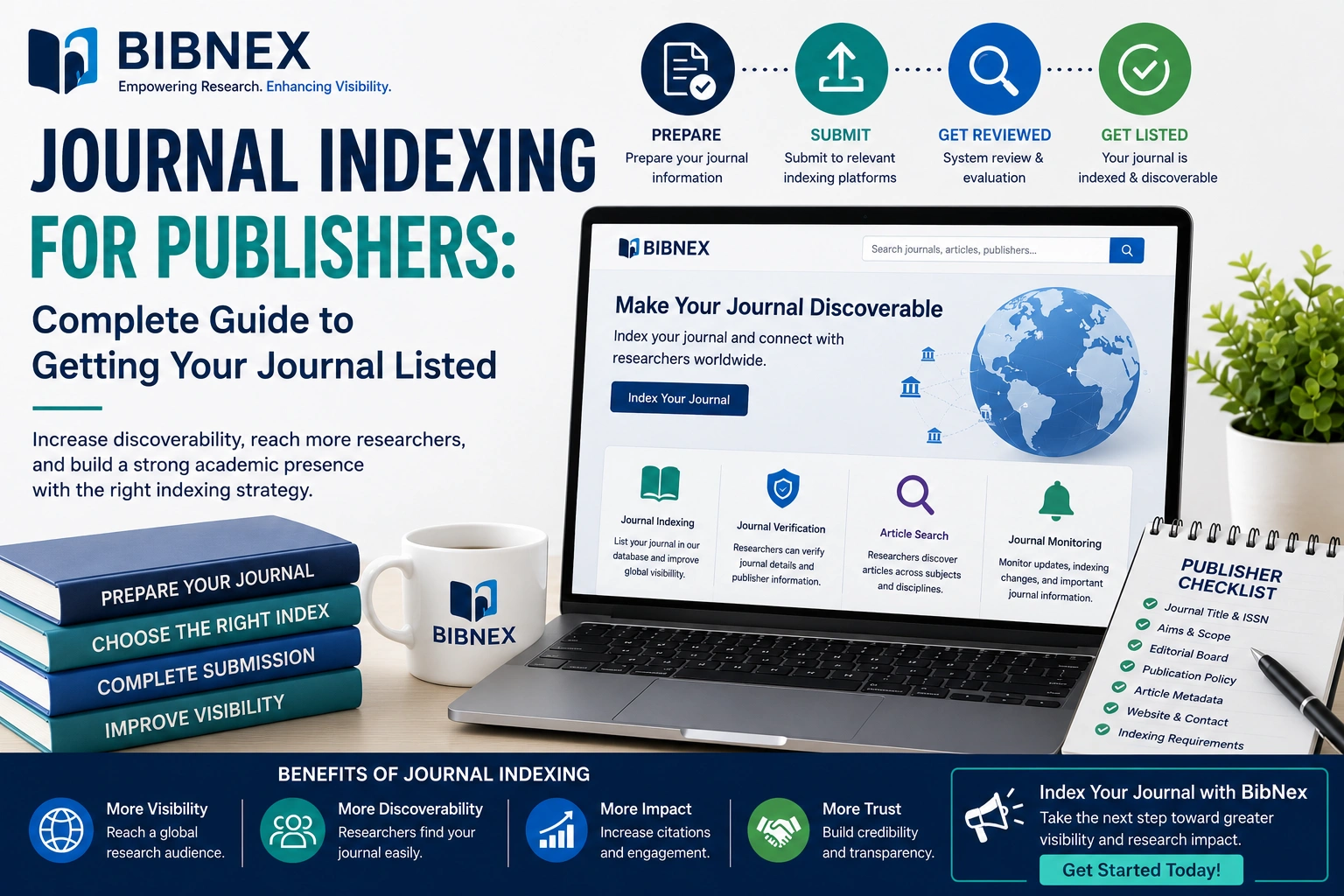
Journal Indexing for Publishers: Complete Guide to Getting Your Journal Listed
Publishing a high-quality academic journal is only the beginning. For a journal to reach more researchers, authors, librarians, and academic professionals, people need to be able to discover it.
This is where journal indexing for publishers becomes important.
Journal indexing can give publishers another way to make their journal information discoverable through organized academic databases and indexing platforms. However, getting a journal listed is not simply about filling out a form. Publishers need to prepare accurate journal information, understand indexing requirements, choose relevant platforms, submit complete details, and maintain their journal record over time.
In this complete guide, you will learn how journal indexing works, what publishers should prepare before submitting a journal, how to submit a journal for indexing, common mistakes to avoid, and how BibNex can support publishers in building a more discoverable journal presence.
What Is Journal Indexing?
Journal indexing is the process of adding structured information about a journal to an indexing or discovery database so that researchers can find and explore the publication.
Depending on the platform, a journal record may contain information such as:
- Journal title
- ISSN
- Publisher
- Journal website
- Subject or discipline
- Aims and scope
- Publication frequency
- Editorial information
- Article information
- Other relevant publication details
The exact information and evaluation process varies between indexing services. Therefore, publishers should always understand what a particular platform actually provides rather than assuming that every indexing database works in the same way.
A useful journal indexing database can provide another discovery channel for publishers while helping researchers find journal information more efficiently.
Why Is Journal Indexing Important for Publishers?
Imagine that a publisher has created a new journal in computer science. The journal has a professional website and publishes relevant research papers, but the journal is not well known outside its existing audience.
A researcher searching for an appropriate journal may never discover it.
This is one of the main problems indexing and discovery platforms can help address.
When journal information is available through relevant discovery environments, researchers have additional opportunities to find the publication.
Journal indexing can support publishers by helping them:
- Increase journal discoverability
- Present journal information in a structured format
- Reach researchers who are searching for journals
- Support author journal discovery
- Connect journal information with published articles
- Build a broader digital presence
- Make journal information easier to investigate
However, publishers should remember that indexing alone does not guarantee higher rankings, citations, submissions, acceptance rates, or research impact.
It should be considered one component of a broader journal visibility strategy.
Journal Indexing vs. Journal Visibility
These two concepts are related but not identical.
Journal indexing generally refers to having journal information included in an indexing or discovery database.
Journal visibility is broader. It refers to how easily researchers can discover, access, understand, and engage with a journal and its published research.
A strong publisher strategy can therefore combine:
- Journal indexing
- Technical SEO
- Article-level SEO
- Internal linking
- Accurate metadata
- Academic content promotion
- Researcher outreach
- Relevant external listings
- Regular information updates
For example, getting a journal listed in a database is useful, but publishers should also make sure that the journal's own website is technically sound and that individual articles are easy to discover.
Who Can Benefit From Journal Indexing?
Journal indexing can be useful for different types of academic publishers, including:
- Independent academic publishers
- Universities and research institutions
- Societies and academic organizations
- Professional associations
- Research organizations
- Open-access journal publishers
- Publishers managing multiple scholarly journals
The suitability of any particular indexing platform depends on the journal, its subject, audience, publication practices, and the purpose of the database.
Before You Submit: Prepare Your Journal
One of the biggest mistakes publishers make is trying to submit a journal before its information is properly organized.
Before starting a journal indexing submission, create a checklist and verify that your journal information is complete.
1. Confirm the Official Journal Title
Make sure the journal has a consistent official title.
The title should match across your:
- Journal website
- Article pages
- PDF files
- ISSN records
- Publisher information
- External databases
Inconsistent titles can make it harder for researchers to identify the correct journal.
2. Verify the ISSN
If your journal has an ISSN, make sure the information is accurate and consistently presented.
For journals with separate print and electronic editions, publishers should clearly distinguish the relevant identifiers.
Identifiers are particularly useful because journal titles can sometimes be similar.
3. Provide Clear Publisher Information
Researchers should be able to identify who publishes the journal.
Include clear information about the publisher and provide an appropriate contact or institutional page where relevant.
4. Create a Clear Aims and Scope Page
The aims and scope page should explain what the journal publishes and who it serves.
For example, instead of writing:
"This journal publishes high-quality research in science."
A more useful description would explain the disciplines, research areas, article types, and intended academic audience.
A clear scope helps researchers determine whether the journal is relevant to their work.
5. Maintain Editorial Information
Provide appropriate information about the editorial team and journal management.
Depending on the journal, this may include:
- Editor-in-Chief
- Associate editors
- Editorial board
- Editorial affiliations
- Contact information
Keep this information updated when changes occur.
6. Organize Published Articles
Your journal should have a clear archive where researchers can find published content.
Article pages should ideally contain information such as:
- Article title
- Author name
- Abstract
- Keywords
- Publication date
- Volume and issue
- Page information where applicable
- DOI where applicable
Good article organization supports both researchers and search engines.
How to Submit a Journal for Indexing
The exact process differs between indexing platforms, but publishers can generally follow a structured workflow.
Step 1: Choose a Relevant Indexing Platform
Do not submit your journal to every database you find.
First determine whether the platform is relevant to your journal's:
- Subject
- Discipline
- Geographic audience
- Publication type
- Target researchers
- Discovery goals
Relevance is more important than simply collecting a large number of listings.
Step 2: Review the Platform's Requirements
Every indexing platform may have different requirements.
Before applying, look for information about:
- Eligibility
- Required journal details
- Publication history
- Editorial information
- Website requirements
- Article metadata
- Submission procedures
- Evaluation criteria
Never assume that meeting the requirements of one platform automatically means that your journal qualifies for another.
Step 3: Prepare Accurate Metadata
Metadata is essential for journal discoverability.
Review the information you plan to submit carefully. Check spelling, identifiers, URLs, publisher information, subject categories, and other required fields.
Incorrect metadata can create confusion and may require additional corrections later.
Step 4: Submit the Journal
Complete the indexing application or submission process using the platform's official procedure.
Provide all requested information accurately rather than adding unnecessary claims or information that cannot be verified.
Step 5: Wait for Evaluation or Processing
Some platforms may review submissions before adding a journal record.
The time and evaluation process can vary considerably. Publishers should avoid assuming that submission automatically means acceptance or immediate listing.
Step 6: Verify the Published Record
Once a journal is listed, review the resulting record.
Check:
- Journal title
- ISSN
- Publisher
- Website
- Subject
- Other important information
If something is incorrect, follow the platform's process for requesting an update.
How BibNex Can Help Publishers Get Their Journals Discovered
BibNex is a journal indexing and discovery platform built around the relationship between publishers, journals, authors, and academic articles.
One of the key purposes of BibNex is to provide publishers with a place where they can index their journals and make journal information more discoverable.
This gives publishers another opportunity to present their journals to researchers who are actively searching for academic publications.
But BibNex is not focused only on publisher listings. Its broader ecosystem includes:
- Journal indexing for publishers
- Journal search and verification for authors
- Academic article search for researchers
- Journal monitoring for ongoing information tracking
This creates a connection between the publisher's need for visibility and the researcher's need for reliable journal and article information.
Publishers can learn more through the journal indexing platform for publishers.
Why BibNex's Publisher-Focused Approach Matters
Traditional publisher visibility efforts often focus heavily on the journal website itself.
While the website remains extremely important, researchers discover journals through many different paths.
For example:
- A researcher searches for a research topic.
- They discover an article.
- They identify the journal that published the article.
- They investigate the journal.
- They compare it with other journals.
- They may eventually consider the journal for future publication.
This means that journal visibility is connected to article discovery.
BibNex's combination of journal indexing and article search reflects this relationship.
Improve Your Journal's Article Discoverability
Getting a journal indexed is useful, but publishers should not stop there.
Each published article should be treated as an individual discovery opportunity.
Make sure article pages have:
- Descriptive titles
- Author names
- Useful abstracts
- Relevant keywords
- Clear publication dates
- Journal information
- Volume and issue details
- DOI information where applicable
- Links to related journal pages
For example, instead of creating an article URL with an unclear string of numbers, use a descriptive URL structure that reflects the article title where appropriate.
Also connect article pages to the journal homepage, issue page, subject pages, and related articles.
Use Internal Linking to Strengthen Journal SEO
Internal linking is an important but often overlooked part of journal SEO.
A publisher can create a logical structure such as:
Homepage → Journal → Issue → Article → Related Article
This helps users navigate the website and gives search engines additional context about the relationship between pages.
For example, a journal page can link to its latest issue, while an article can link back to the journal and related articles.
Publishers can also create useful topical pages around subjects covered by their journals.
Journal Indexing Is Not the Same as SEO
This distinction is important.
SEO focuses on improving the visibility of web pages in search engines and helping users discover useful content.
Journal indexing focuses on inclusion and discoverability within a specific indexing or database environment.
They can complement each other.
A publisher's strategy can include both:
- Indexing journals in relevant databases
- Optimizing the journal website
- Optimizing article pages
- Improving site architecture
- Building relevant internal links
- Creating useful research content
- Improving technical performance
The goal should be to create multiple legitimate discovery paths rather than relying on a single source of traffic.
Common Journal Indexing Problems
Problem 1: Incomplete Journal Profile
If important information is missing, researchers may have difficulty understanding the journal.
Solution: Create a complete journal information checklist before submission.
Problem 2: Incorrect Metadata
Typos or inconsistent identifiers can make journal records confusing.
Solution: Verify metadata against your official journal records before submitting.
Problem 3: Poor Website Structure
If researchers cannot easily find aims and scope, editorial information, articles, or author guidelines, the journal may appear less transparent.
Solution: Organize the website around clear navigation and logical page relationships.
Problem 4: Outdated Information
Journal information can change over time.
Solution: Schedule periodic reviews of your journal website and external database records.
Problem 5: Focusing Only on the Journal Homepage
Researchers may discover your publication through individual articles.
Solution: Optimize article pages and connect them to the broader journal structure.
Mistakes Publishers Should Avoid
- Do not submit inaccurate information. Accuracy should always come before speed.
- Do not make unsupported indexing claims. Clearly distinguish between actual listings and applications or submissions.
- Do not assume every database has the same standards. Research each platform independently.
- Do not ignore your journal website. An external listing cannot replace a useful publisher website.
- Do not neglect article metadata. Individual articles are important discovery assets.
- Do not stop after the initial submission. Journal information needs ongoing maintenance.
- Do not equate indexing with quality. Indexing is only one part of a journal's overall evaluation.
Expert Recommendations for Publishers
1. Create a Journal Indexing Checklist
Maintain a standard checklist containing all journal information required for submissions. This makes future indexing applications easier and reduces errors.
2. Maintain a Master Metadata Record
Keep one authoritative record of your journal's title, identifiers, publisher details, website, scope, and other important information.
Use this record when updating external platforms.
3. Review Your Journal Quarterly
A quarterly review can help you identify outdated information, broken links, missing articles, and changes that should be reflected across your digital presence.
4. Monitor Journal Visibility
Track how researchers discover your journal. Look at organic search performance, referral traffic, article discovery, and other meaningful indicators.
5. Think Like a Researcher
Ask a simple question:
"If I had never heard of this journal, could I find enough information to decide whether it is relevant to my research?"
If the answer is no, improve the journal's discoverability and information architecture.
A Practical Journal Indexing Checklist
Before submitting your journal to an indexing database, use this checklist:
- ✓ Official journal title is correct
- ✓ ISSN information is accurate
- ✓ Publisher information is clear
- ✓ Journal website is active
- ✓ Aims and scope are clearly written
- ✓ Editorial information is available
- ✓ Author guidelines are available
- ✓ Publication policies are clear
- ✓ Published issues are organized
- ✓ Article metadata is complete
- ✓ DOI information is correct where applicable
- ✓ Journal subject classification is appropriate
- ✓ Indexing requirements have been reviewed
- ✓ Submitted information has been checked for errors
- ✓ A process exists for monitoring and updating information
What Should Publishers Do After Getting Listed?
Getting a journal listed is not the final step.
After indexing, publishers should continue working on discoverability.
Consider the following activities:
- Verify the published journal record.
- Correct inaccurate information where necessary.
- Continue publishing quality research.
- Improve article metadata.
- Build internal links between articles and journal pages.
- Promote useful research through appropriate channels.
- Monitor search visibility.
- Review indexing records regularly.
- Keep publisher and editorial information current.
This turns journal indexing from a one-time task into part of a long-term publishing strategy.
How Journal Monitoring Supports Long-Term Visibility
Academic publishing is constantly changing.
Journal websites change. Editors change. Publishers may update information. New issues and articles are published. Journal scopes can evolve.
For this reason, publishers should consider journal monitoring as part of their ongoing digital publishing workflow.
BibNex includes journal monitoring as one of its core areas, alongside indexing, journal verification, and article search.
This broader approach recognizes an important principle: journal visibility requires ongoing maintenance.
Frequently Asked Questions
What is journal indexing for publishers?
Journal indexing for publishers is the process of submitting and maintaining journal information in an indexing or discovery database. It can provide another channel through which researchers discover and explore a journal.
How can I submit my journal for indexing?
First, identify a relevant indexing platform and review its requirements. Prepare accurate journal information, complete the submission process, and verify the resulting journal record if the journal is listed.
What information is required for journal indexing?
Requirements vary, but publishers may need information such as the journal title, ISSN, publisher, website, aims and scope, editorial information, publication details, and article information.
How does BibNex help publishers?
BibNex provides publishers with a platform for journal indexing and discovery. It also connects journal information with journal verification, article search, and journal monitoring features.
Does getting indexed guarantee more authors or citations?
No. Indexing does not guarantee increased submissions, citations, rankings, acceptance, or research impact. Publishers should combine indexing with quality publishing, SEO, article discoverability, and broader academic outreach.
Why should publishers monitor their journal after indexing?
Journal information can change over time. Regular monitoring helps publishers identify outdated or incorrect information and maintain a more accurate digital presence.
Is journal indexing the same as journal quality evaluation?
No. Indexing and quality evaluation are related but different concepts. Researchers should independently assess a journal according to relevant academic, editorial, institutional, and publication criteria.
Conclusion
Journal indexing for publishers should be viewed as part of a long-term journal visibility strategy rather than a one-time submission.
Before submitting your journal, make sure your title, ISSN, publisher information, aims and scope, editorial information, website, publication policies, and article metadata are accurate and easy to understand.
Then identify relevant indexing and discovery platforms, review their requirements, submit complete information, and verify your journal record after listing.
Most importantly, continue improving your journal after the initial submission. Maintain accurate metadata, optimize article pages, build useful internal links, publish quality research, and monitor your journal information regularly.
BibNex can be part of this process by giving publishers a dedicated environment for journal indexing and discovery while connecting that activity with journal verification, academic article search, and journal monitoring.
For publishers looking to build a stronger digital presence, the objective is not simply to have a journal "listed." The bigger goal is to make the journal easy to discover, easy to understand, and useful to the researchers it aims to serve.
Ready to List Your Journal?
If you are a publisher looking for an additional way to improve journal discoverability, explore BibNex journal indexing.
BibNex is designed to connect publishers with researchers through journal indexing, journal search and verification, academic article discovery, and journal monitoring.