
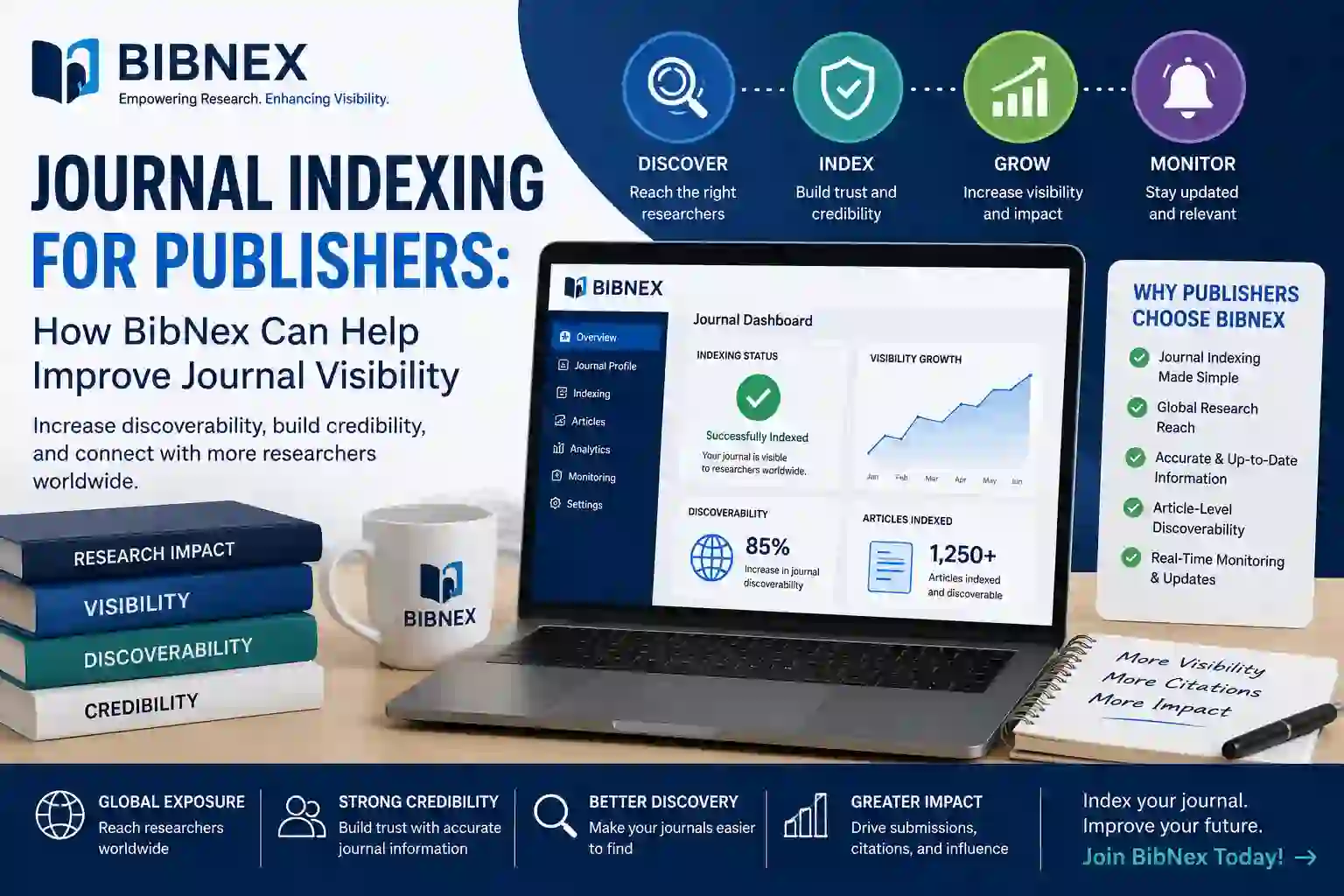
Journal Indexing for Publishers: How BibNex Can Help Improve Journal Visibility
Publishing a high-quality academic journal is only part of the challenge for publishers. Researchers also need to be able to find, identify, verify, and discover that journal when searching for a suitable publication venue.
This is where journal indexing and discoverability become important.
A journal may publish valuable research, have an experienced editorial team, and follow appropriate publishing practices, but limited online visibility can make it difficult for researchers to discover the journal. Publishers therefore need a structured approach to presenting journal information, improving discoverability, maintaining accurate records, and keeping indexing information up to date.
BibNex is a journal indexing and discovery platform designed to connect publishers and researchers. Publishers can use BibNex to index their journals, while authors can use the platform to search and verify journals, discover articles, and follow relevant journal information.
In this guide, we will explain the most common journal visibility problems publishers face, why these problems occur, how publishers can address them step by step, and how journal indexing through BibNex can become part of a broader journal visibility strategy.
What Is Journal Indexing for Publishers?
Journal indexing is the process of making journal information and, depending on the indexing service, its published content discoverable through an organized database or indexing platform.
For publishers, indexing can support journal discoverability by making information such as the journal title, publisher, subject area, identifiers, and other relevant details easier for researchers to find.
However, journal indexing should not be confused with a guarantee of journal quality, acceptance, citations, or publication success. Different indexing platforms have different purposes, requirements, and evaluation approaches.
A practical publisher strategy should therefore combine:
- Accurate journal information
- Strong journal discoverability
- Clear publisher and editorial information
- Consistent identifiers
- Relevant indexing opportunities
- Search-friendly journal pages
- Regular monitoring and updates
- Useful article-level information
These elements work together to create a stronger digital presence for an academic journal.
Why Do Publishers Struggle With Journal Visibility?
Many publishers assume that publishing good research automatically makes a journal easy to find. In reality, researchers use search engines, journal databases, indexing services, academic platforms, publisher websites, and article databases to discover research.
If journal information is incomplete, inconsistent, difficult to discover, or not maintained properly, researchers may have difficulty finding it.
Here are some common problems publishers face.
Problem 1: Researchers Cannot Easily Discover the Journal
A publisher may have a functioning website, but the journal can still have limited visibility outside the publisher's own domain.
Researchers often search for journals using phrases such as:
- Indexed journals
- Academic journals
- Journals by subject
- Research journals
- Journals for publication
- Journals by publisher
- Journals by country
If a journal is not represented in relevant discovery environments, potential authors may never encounter it.
Problem 2: Journal Information Is Incomplete
Researchers need basic information before they can evaluate a journal.
Important information can include the journal title, ISSN, publisher, subject area, website, publication frequency, editorial information, aims and scope, and article information.
When this information is incomplete or inconsistent across different pages, researchers may have difficulty determining whether they have found the correct journal.
Problem 3: Journal Indexing Information Is Difficult to Find
Publishers may mention indexing on their website without creating a clear, easy-to-understand indexing page.
A researcher may therefore see a claim that a journal is indexed but struggle to understand:
- Where the journal is indexed
- Which journal record is being referenced
- Which identifier belongs to the journal
- Whether the information is current
Clear indexing information improves transparency and makes journal evaluation easier.
Problem 4: Journal Records Become Outdated
Academic publishing information changes over time. A journal may change its publisher, website, editorial team, publication frequency, or other details.
If a journal record is created once and never reviewed again, outdated information can remain available to researchers.
This is why journal monitoring should be treated as an ongoing activity rather than a one-time task.
Problem 5: Articles Are Difficult to Discover
Journal visibility and article visibility are closely connected.
A researcher may discover a journal because of a specific article. If article titles, authors, journal information, and other metadata are difficult to discover, the publisher may lose opportunities to reach new researchers.
Publishers should therefore think beyond the journal homepage and consider how individual articles can be discovered through academic search and journal databases.
How Can Publishers Improve Journal Visibility?
Improving journal visibility is not normally achieved through one action. It requires a combination of accurate information, technical organization, indexing, content discoverability, and ongoing maintenance.
The following process provides a practical starting point.
Step 1: Create a Complete Journal Profile
Before submitting a journal to an indexing platform, make sure the basic journal information is complete and consistent.
At minimum, review:
- Official journal title
- ISSN or relevant identifiers
- Publisher name
- Journal website
- Aims and scope
- Subject or discipline
- Publication frequency
- Editorial information
- Author guidelines
- Publication policies
- Published articles
Consistency is particularly important. If the title or identifiers differ between your journal website and external records, researchers may become confused.
Step 2: Make Your Journal Easy to Understand
Journal visibility is not only about appearing in search results. When a researcher discovers your journal, they should immediately understand what it publishes.
Your journal page should clearly communicate:
- What subjects the journal covers
- What type of research it accepts
- Who the intended audience is
- How frequently it publishes
- How authors can submit manuscripts
- How the peer-review process works
A clear journal profile reduces friction for both researchers and prospective authors.
Step 3: Submit Your Journal to Relevant Indexing Platforms
Once your journal information is organized, identify indexing and discovery platforms that are relevant to your journal.
Different platforms have different purposes. Some focus on specific disciplines, regions, publication types, or discovery functions.
Publishers should avoid submitting a journal simply because a platform exists. Instead, evaluate whether the platform is relevant to the journal's subject, audience, and visibility objectives.
BibNex provides publishers with a dedicated environment for journal indexing and discovery. A publisher can index its journal on BibNex so that researchers have another place to discover and investigate journal information.
This creates an important connection between publishers and authors: publishers provide structured journal information, while researchers can use the platform to search and verify journals.
Step 4: Optimize Journal Information for Discoverability
After indexing a journal, think about how researchers actually search.
Researchers may not search for your exact journal title. They may search by:
- Subject
- Discipline
- Publisher
- Country
- Research topic
- Journal type
- Article topic
Therefore, structured journal metadata and accurate categorization can help make the journal more discoverable in relevant contexts.
This is one reason BibNex journal indexing can be useful as part of a publisher's visibility strategy. The objective is not simply to create a listing; it is to make journal information easier for researchers to find and investigate.
Step 5: Improve Article Discoverability
Journal visibility should eventually lead to article discovery.
Make sure each published article has useful information such as:
- Article title
- Author names
- Journal title
- Publication date
- Abstract
- Keywords
- Volume and issue information
- DOI, where applicable
- Relevant subject information
Clear article information helps researchers understand what a paper is about before deciding whether to read or cite it.
BibNex also supports article discovery, connecting journal-level visibility with the ability for researchers to search for academic articles.
Step 6: Build Strong Internal Linking
Internal linking is often overlooked by publishers.
Your journal website should create logical connections between:
- Journal homepage
- About page
- Aims and scope
- Editorial board
- Author guidelines
- Current issue
- Archive
- Individual articles
For example, an article page should link back to its journal page. A journal page should link to relevant issues and articles. An issue page should link to individual articles.
This creates a clear information structure for both users and search engines.
Step 7: Keep Journal Information Updated
Indexing should not be treated as a "set it and forget it" activity.
Publishers should periodically review their journal records and verify that important information remains accurate.
Check for:
- Publisher changes
- Website changes
- ISSN information
- Editorial changes
- Publication frequency changes
- Subject scope changes
- New issues and articles
- Indexing information changes
BibNex's journal monitoring concept is particularly relevant here. Publishers can think of journal visibility as an ongoing process that requires maintenance and attention rather than a one-time submission.
How BibNex Can Help Publishers
BibNex is built around four connected activities:
- Journal indexing for publishers
- Journal search and verification for authors
- Article discovery for researchers
- Journal monitoring for ongoing visibility and information management
This creates a useful ecosystem around academic journals.
For publishers, BibNex provides an opportunity to place journal information in a dedicated journal discovery environment. For authors, it provides a place to search and investigate journals before making publication decisions.
The broader journal database approach also supports the idea that journal visibility should connect journal-level information with article-level discovery.
For Publishers
Publishers can use BibNex to improve the discoverability of their journals by creating or maintaining a structured journal presence.
For Authors
Authors can search journals and investigate available information when looking for potential publication venues.
For Researchers
Researchers can search for academic articles and explore journal-related information in one connected environment.
For Ongoing Journal Management
Journal monitoring provides a way to think about journal information as something that should remain current over time.
Expert Tips for Publishers
Tip 1: Treat Indexing as Part of Your Marketing Strategy
Do not view indexing as a purely technical activity. It can also contribute to how researchers discover your journal.
Tip 2: Focus on Accurate Information
Never sacrifice accuracy for visibility. An incomplete or inconsistent journal profile can reduce trust even if the journal is easy to find.
Tip 3: Think About the Researcher's Search Journey
Ask yourself how a researcher would find your journal if they did not already know its name.
Could they discover it through the subject? The publisher? An article? A journal database? A journal search?
Tip 4: Promote Individual Articles
Every article is another opportunity to introduce researchers to your journal. Make article pages informative, searchable, and connected to the journal profile.
Tip 5: Monitor Your Information Regularly
Set a schedule for reviewing your journal records. Regular monitoring can help identify outdated information before it becomes a larger problem.
Mistakes Publishers Should Avoid
1. Submitting Incomplete Information
Do not rush to submit a journal before its basic information is ready. Complete information creates a better experience for researchers.
2. Using Inconsistent Journal Details
Keep the journal title, identifiers, publisher information, and other core details consistent across your website and external platforms.
3. Treating One Index as the Entire SEO Strategy
Journal indexing is only one part of visibility. Publishers should also work on technical SEO, content quality, article discoverability, internal linking, digital PR, and relevant external visibility.
4. Ignoring Article-Level SEO
A journal can have a strong homepage while individual articles remain difficult to discover. Optimize both journal-level and article-level content.
5. Forgetting About Updates
Old journal information can create confusion. Review important records regularly and update them when necessary.
6. Focusing Only on Search Engines
SEO is important, but publishers should remember that the ultimate audience is researchers, authors, librarians, and academic professionals.
Create information that helps real people first. Search visibility should support that goal.
A Simple Journal Visibility Workflow for Publishers
If you are starting journal indexing for the first time, use this simple workflow:
- Audit your journal. Review the title, ISSN, publisher, scope, editorial information, website, and articles.
- Improve the journal website. Make important information easy to find.
- Organize article information. Give each article a clear and useful page.
- Identify relevant indexing opportunities. Choose platforms that match your journal.
- Submit your journal. Provide complete and accurate information.
- Build discoverability. Connect journal, issue, and article pages.
- Monitor information. Review journal records and update them when necessary.
- Measure progress. Monitor organic search visibility, referrals, article discovery, and relevant publisher metrics.
Frequently Asked Questions
What is journal indexing for publishers?
Journal indexing for publishers is the process of making structured journal information available through an indexing or discovery platform. It can help researchers discover journals and investigate relevant publication information.
How can publishers improve journal visibility?
Publishers can improve visibility by maintaining accurate journal information, optimizing their website, improving article discoverability, building internal links, submitting journals to relevant indexing platforms, creating useful content, and monitoring journal information regularly.
How does BibNex help journal publishers?
BibNex provides publishers with a platform to index their journals and make journal information more discoverable. BibNex also connects journal discovery with author journal verification, academic article search, and journal monitoring.
Why is journal monitoring important?
Journal information can change over time. Monitoring helps publishers identify changes and keep important journal information current, which can make the journal record more useful to researchers.
Does journal indexing guarantee higher citations?
No. Indexing does not guarantee citations, submissions, rankings, or publication success. It is one component of a broader journal visibility and discoverability strategy.
Can publishers index their journals on BibNex?
Yes. BibNex is designed to allow publishers to index their journals so researchers can discover and investigate journal information through the platform.
Conclusion: Make Journal Visibility an Ongoing Process
For academic publishers, publishing quality research is only one part of building a successful journal. Researchers must also be able to discover the journal, understand what it publishes, evaluate its information, and find its articles.
Journal indexing, journal discovery, article visibility, and monitoring should therefore work together.
Start by creating a complete and accurate journal profile. Make your website easy to navigate. Improve article-level information. Submit your journal to relevant indexing and discovery platforms. Keep your records updated and regularly evaluate how researchers can find your publication.
BibNex can become part of this strategy by providing publishers with a dedicated platform for journal indexing and discovery, while also connecting journals with author verification, article search, and journal monitoring.
If your goal is to make your journal easier for researchers to discover and investigate, taking a structured approach to indexing is a practical place to start.
Ready to Improve Your Journal's Visibility?
Give your journal another opportunity to be discovered by researchers and authors. Explore BibNex journal indexing and learn how publishers can create a stronger, more discoverable journal presence.