
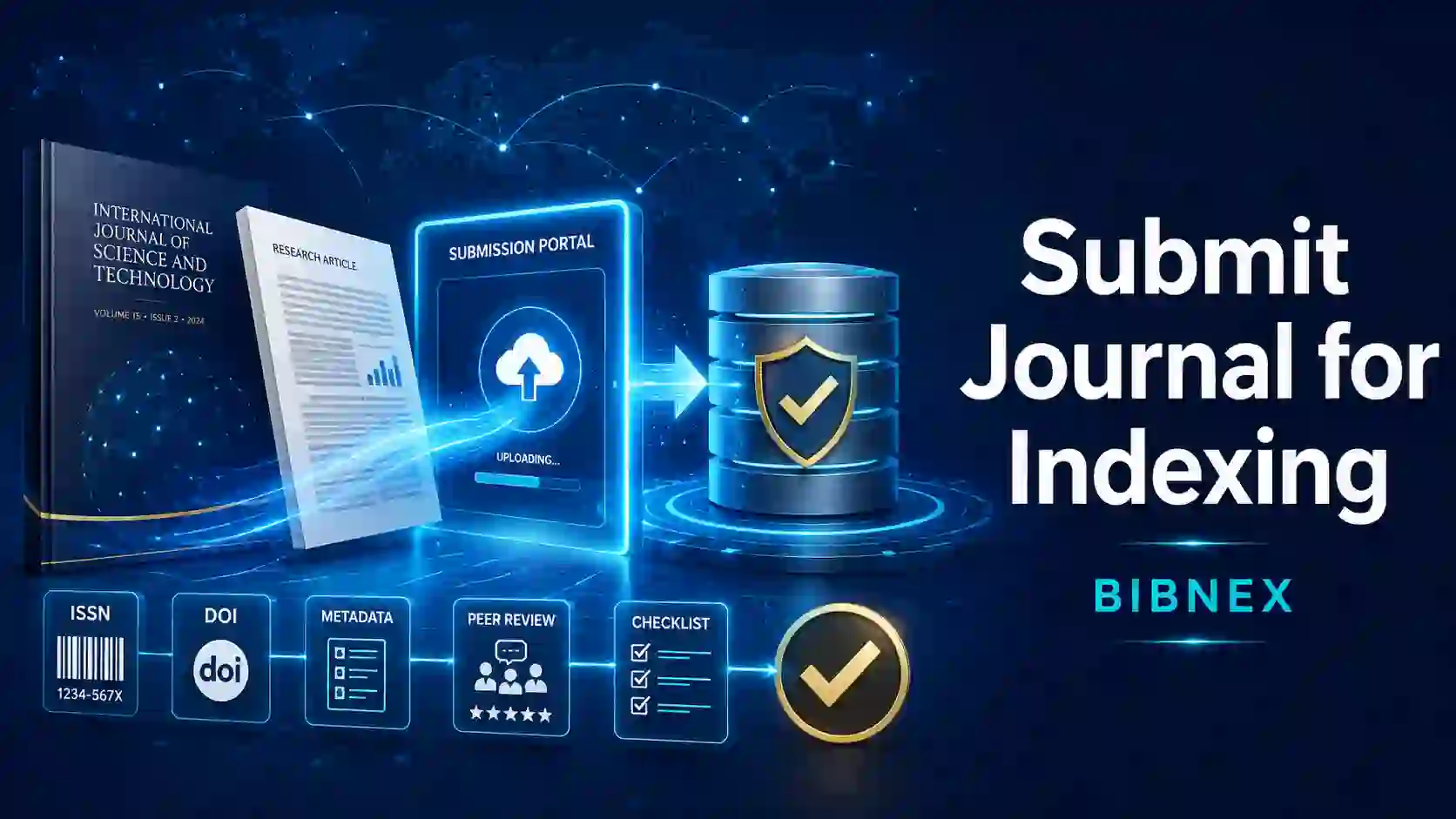
Submit Journal for Indexing: Complete Guide for Publishers
Learn how to prepare and submit your academic journal for indexing, understand the common evaluation requirements and improve the discoverability of your published research.
Journal indexing is an important step for publishers seeking to improve the visibility, accessibility and discoverability of their scholarly content. Inclusion in a relevant academic database can make journal articles easier for researchers, universities, libraries and search systems to find.
However, publishers should not submit applications without first reviewing their journal website, publishing policies and article metadata. Incomplete information, irregular publication, unclear peer review or missing ethical policies can negatively affect an indexing application.
This guide explains how to submit a journal for indexing , what information may be required and how publishers can prepare their journals for evaluation.
What Is Journal Indexing?
Journal indexing is the process through which information about a scholarly journal and its published articles is included in an academic database, bibliographic directory, citation index or research discovery platform.
Depending on the database, an indexed journal record may contain:
- Journal title and abbreviation
- Print ISSN and online ISSN
- Publisher name and country
- Aims and scope
- Academic subject categories
- Editorial and peer-review information
- Open-access and licensing details
- Article titles and abstracts
- Author names and affiliations
- Keywords and references
- Digital Object Identifiers
- Publication dates, volumes and issues
Indexing services have different purposes and evaluation standards. Some platforms focus on bibliographic discovery, while others provide citation analysis, subject-specific coverage or open-access journal directories.
Why Submit Your Journal for Indexing?
Indexing can improve how scholarly publications are discovered and accessed. It also helps publishers distribute structured journal and article information beyond their own websites.
Benefits of Journal Indexing
- Improved discoverability: Researchers can find journal articles through database searches.
- Greater research visibility: Indexed content may reach readers outside the publisher's existing audience.
- International exposure: A global database can connect journals with researchers from different countries and institutions.
- Better metadata distribution: Structured bibliographic records can be used by academic search systems and discovery tools.
- Potential citation opportunities: Research that is easier to find has more opportunities to be read and cited.
- Stronger publishing standards: Preparing for indexing encourages publishers to improve policies, metadata and editorial transparency.
Indexing can increase visibility, but it does not guarantee citations, academic recognition or acceptance by another database.
Common Journal Indexing Requirements
Every database maintains its own eligibility and evaluation criteria. Nevertheless, most reputable indexing services expect publishers to demonstrate several fundamental scholarly publishing practices.
1. Valid ISSN
A journal should have at least one valid International Standard Serial Number. Separate ISSNs may be assigned to print and online versions.
The journal title and ISSN displayed on the website should match the official ISSN record. Publishers should avoid using inconsistent journal titles or abbreviations across different pages.
2. Dedicated Journal Website
The journal should have a functional and publicly accessible website. Important information should be easy for authors, readers and evaluators to locate.
The website should clearly display:
- Journal title and ISSN
- Publisher information
- Aims and scope
- Editorial board
- Peer-review process
- Instructions for authors
- Publication ethics
- Copyright and licensing terms
- Publication fees and waiver policy
- Journal contact information
- Current and previous issues
3. Clearly Defined Aims and Scope
The aims and scope should explain the journal's academic purpose, intended audience, disciplines and types of manuscripts accepted. Published articles should remain consistent with the declared scope.
4. Transparent Peer-Review Process
The journal should explain how submitted manuscripts are evaluated. Publishers should identify whether the journal uses single-anonymous, double-anonymous, open or another recognized review model.
The policy should also explain the roles of reviewers and editors, expected review stages and the process used to reach an editorial decision.
5. Qualified Editorial Board
Editorial-board members should have suitable qualifications and expertise in the journal's subject areas. The website should display their full names and institutional affiliations.
Publishers must obtain permission before listing a person as an editor. Editorial-board information should be reviewed regularly and updated when a member's position or affiliation changes.
6. Publication Ethics Policies
A journal should maintain clear policies addressing integrity and responsible scholarly publishing. These normally include:
- Authorship and contributorship
- Plagiarism and duplicate publication
- Conflicts of interest
- Research involving humans or animals
- Data availability and reproducibility
- Complaints and appeals
- Corrections and retractions
- Handling allegations of research misconduct
7. Regular Publication Schedule
Issues should be published according to the frequency stated on the journal website. Repeated delays, missing issues or unexplained interruptions can indicate weak editorial management.
8. Transparent Publication Charges
All submission, processing, publication, page, colour or other author charges should be clearly stated. If the journal does not charge any fees, it should explicitly state that no article processing charge is required.
Any fee-waiver or discount policy should explain the applicable conditions. Editorial decisions should not be influenced by an author's ability to pay.
9. Copyright and Licensing
The website should clearly identify who retains copyright and what licence applies to published articles. Open-access journals should explain how readers may access, share and reuse their content.
10. Digital Preservation
Publishers should establish a long-term preservation system to ensure that articles remain accessible if the journal website becomes unavailable. The journal's archiving policy should be published on its website.
11. Complete Article Metadata
Accurate metadata helps databases understand and organize journal content. Each article should have its own landing page and include:
- Article title
- Full author names
- Author affiliations
- Abstract
- Keywords
- Publication date
- Volume and issue
- Page range or article number
- References
- DOI, where available
- Copyright and licensing information
Information Needed to Submit a Journal for Indexing
Publishers should collect all journal information before starting an application. The required fields vary between databases, but the following details are commonly requested:
| Category | Information Required |
|---|---|
| Journal identity | Title, abbreviation, print ISSN and online ISSN |
| Publisher | Publisher name, address, country and website |
| Contact | Official journal email and responsible contact person |
| Subject | Aims, scope, disciplines and keywords |
| Publication | Starting year, frequency, language and access model |
| Editorial process | Peer-review model and editorial decision procedure |
| Editorial board | Editor names, qualifications and affiliations |
| Policies | Ethics, plagiarism, retraction and conflict-of-interest policies |
| Access | Open-access statement, copyright and licence |
| Fees | APCs, other charges and waiver conditions |
| Content | Current issue, archive and sample article URLs |
| Metadata | DOI registration, OAI-PMH endpoint and metadata formats |
| Preservation | Digital archiving and long-term preservation policy |
How to Submit a Journal for Indexing
Follow these steps before submitting your journal to an academic indexing database.
- Select a suitable indexing database. Confirm that the database covers the journal's discipline, language, publication model and content type.
- Read the official eligibility requirements. Do not depend only on third-party websites. Review the latest criteria published by the database itself.
- Conduct a journal website audit. Check that all policies, editorial details, issues and article pages are complete and publicly accessible.
- Correct inconsistent information. Ensure that the journal title, ISSN, publisher, frequency and contact details are identical throughout the website.
- Prepare the required metadata. Organize journal-level and article-level information before beginning the application.
- Complete the official application form. Provide accurate, complete and verifiable answers.
- Review the application before submission. Incorrect links, incomplete policies and inaccurate statements can delay or negatively affect an evaluation.
- Save the application reference number. Keep any confirmation email, tracking number or application ID.
- Respond to evaluation queries. Monitor the journal's official email and answer requests for clarification promptly.
- Maintain publishing standards. Continue publishing regularly and update journal information even after acceptance.
Submit Your Journal to BIBNEX
BIBNEX is a global bibliographic network designed to support the organized discovery of academic journals and scholarly information. Publishers can present accurate journal information for review and potential inclusion in the BIBNEX database.
Before applying, publishers should ensure that their journal has a valid identity, transparent editorial policies, accessible published content and complete bibliographic metadata.
Prepare These Details for BIBNEX
- Official journal title
- Print and online ISSN
- Journal website URL
- Publisher name and country
- Academic disciplines and subject categories
- Journal aims and scope
- Peer-review policy
- Editorial-board information
- Open-access and licensing information
- Publication frequency
- Current issue and archive links
- Official journal contact details
Providing complete and accurate information helps facilitate an efficient review. Submission of an application does not automatically guarantee inclusion.
Ready to Improve Your Journal's Discoverability?
Explore BIBNEX and begin preparing your journal information for indexing review.
Submit Journal for IndexingSubmitting to Major Journal Indexing Databases
Scopus
Scopus evaluates eligible serial publications using technical and editorial criteria. Its assessment considers journal policy, peer review, content quality, editor and author distribution, citation standing, publication regularity and online availability.
Publishers should confirm that a journal is not already covered and review the official selection requirements before using the title suggestion process.
Web of Science
Web of Science applies an editorial selection process to evaluate scholarly journals. Publishers should review the current criteria and use the official journal submission portal when their publication is ready.
DOAJ
DOAJ accepts peer-reviewed open-access journals that meet its transparency and publishing requirements. The journal should clearly present its open-access policy, editorial board, peer-review process, licensing terms, copyright conditions, author charges and publisher details.
New journals should carefully check DOAJ's current publishing-history requirements before applying.
Google Scholar
Google Scholar generally discovers scholarly content through automated crawling rather than a conventional journal application. Publishers should provide accessible article pages, stable URLs, accurate bibliographic metadata and readable full-text documents.
Common Journal Indexing Application Mistakes
Avoid the following mistakes when preparing an application:
- Submitting before the journal meets the minimum requirements
- Providing an incorrect or unconfirmed ISSN
- Using inconsistent journal titles across the website
- Listing editors without their knowledge or permission
- Publishing incomplete editorial affiliations
- Failing to explain the peer-review process
- Hiding article processing or publication charges
- Displaying unclear copyright and licensing information
- Publishing issues irregularly
- Providing broken article or archive links
- Using unofficial impact factors or misleading metrics
- Making false claims about existing indexing coverage
- Submitting inaccurate information in the application form
- Ignoring emails from the evaluation team
What Happens After You Submit a Journal?
After submission, the database may conduct an initial technical check followed by an editorial or subject-based evaluation. The evaluator may verify the journal website, editorial board, published articles, publication history, metadata and ethical policies.
The database may:
- Accept the journal for inclusion
- Request additional information or corrections
- Place the application under further evaluation
- Reject the application with reasons
- Require the publisher to wait before reapplying
Publishers should not describe the journal as indexed while the application is pending. An application is not the same as acceptance. Indexing should only be claimed after the journal appears in the database's official records.
How to Maintain Journal Indexing
Indexing is not necessarily permanent. Databases may periodically reassess journals and discontinue coverage when publishing standards decline or important information changes.
After acceptance, publishers should:
- Continue publishing according to the declared schedule
- Maintain an active and qualified editorial board
- Apply peer review consistently
- Keep policies and contact information updated
- Deposit complete article metadata
- Maintain secure and accessible article URLs
- Correct publication errors transparently
- Investigate allegations of research misconduct
- Notify databases about significant journal changes
- Avoid misleading indexing or metric claims
Journal Indexing Readiness Checklist
- Valid and confirmed ISSN
- Dedicated journal website
- Clear aims and scope
- Complete editorial-board information
- Transparent peer-review policy
- Publication ethics policies
- Copyright and licensing statement
- Clearly declared author charges
- Regular publication schedule
- Accessible issue archive
- Individual article landing pages
- Accurate article metadata
- DOIs or other persistent identifiers
- Digital preservation policy
- Official journal contact email
- Functional links and downloadable articles
Conclusion
Publishers planning to submit a journal for indexing should begin with editorial quality, transparency and accurate metadata. A valid ISSN alone does not make a journal ready for inclusion in a scholarly database.
Before applying, review every important website page, correct inconsistent information, verify the editorial board, disclose all publication charges and ensure that published articles contain complete bibliographic metadata.
Visit BIBNEX – The Global Bibliographic Network to explore academic journal discovery and learn more about submitting your journal for indexing.
Frequently Asked Questions
How can I submit my journal for indexing?
Select a suitable database, review its eligibility criteria, prepare your journal information, audit the website and complete the database's official application form. All information should be accurate and verifiable.
What are the basic requirements for journal indexing?
Common requirements include a valid ISSN, a dedicated journal website, transparent peer review, a qualified editorial board, regular publication, ethical policies, clear fees, licensing information and complete article metadata.
Can a new journal apply for indexing?
It depends on the database. Some services accept recently launched journals, while selective databases may require a minimum publishing history, sufficient research content or evidence of citation influence.
Does an ISSN mean that a journal is indexed?
No. An ISSN identifies a serial publication. It does not mean that the journal has been evaluated or accepted by an academic indexing database.
How long does journal indexing take?
Evaluation time varies by database, application quality, journal type and evaluator workload. Publishers should consult the official database for current processing information.
Does submitting a journal guarantee indexing?
No. Submission begins the evaluation process and does not guarantee acceptance. A journal should only claim indexing after its inclusion has been officially confirmed.
Can a journal be removed from an indexing database?
Yes. A database may discontinue a journal if it no longer meets publishing, ethical, technical or quality requirements.
Can I submit an open-access journal to BIBNEX?
Academic publishers can prepare their journal information for BIBNEX review. The application should accurately describe the journal's access model, licensing, peer review and publication policies.