
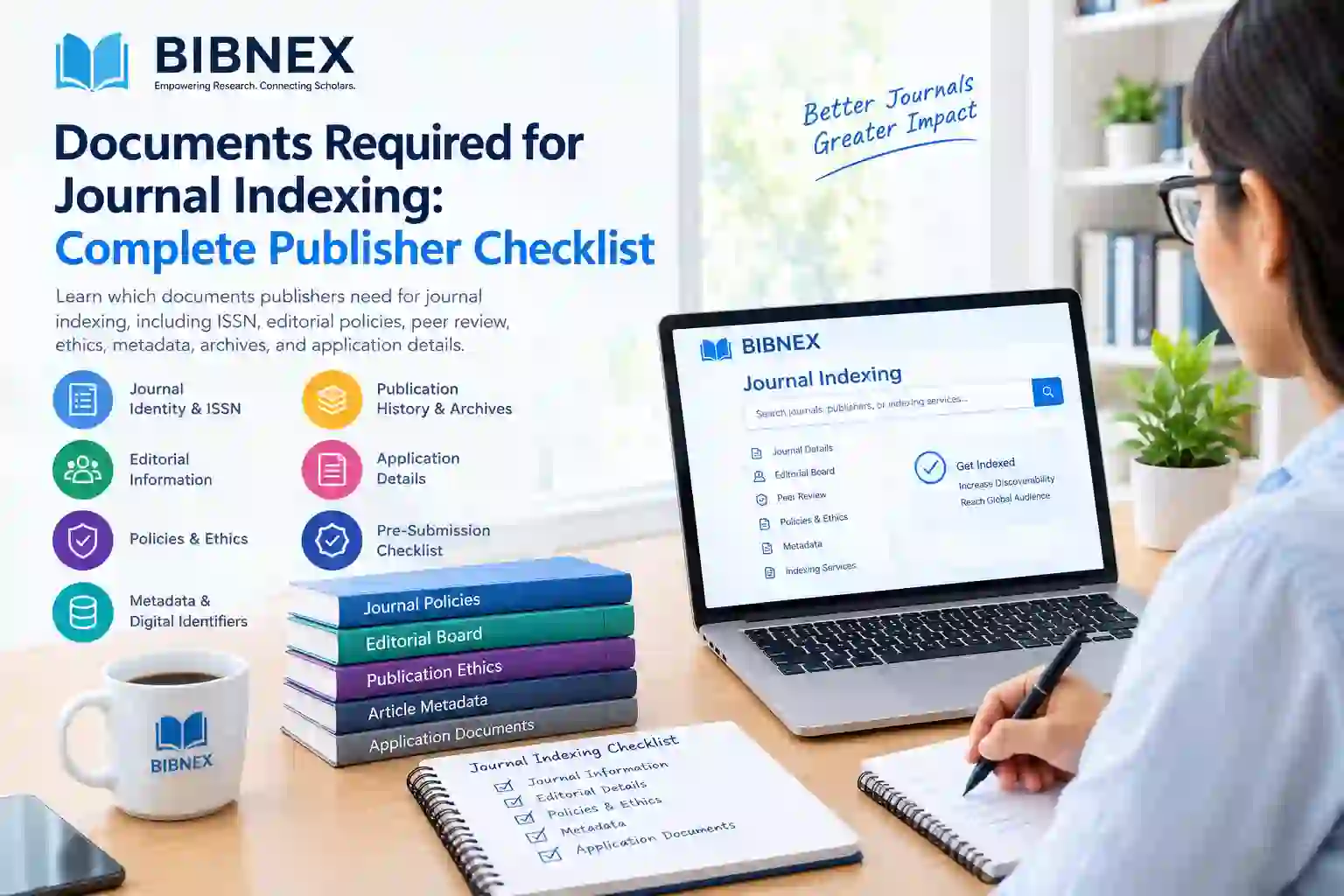
Documents Required for Journal Indexing: Complete Publisher Checklist
Preparing a journal for indexing is more than completing an online application. Publishers need to provide accurate information about the journal, its editorial structure, publishing practices, policies, articles, and publication history. Having these materials ready can make the application process more organized and help publishers identify gaps before submitting a journal for evaluation.
This guide explains the documents required for journal indexing, the information publishers should prepare, how to organize the documentation, common mistakes to avoid, and how to create a practical pre-submission checklist.
Whether you publish a university journal, society journal, independent academic publication, open-access journal, or multidisciplinary journal, the exact requirements can vary between indexing and bibliographic services. Therefore, publishers should always compare their documentation with the specific requirements of the service to which they are applying.
What Documents Are Required for Journal Indexing?
There is no single universal document list that applies to every indexing service. Different databases and scholarly discovery platforms can have different eligibility requirements and evaluation procedures.
However, publishers should generally be prepared to provide or demonstrate information in the following areas:
- Journal identification and ISSN information
- Publisher information
- Journal aims and scope
- Editorial board information
- Peer-review policy
- Publication ethics policies
- Copyright and licensing information
- Publication frequency
- Published issues and articles
- Article metadata
- Journal website information
- Archiving or preservation information, where applicable
- Digital identifiers such as DOI information, where applicable
- Indexing or database application information
Not every service will ask for every item as a separate uploaded document. In many cases, the information may be reviewed directly on the journal website or requested through an application form.
1. Journal Title and ISSN Information
The first thing a publisher should verify is the identity of the journal.
Prepare the journal's official title and applicable identifiers before beginning an indexing application. If the journal has both print and electronic editions, make sure the relevant ISSN information is correctly presented.
Check that the journal title is consistent across:
- Journal website
- PDF articles
- Issue pages
- Article pages
- Publisher records
- Metadata
- Application forms
Small inconsistencies can create unnecessary confusion during the verification process.
It is also important to understand that an ISSN and journal indexing are not the same thing. An ISSN identifies a serial publication; it does not by itself establish that a journal is indexed in a particular database.
2. Publisher Information
Publishers should prepare clear information identifying the organization or entity responsible for publishing the journal.
This may include:
- Publisher name
- Official website
- Business or institutional address
- Contact email
- Editorial contact information
- Publishing organization details
The publisher information should match the information displayed on the journal website.
If the journal is published by a university, research institution, professional society, or independent publishing organization, explain the relationship clearly.
3. Journal Aims and Scope
A clear aims-and-scope statement is an important part of a journal's identity.
Publishers should prepare a concise description explaining:
- The subjects covered by the journal
- The type of research considered
- The academic community the journal serves
- The geographic or disciplinary focus, if applicable
- The types of articles accepted
Aims and scope should reflect the journal's actual published content. Avoid creating a very broad scope simply to attract more submissions if the journal does not realistically publish research across those areas.
4. Editorial Board Information
Publishers should maintain an up-to-date editorial board page.
Depending on the journal and indexing service, useful information can include:
- Editor-in-Chief
- Managing or associate editors
- Editorial board members
- Institutional affiliations
- Country or geographic information, where relevant
- Editorial roles
Do not list individuals as editors without their knowledge or authorization. Editorial information should be genuine and kept current.
5. Peer-Review Policy
Publishers should clearly document how submitted manuscripts are evaluated.
The journal's peer-review policy should explain the review model used by the publication and provide enough information for authors and readers to understand the editorial process.
Depending on the journal, the policy may address:
- Type of peer review
- Reviewer selection
- Number of reviewers, where applicable
- Confidentiality
- Conflict-of-interest procedures
- Editorial decision-making
- Revision procedures
The policy should describe the journal's actual practices rather than an ideal process that is not consistently followed.
6. Publication Ethics Policy
Ethical publishing information is another important area publishers should organize before applying for indexing.
A journal should have appropriate policies covering issues relevant to its publication model, such as:
- Plagiarism
- Duplicate publication
- Conflicts of interest
- Research misconduct
- Authorship
- Corrections and retractions
- Complaints and appeals
- Ethical research requirements where applicable
Policies should be easy to find on the journal website and should correspond with the journal's actual editorial procedures.
7. Copyright and Licensing Documents
Publishers should clearly explain what happens to copyright when an article is published.
Depending on the journal's publishing model, documentation may include:
- Copyright policy
- Author agreement
- License information
- Open-access license
- Reuse permissions
For open-access journals, the applicable licensing information should be clearly displayed on article pages or in the journal's publishing policies.
8. Publication Frequency
Prepare documentation or website information showing how frequently the journal publishes.
Examples include:
- Monthly
- Quarterly
- Biannual
- Continuous publication
- Other clearly defined schedules
Make sure the stated frequency matches the journal's actual publication history.
For example, if the journal website states that it publishes four issues each year, its archive should provide a publication record that reasonably corresponds with that schedule.
9. Previous and Current Issues
Publishers should organize their journal archive before submitting an indexing application.
The archive should make it easy to identify:
- Volumes
- Issues
- Publication dates
- Article titles
- Authors
- Article pages or identifiers
Well-organized archives are useful not only for indexing applications but also for researchers looking for previously published work.
If you are working on broader journal discoverability, you may also find our guide on journal indexing for publishers useful.
10. Article Metadata
Article metadata is particularly important for scholarly discovery.
Publishers should review a sample of recent articles and confirm that the metadata is complete and consistent.
Useful article information can include:
- Article title
- Author names
- Author affiliations
- Abstract
- Keywords
- Publication date
- Volume
- Issue
- Page numbers where applicable
- DOI where applicable
- References
Good metadata makes it easier for scholarly systems and researchers to identify and understand published content.
Publishers should therefore treat metadata as part of their publishing infrastructure rather than as an afterthought added only when applying for indexing.
11. DOI Information, Where Applicable
If the journal assigns DOIs to articles, publishers should maintain accurate DOI metadata and ensure that article pages use the correct identifiers.
Review a sample of published articles and check whether:
- The DOI is displayed correctly
- The DOI resolves correctly
- The article title matches the DOI metadata
- Author information is accurate
- Publication information is consistent
Remember that DOI registration and journal indexing are separate processes. Having DOIs does not automatically mean that a journal is included in a particular indexing database.
12. Journal Website Information
In many cases, the journal website itself is an important source of information during evaluation.
Before submitting an application, review whether visitors can easily find:
- About the journal
- Aims and scope
- Editorial board
- Author guidelines
- Peer-review policy
- Publication ethics
- Copyright and licensing
- Fees and charges
- Archives
- Current issue
- Contact information
Important information should not be hidden behind confusing navigation or broken links.
13. Author Guidelines
A complete set of author guidelines helps demonstrate how the journal manages submissions.
Guidelines can cover:
- Manuscript structure
- Submission procedure
- Formatting requirements
- Reference style
- Ethical requirements
- Peer-review information
- Revision process
- Copyright or licensing requirements
Make sure the guidelines match the actual editorial workflow.
14. Article Processing Charges and Other Fees
If the journal charges authors or readers, the fee structure should be clearly disclosed.
Publishers should prepare accurate information about:
- Article processing charges
- Submission fees
- Subscription fees
- Waiver policies
- Other mandatory charges
If there are no author charges, publishers can state this clearly rather than leaving readers to guess.
15. Archiving and Preservation Information
Where applicable, publishers should document how published content is preserved and maintained over time.
This can include information about digital preservation arrangements, institutional repositories, archival services, or other preservation mechanisms used by the journal.
The exact requirements vary between indexing services, so publishers should verify what is actually requested rather than assuming that every database has identical preservation requirements.
16. Journal Indexing and Database Information
Publishers should maintain a verified record of the databases and scholarly services in which their journal is actually included.
A useful internal record can contain:
| Database or Service | Journal Status | Verification Date | Evidence or Record |
|---|---|---|---|
| Database A | Active / Pending / Not Included | Review date | Official record or source |
| Database B | Active / Pending / Not Included | Review date | Official record or source |
| BIBNEX | Application / Evaluation / Listed | Review date | Relevant BIBNEX record |
This helps prevent outdated or unsupported indexing claims from appearing on the journal website.
What Should Be Included in a Journal Indexing Application?
While the exact application varies, publishers should be prepared to provide information such as:
- Journal title
- ISSN or eISSN
- Publisher details
- Journal website
- Aims and scope
- Subject area
- Editorial board
- Peer-review information
- Publication frequency
- Publication history
- Recent issues
- Article information
- Ethics policies
- Copyright and licensing information
- Fee information
- Digital identifiers where applicable
- Other information requested by the indexing service
For a broader overview of the application process, read Journal Indexing Application Requirements, Process and Checklist.
Documents vs Information: An Important Difference
One important point is often overlooked: an indexing service may not require every piece of information as a PDF or uploaded document.
Some information may be verified directly from the journal website.
For example, instead of uploading a separate document containing the journal's aims and scope, an application may simply request the official journal website where that information can be reviewed.
Therefore, publishers should think in terms of a documentation and evidence package, not simply a folder full of files.
How to Organize Your Journal Indexing Documents
A simple folder structure can make future applications much easier.
Journal Indexing Documents/
│
├── 01-Journal-Identity/
│   ├── Journal-Title
│   ├── ISSN-Information
│   └── Publisher-Details
│
├── 02-Editorial/
│   ├── Editorial-Board
│   └── Peer-Review-Policy
│
├── 03-Publishing-Policies/
│   ├── Publication-Ethics
│   ├── Copyright
│   └── Licensing
│
├── 04-Publication/
│   ├── Publication-Frequency
│   ├── Archives
│   └── Recent-Issues
│
├── 05-Article-Metadata/
│   ├── Article-Examples
│   └── DOI-Information
│
└── 06-Indexing/
    ├── Applications
    ├── Approvals
    └── Verification-Records
Use clear filenames and dates so that the latest version of each document is easy to identify.
Publisher Checklist Before Applying for Indexing
| Checklist Item | Ready? |
|---|---|
| Journal title is consistent everywhere | ☐ |
| ISSN/eISSN information has been verified | ☐ |
| Publisher information is current | ☐ |
| Aims and scope are clearly written | ☐ |
| Editorial board is current | ☐ |
| Peer-review policy is published | ☐ |
| Publication ethics policy is available | ☐ |
| Copyright and licensing information is clear | ☐ |
| Publication frequency is accurate | ☐ |
| Journal archives are accessible | ☐ |
| Recent articles are available | ☐ |
| Article metadata is complete | ☐ |
| DOI information is accurate where applicable | ☐ |
| Fees are clearly disclosed | ☐ |
| Website links work correctly | ☐ |
| Indexing claims have been verified | ☐ |
| Application information matches the journal website | ☐ |
Common Documentation Mistakes Publishers Should Avoid
Using Outdated Information
Editorial boards, publisher contacts, policies, and publication schedules can change. Review documentation before every major indexing application.
Submitting Inconsistent Information
If the application, website, PDF articles, and publisher records contain different information, review and correct the inconsistencies before submission.
Providing Generic Policies
Policies should reflect the journal's real practices. Copying a generic policy without adapting it to the journal can create confusion.
Ignoring Article-Level Information
A publisher may focus heavily on the journal homepage while overlooking inconsistent metadata across individual articles.
Making Unverified Indexing Claims
Publishers should verify the current status of a journal before claiming inclusion in an indexing database. A historical listing or third-party statement should not automatically be treated as current evidence.
Assuming One Checklist Works Everywhere
The requirements of one indexing or bibliographic service may not apply to another. Always check the current requirements of the specific service.
How BIBNEX Can Fit Into a Journal Discoverability Strategy
Publishers looking for a journal indexing database can consider BIBNEX as part of a broader scholarly discovery strategy.
BIBNEX focuses on journal and article discovery, journal verification, bibliographic information, and related scholarly publication services. For publishers, this means that accurate journal information and consistent publication metadata are important when preparing a journal for submission and evaluation.
If you are preparing a journal specifically for BIBNEX, you can review the Submit Your Journal to BIBNEX: Complete Publisher Guide.
You can also learn more about the evaluation approach in How BIBNEX Evaluates Journals for Indexing: Complete Guide.
How to Handle Missing Documents
If your journal does not have all the expected documentation, do not create information simply to complete an application.
Instead:
- Identify what is missing.
- Check whether the specific indexing service actually requires it.
- Create or update the relevant policy if appropriate.
- Publish the information clearly on the journal website.
- Make sure the policy reflects actual journal practices.
- Review the entire application again before submission.
This approach is more sustainable than trying to assemble documents solely for the purpose of passing an application review.
Frequently Asked Questions
What documents are required for journal indexing?
Requirements vary by service, but publishers should generally prepare journal identity information, ISSN details, publisher information, aims and scope, editorial board details, peer-review policy, publication ethics, copyright and licensing information, publication history, article metadata, website information, and other materials requested by the indexing service.
Is an ISSN enough to get a journal indexed?
No. An ISSN identifies a serial publication but does not automatically establish inclusion in an indexing database.
Do I need DOI information for journal indexing?
DOI information may be relevant depending on the journal and indexing service. If your journal uses DOIs, make sure the DOI metadata is accurate and consistent.
Do indexing services require PDF documents?
Not necessarily. Some information may be requested through an application form or reviewed directly from the journal website. Publishers should follow the specific submission requirements of the service.
What documents should a new journal prepare before applying?
A new journal should organize its journal identity, publisher details, editorial information, aims and scope, peer-review policy, ethics policies, copyright and licensing information, author guidelines, publication information, and available article metadata before applying.
Can I apply for indexing without a complete journal website?
Publishers should first review the requirements of the relevant service. A complete and transparent journal website is generally useful because it allows authors, readers, and evaluators to understand the publication and its policies.
Does journal indexing guarantee more citations?
No. Indexing can contribute to discoverability, but citation performance depends on many factors, including the relevance and quality of research, readership, subject interest, article visibility, and how researchers use the published work.
How can I verify a journal's indexing status?
Check the official source or database record associated with the claimed indexing service rather than relying only on a journal's own website or third-party lists. BIBNEX also provides journal discovery and verification-oriented resources for researchers and publishers.
For additional guidance, see BIBNEX Journal Verification: Check Before Publishing.
Final Publisher Checklist
Before submitting your journal for indexing, ask five simple questions:
- Is the journal identity accurate?
- Are the editorial and publishing policies clearly documented?
- Is the article metadata complete and consistent?
- Does the journal website support the information in the application?
- Have all indexing claims and supporting information been verified?
If the answer to all five questions is yes, your documentation is in a much better position for the next stage of the application process.
Conclusion
Preparing the documents required for journal indexing should be treated as a quality-control exercise rather than a paperwork exercise. A well-prepared publisher can demonstrate the journal's identity, editorial structure, publishing policies, publication history, and article-level information in a consistent and transparent way.
Remember that there is no universal indexing checklist. Requirements differ between databases and scholarly discovery services, so publishers should always check the specific requirements before submitting an application.
For publishers building long-term discoverability, accurate metadata, transparent publishing policies, consistent publication practices, and reliable journal information are valuable beyond the indexing application itself.
If you are preparing your journal for submission, explore BIBNEX journal indexing and review the relevant publisher resources to understand how journal submission, evaluation, verification, and scholarly discovery fit together.
Related BIBNEX Resources
- Journal Indexing Application Requirements, Process and Checklist
- Step-by-Step Guide to Applying for Journal Indexing
- How to Submit a Journal for Indexing: Publisher Guide
- Journal Indexing for Publishers: Complete Guide
- How BIBNEX Evaluates Journals for Indexing
- Submit Your Journal to BIBNEX: Complete Publisher Guide
- BIBNEX Journal Database: How to Find and Verify Indexed Journals
- BIBNEX Journals: Search and Explore Indexed Journals