
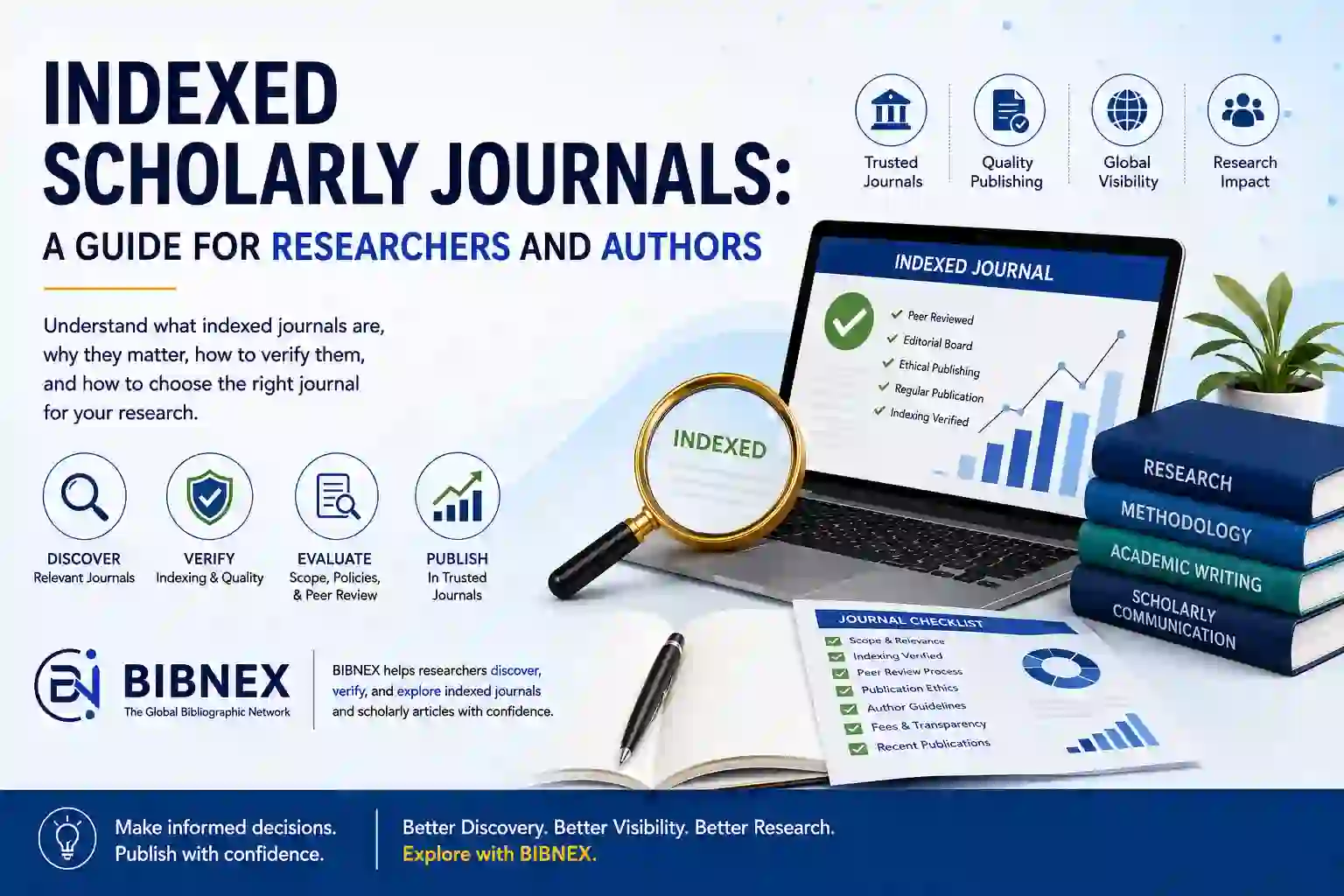
Indexed Scholarly Journals: A Guide for Researchers and Authors
Finding the right journal is one of the most important decisions a researcher or author makes before submitting a manuscript. With thousands of academic journals available across different disciplines, publishers, countries, and research areas, identifying a suitable and trustworthy journal can be difficult.
This is where indexed scholarly journals become important. Journal indexing can make scholarly publications easier to discover, search, organize, and connect with other research records. However, the word "indexed" by itself does not tell you everything you need to know.
A journal can be indexed in one database but not another, and different databases have different purposes, coverage, selection policies, and evaluation systems. Researchers should therefore ask not only "Is this journal indexed?" but also "Where is it indexed, is the coverage current, and is the journal appropriate for my research?"
This guide explains what indexed scholarly journals are, why journal indexing matters, how to verify indexing claims, what current publishing trends mean for researchers, and how to choose a journal more confidently.
What Are Indexed Scholarly Journals?
An indexed scholarly journal is an academic journal whose publications are included in a particular scholarly database, indexing service, directory, or research discovery platform.
Indexing helps organize journal and article information so that researchers can discover scholarly literature more efficiently. Depending on the database, indexed records may include information such as:
- Journal title
- ISSN and eISSN
- Article title
- Author information
- Abstract
- Keywords
- DOI
- Publication date
- Publisher information
- Cited references and citation relationships
However, journal indexing is not a single universal system. Different databases serve different purposes.
For example, some services concentrate on citation analysis, some specialize in particular disciplines, some focus on open-access journals, and others provide broad scholarly discovery and bibliographic information.
Key point: When someone says that a journal is "indexed," always ask which database or indexing service includes it. Indexing in one database does not automatically mean indexing in every other database.
If you are starting your journal search, our guide to searching and exploring indexed journals provides additional practical guidance.
Why Does Journal Indexing Matter?
Journal indexing matters primarily because research needs to be discoverable. A well-written research paper has limited reach if the people who need it cannot find it.
1. Improves Research Discoverability
Indexed records can make scholarly articles easier to find through academic databases and research search systems. Researchers can search by topics, authors, journals, keywords, DOI, subject areas, and other bibliographic information.
2. Supports Literature Reviews
Researchers conducting literature reviews need to identify relevant studies from potentially thousands of publications. Structured indexing makes this process more manageable by organizing research records around consistent metadata.
3. Helps Authors Identify Suitable Journals
Authors can examine where similar research has been published and identify journals that match their subject area, methodology, audience, and publication requirements.
4. Supports Journal Verification
Indexing information can form one part of a broader journal verification process. Authors can compare a journal's claims with information available from relevant databases and other authoritative sources.
5. Makes Scholarly Information Easier to Organize
Large volumes of research require structured metadata. Journal and article indexing helps researchers navigate scholarly information more efficiently.
However, indexing should not be treated as a guarantee of article acceptance, citation performance, research quality, or academic recognition. It is one factor that should be considered alongside the journal's editorial and publishing practices.
Why Are Indexed Scholarly Journals Trending?
Interest in indexed scholarly journals is increasing because the scholarly publishing environment is becoming larger, more digital, and more complex.
Growing Volume of Scholarly Literature
Researchers today have access to an enormous amount of academic literature. Searching through individual journal websites is rarely enough for a comprehensive research workflow.
Large bibliographic databases help researchers search across many journals, publishers, disciplines, and publication types.
More Choices for Authors
Authors have more publishing options than ever, including traditional subscription journals, hybrid journals, fully open-access journals, society journals, institutional publications, and specialist journals.
More choice is useful, but it also makes journal selection more complicated. Researchers must evaluate scope, editorial quality, indexing, fees, access models, peer review, and publisher transparency.
Growth of Open Access
Open access is another major development. Springer Nature reported that 53% of its primary research was published open access in 2025, with more than 288,000 open-access articles published during that year.
Open access and indexing are different concepts. An open-access journal is not automatically indexed in every database, and an indexed journal is not necessarily open access.
AI Is Changing Research Discovery
AI-assisted research tools are changing how researchers discover and explore academic literature. This makes structured and reliable bibliographic metadata increasingly valuable.
Clear article titles, abstracts, author information, DOI data, journal metadata, keywords, and citation relationships can all contribute to better research discovery.
Researchers Want Faster Verification
Researchers increasingly want to verify journal information before spending time preparing and submitting a manuscript. This has increased interest in journal verification tools, journal databases, journal finders, and indexing checkers.
Latest Statistics and Insights on Scholarly Journals
Current data from major scholarly information providers illustrates the scale of the modern research ecosystem.
| Research Publishing Insight | Latest Available Figure | Why It Matters |
|---|---|---|
| Scopus active journal coverage | 29,780 active peer-reviewed journals | Researchers have a very large journal landscape to evaluate. |
| Scopus indexed articles | Approximately 15,000 articles per day | Shows the scale and continuous growth of scholarly discovery. |
| Scopus records | Approximately 105 million records | Demonstrates the scale of modern bibliographic databases. |
| Web of Science JCR 2026 | 22,643 journals across 254 categories | Shows the breadth of journal-level evaluation and research metrics. |
| New Journal Impact Factors in JCR 2026 | 521 journals received a JIF for the first time | Journal evaluation and coverage continue to evolve. |
| Springer Nature open access | 53% of primary research published OA in 2025 | Open-access publishing is becoming an increasingly important consideration for authors. |
These figures are snapshots of particular databases or publishers rather than a count of every scholarly journal in the world. Database coverage changes over time, so researchers should always verify current information before making important publication decisions.
The January 2026 Scopus coverage summary reported 29,780 active peer-reviewed journals, more than 105 million records, and approximately 15,000 articles indexed per day. :contentReference[oaicite:1]{index=1}
Clarivate's 2026 Journal Citation Reports includes metrics for 22,643 journals across 254 categories, while 521 journals received a Journal Impact Factor for the first time. :contentReference[oaicite:2]{index=2}
Springer Nature reported that 53% of its primary research was published open access in 2025, including more than 288,000 open-access articles. :contentReference[oaicite:3]{index=3}
Types of Journal Indexing
Not all indexing services have the same purpose. Understanding the differences helps researchers choose the right sources for their specific needs.
1. Multidisciplinary Citation Databases
Multidisciplinary databases cover research across numerous academic fields. They can provide article metadata, references, citations, author information, journal information, and research metrics.
Scopus and Web of Science are examples of major multidisciplinary research information systems, although their coverage and methodologies differ.
2. Subject-Specific Databases
Some indexes focus on particular disciplines such as medicine, engineering, chemistry, education, agriculture, psychology, or the social sciences.
Subject-specific indexing can be particularly valuable when researchers need literature from a specialized academic community.
3. Open-Access Directories
Open-access directories help researchers discover journals that provide freely accessible scholarly content. However, open access should not be confused with indexing.
4. Scholarly Search Engines
Scholarly search engines provide broad discovery across academic literature. Their coverage and inclusion mechanisms can differ substantially from curated journal indexes.
5. Bibliographic Discovery Platforms
Bibliographic platforms focus on organizing journal and article information so researchers can discover and evaluate scholarly publications.
BIBNEX is positioned in this space, with capabilities for journal discovery, article search, bibliographic information, journal evaluation, and ongoing journal monitoring within the BIBNEX database.
For a broader comparison, see our guide to journal indexing databases .
Indexing vs. Journal Impact: What Is the Difference?
One of the most common misunderstandings in academic publishing is treating indexing and journal impact as the same thing. They are not.
What Is Indexing?
Indexing generally means that a journal or its articles are included in a particular database or discovery service according to that service's policies.
What Are Journal Metrics?
Journal metrics attempt to describe aspects of journal-level citation activity or influence. Different databases use different metrics and methodologies.
Why the Difference Matters
A journal can be indexed without having a particular metric. Likewise, the presence of a journal metric does not eliminate the need to examine the journal's scope, editorial policies, peer-review process, ethics, and relevance to your manuscript.
Authors should therefore avoid choosing a journal based on one number or one database claim alone.
How to Check if a Journal Is Indexed
If a journal claims to be indexed, verify the claim independently whenever possible. The following process can reduce the risk of relying on outdated or inaccurate information.
-
Identify the exact journal.
Record the journal title, ISSN, eISSN, publisher, and official website.
-
Check the indexing claim.
Identify exactly which database or indexing service the journal claims to be included in.
-
Search the indexing service.
Whenever possible, verify the journal directly through the relevant database or official title list.
-
Match the ISSN.
Matching the ISSN is generally more reliable than relying only on a similar journal title.
-
Check current coverage.
Determine whether the journal is currently covered rather than relying on an old claim from several years ago.
-
Review recent issues.
Check whether the journal is publishing regularly and whether recent articles are consistent with its stated scope.
-
Compare information.
Compare information from the journal website, indexing service, publisher, and other reliable sources.
For a detailed practical framework, read our guide to finding and verifying indexed journals .
You can also review our journal verification guide before submitting a manuscript.
How to Evaluate an Indexed Journal
Finding a journal in an indexing database is only the beginning. A suitable publication venue should also pass several additional checks.
Journal Scope
Read the journal's aims and scope carefully. Your manuscript should have a clear connection with the topics the journal publishes.
Peer-Review Process
A credible journal should explain how submitted manuscripts are reviewed. Be cautious about promises of guaranteed acceptance or unrealistically fast publication.
Editorial Board
Check whether editors and editorial board members are clearly identified and whether their academic backgrounds are relevant to the journal.
Publication Ethics
Look for policies covering plagiarism, research ethics, authorship, conflicts of interest, corrections, retractions, and other publication-integrity issues.
Publisher Information
A journal should provide clear information about its publisher, ownership, contact details, editorial structure, and publication policies.
Publication Fees
If the journal charges an article processing charge or another publication fee, check the amount and payment conditions before submitting.
Indexing Information
Verify every important indexing claim separately. Do not assume that inclusion in one database automatically means inclusion in another.
Recent Articles
Reading several recent papers can tell you whether the journal regularly publishes work similar to yours and whether your intended audience is likely to find the article relevant.
Red Flags to Watch For
Researchers should be cautious when evaluating journals that make strong claims without providing enough evidence.
- Guaranteed acceptance.
- Guaranteed publication within an unrealistically short period.
- Unverifiable indexing claims.
- Misleading or unexplained database logos.
- No identifiable editorial board.
- No clear peer-review policy.
- Hidden publication charges.
- Pressure to submit immediately.
- Extremely broad scope with little editorial focus.
- Unclear publisher identity.
- Copied or inconsistent publication policies.
- Claims of guaranteed citations or academic recognition.
An indexing claim should be treated as something to verify, not simply something to trust.
How BIBNEX Helps With Journal Discovery and Verification
BIBNEX is a bibliographic and journal discovery platform designed to help researchers, authors, and publishers explore scholarly journal and article information.
BIBNEX brings together capabilities related to journal discovery, article search, journal verification, bibliographic information, journal evaluation, and continuous monitoring.
For researchers, this can provide another useful layer in the journal-selection workflow: discover a journal, examine its information, verify relevant details, explore articles, and make a more informed decision.
Journal Discovery
Researchers can use BIBNEX to explore journal information and discover publications based on available bibliographic details.
Learn more about searching and exploring indexed journals with BIBNEX .
Article Search
Looking at articles already published by a journal can help authors understand its research focus, article types, subject areas, and audience.
Journal Verification
Journal verification involves checking information such as journal identity, ISSN, publisher, scope, indexing claims, and publication history.
BIBNEX can be part of that discovery and verification workflow, while researchers should still consult the relevant official indexing service when verifying a specific external indexing claim.
Journal Monitoring
Journal information can change over time. Continuous monitoring helps researchers and publishers pay attention to changes in journal status and bibliographic information.
Read more about BIBNEX journal indexing, verification, article search, and monitoring .
Important: BIBNEX indexing is specific to the BIBNEX database. Inclusion in BIBNEX should not be interpreted as inclusion in Scopus, Web of Science, PubMed, or another independent indexing service.
How to Choose the Right Indexed Journal
The best journal for an author is not necessarily the journal with the largest database coverage or the highest metric. The right choice depends on the research, audience, journal scope, publication requirements, and the author's objectives.
Step 1: Define Your Research Topic
Identify your research subject, methodology, population, geographic focus, discipline, and main contribution.
Step 2: Find Relevant Journals
Search academic databases and journal discovery platforms for journals that publish research similar to yours.
Step 3: Check Indexing Requirements
Identify which indexing databases matter for your institution, discipline, funder, employer, or research objectives.
Step 4: Verify the Journal
Check the journal's exact title and ISSN in the relevant indexing service.
Step 5: Read Recent Articles
Review recent papers to determine whether your manuscript fits the journal's content and readership.
Step 6: Review Author Guidelines
Check manuscript requirements, word limits, formatting, referencing style, figures, supplementary files, ethical requirements, and submission procedures.
Step 7: Check Publication Costs
Determine whether the journal charges submission fees, article processing charges, page charges, or other publication costs.
Step 8: Compare Your Shortlist
Ideally, create a shortlist of several suitable journals and compare them before making your final decision.
Our journal finder guide provides additional guidance for researchers trying to identify an appropriate publication venue.
Indexed Scholarly Journal Checklist for Authors
Before submitting your manuscript, use this quick checklist:
- ✓ The journal title has been verified.
- ✓ The ISSN/eISSN has been checked.
- ✓ The journal's scope matches your research.
- ✓ Current indexing claims have been independently checked.
- ✓ The publisher is clearly identified.
- ✓ The editorial board is publicly available.
- ✓ The peer-review process is explained.
- ✓ Publication ethics policies are available.
- ✓ Recent issues are being published consistently.
- ✓ The journal publishes research similar to yours.
- ✓ Publication fees are clearly disclosed.
- ✓ Author guidelines are easy to find.
- ✓ The journal is appropriate for your intended audience.
What Does Journal Indexing Mean for Publishers?
Researchers are not the only people interested in journal indexing. Publishers also need reliable ways to present journal information and make their publications easier to discover.
For publishers, the indexing process can involve preparing journal information, providing publication metadata, demonstrating editorial transparency, and meeting the requirements of the relevant indexing service.
Publishers interested in the process can read our guide to submitting a journal for indexing for an overview of the process and information commonly required.
It is important to remember that applying for indexing does not automatically guarantee acceptance. Each indexing service makes its own decisions according to its policies and evaluation criteria.
Frequently Asked Questions About Indexed Scholarly Journals
What is an indexed scholarly journal?
An indexed scholarly journal is an academic journal whose publications are included in a particular scholarly database, indexing service, directory, or research discovery platform.
Why are indexed journals important for researchers?
Indexed journals can improve the discoverability and organization of scholarly literature. They can also help researchers locate relevant articles and evaluate potential journals for publication.
How can I check if a journal is indexed?
First identify the exact journal title and ISSN. Then determine which database the journal claims to be indexed in and verify the journal directly through that database or its official title list whenever possible.
Does indexing mean a journal is high quality?
Not necessarily. Indexing can be an important signal, but authors should also evaluate peer review, editorial policies, publication ethics, publisher transparency, journal scope, fees, and recent publication history.
Are all indexed journals indexed in Scopus or Web of Science?
No. Different databases have different selection criteria and coverage. A journal can be included in one database without being included in another.
What is the difference between indexing and a journal impact factor?
Indexing generally refers to inclusion in a database or indexing service. A journal impact factor is a specific journal-level citation metric associated with Journal Citation Reports. The two concepts should not be treated as interchangeable.
Is an open-access journal automatically indexed?
No. Open access describes how readers access content, while indexing describes inclusion in a particular database or discovery service. They are separate concepts.
Can BIBNEX help me find indexed scholarly journals?
BIBNEX provides journal discovery, article search, bibliographic information, journal verification-related information, evaluation, and monitoring within the BIBNEX database. Researchers should still verify specific external indexing claims directly with the relevant indexing service.
Should I choose a journal only because it is indexed?
No. Indexing should be one part of your decision. Your final choice should also consider journal scope, readership, peer review, editorial quality, publication ethics, fees, access model, publication speed, and your research objectives.
Conclusion: Choose Indexed Journals Carefully
Indexed scholarly journals play an important role in modern academic communication. As the volume of research continues to grow, researchers need reliable ways to discover, organize, compare, and verify scholarly publications.
Current publishing data shows the scale of this ecosystem. Scopus reported 29,780 active peer-reviewed journals in its January 2026 coverage summary, while Clarivate's 2026 Journal Citation Reports covers 22,643 journals across 254 categories. At the same time, open-access publishing continues to expand, with Springer Nature reporting that 53% of its primary research was open access in 2025.
These numbers highlight an important reality: having more journals available makes informed journal selection more important, not less important.
Before submitting your research, verify the journal's identity, indexing claims, scope, editorial policies, peer-review process, publication ethics, fees, and recent publication record.
BIBNEX can support this workflow by helping researchers discover journals, explore article information, review bibliographic records, and monitor journal information within its database.
Ready to Explore Indexed Scholarly Journals?
Start your journal discovery process with BIBNEX and explore scholarly journal and article information in one place.
Explore Indexed Journals and Scholarly Research with BIBNEX
Whether you are an author searching for a publication venue, a researcher exploring academic literature, or a publisher looking to improve journal discoverability, use reliable information and verify important claims before making your final decision.