
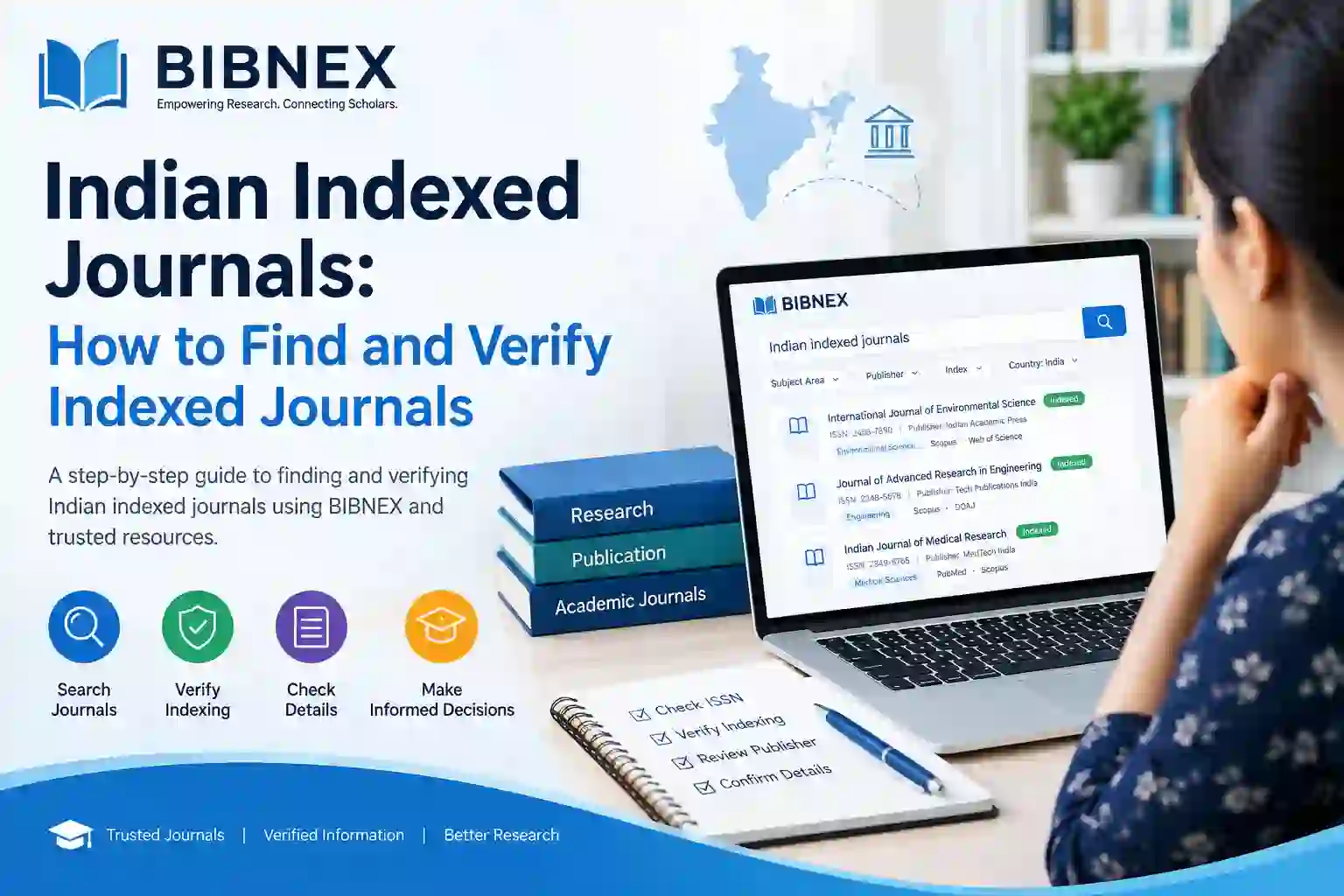
Finding a suitable journal for publishing research is an important decision for Indian researchers, PhD scholars, faculty members, and students. A journal may appear in search results or advertise itself as "indexed," but that claim should be verified before an author submits a manuscript or pays a publication fee.
This is especially important because journal indexing can mean different things depending on the database. A journal may be included in one scholarly database but not another, and inclusion in a metadata or discovery service is not automatically equivalent to inclusion in a selective citation index.
This guide explains how to find Indian indexed journals, how to verify indexing claims, what researchers should check before submission, and how BIBNEX Journal Indexing Database can support journal discovery and verification.
What Are Indian Indexed Journals?
The term "Indian indexed journals" generally refers to scholarly journals published by Indian publishers, institutions, universities, professional organizations, or other organizations based in India that are included in one or more academic databases or indexing services.
However, the phrase should not be interpreted as meaning that there is one single database called an "Indian Journal Index." Journal indexing is distributed across many services, and each service has its own scope, selection criteria, metadata requirements, and coverage.
For example, researchers may encounter Indian journals in databases or discovery services such as Scopus, Web of Science, DOAJ, Crossref, and other subject-specific or bibliographic resources. BIBNEX adds another discovery layer by helping users search and explore journal information in a structured bibliographic environment.
Why Journal Indexing Matters
Indexing can make scholarly content easier to discover. Researchers often use databases to find journals, articles, authors, citations, and publication information.
However, indexing should not be treated as a simple "good" or "bad" label. The value of an index depends on what the database covers and why the researcher needs it.
For example, an author looking for an open-access journal may check DOAJ. A researcher investigating citation coverage may need to check Web of Science or Scopus. Someone verifying bibliographic or DOI metadata may consult services such as Crossref and the ISSN Portal.
Therefore, the better question is not simply:
"Is this journal indexed?"
Instead, ask:
"Indexed where, under which title or ISSN, and is that indexing status currently verifiable?"
Important Update for Indian Researchers: UGC-CARE
Researchers in India should be particularly careful with older articles and websites that present the UGC-CARE list as a currently maintained journal approval list.
The University Grants Commission discontinued UGC-CARE journal listing. In its July 16, 2025 public notice, UGC stated that the final list of 1,474 UGC-CARE journals as of February 10, 2025 was uploaded for reference purposes and that inclusion or exclusion from that list does not imply validation or endorsement by the Commission.
UGC also approved suggestive parameters for choosing peer-reviewed journals. This means researchers should not assume that a website advertising a journal as "UGC CARE approved" is describing a current active UGC listing.
For current decisions, researchers should check the journal's actual indexing, peer-review process, editorial information, publication practices, identifiers, and any requirements imposed by their university or institution.
Read the UGC public notice on CARE journals for the primary policy information.
How to Find Indian Indexed Journals
Finding journals should begin with your research topic rather than with a database name. A good search process combines subject relevance, journal identity, indexing verification, editorial transparency, and publication policies.
Step 1: Define Your Research Subject
Start by identifying the main subject of your manuscript.
For example, a paper about machine learning in healthcare could potentially fit into areas such as computer science, artificial intelligence, medical informatics, healthcare technology, or interdisciplinary research.
Creating a short list of subject keywords will make journal discovery easier.
Step 2: Search by Journal Title or ISSN
Once you find a potential journal, record its exact title and ISSN.
The ISSN is particularly useful because journal titles can be similar. An exact ISSN provides a stronger identifier for checking whether the record you found belongs to the journal you are researching.
The ISSN Portal provides a way to search ISSN records and bibliographic information.
Step 3: Search the Journal in BIBNEX
BIBNEX is designed as a bibliographic discovery network for journals, articles, DOI metadata, citations, and scholarly research. Researchers can use the BIBNEX journal database to discover and explore journal information instead of relying only on general web search results.
When searching, try the journal's:
- Full journal title
- ISSN or eISSN
- Publisher name
- Subject area
- Country or publication region
For a broader explanation of journal discovery through BIBNEX, see BIBNEX Journals: Search and Explore Indexed Journals.
Step 4: Verify the Claimed Index
This is one of the most important steps.
If a journal website says it is indexed in Scopus, do not rely only on the journal's own logo or claim. Search for the journal in the official Scopus source information.
Elsevier states that the Scopus source title list can be used to check whether a title is indexed and that the source information is updated regularly. Scopus also has an ongoing re-evaluation process for indexed titles.
Check the official Scopus content policy and selection information when verifying a Scopus claim.
Similarly, for Web of Science claims, use Clarivate's Master Journal List rather than relying solely on information displayed on a journal website.
Search the Web of Science Master Journal List to verify journal coverage.
How to Verify an Indexed Journal
A reliable journal verification process should use more than one signal. The following checklist can help.
1. Verify the Exact Journal Title
Check that the journal title in the database matches the journal you are considering. Be careful with journals that have similar names.
2. Verify the ISSN
Compare the print ISSN and electronic ISSN where applicable. A mismatch can indicate that you are looking at a different publication.
3. Verify the Publisher
Check whether the publisher shown in the indexing database matches the publisher identified on the journal's official website.
4. Check Coverage Dates
A journal may have been indexed in a database in the past but later discontinued. Therefore, "indexed previously" and "currently indexed" are not necessarily the same thing.
This is particularly important when reviewing old lists shared as PDFs, social media posts, university documents, or third-party websites.
5. Check the Journal's Official Website
Look for transparent information about:
- Aims and scope
- Editorial board
- Peer-review process
- Publication ethics
- Author guidelines
- Copyright and licensing
- Article processing charges
- Publication frequency
- ISSN information
- Published issues and articles
These checks help you understand the publication rather than relying on an indexing badge alone.
How BIBNEX Can Help With Journal Verification
BIBNEX focuses on journal discovery, indexing information, verification, article discovery, and journal monitoring. This can be useful when a researcher wants to organize the information needed to evaluate a journal before submission.
For example, suppose you find an Indian journal through a Google search. Instead of immediately submitting your manuscript, you can first record the journal title and ISSN, search the journal in BIBNEX, review the available journal information, and then independently confirm any important indexing claims with the relevant indexing provider.
This creates a more reliable workflow:
- Discover the journal.
- Identify the exact journal and ISSN.
- Review its BIBNEX record and available information.
- Check the journal's official website.
- Verify important indexing claims at the relevant database.
- Review peer-review and publication policies.
- Check your university or institutional requirements.
- Make your publication decision based on the evidence.
Learn more about this workflow in BIBNEX Journal Indexing, Verification, Article Search and Monitoring.
Do Not Confuse DOI Registration With Journal Indexing
Another common source of confusion is the relationship between DOI registration and indexing.
A journal may register article DOIs through Crossref, but that does not automatically mean the journal is indexed in every major academic database.
Crossref explains that its services register and distribute scholarly metadata, including information about journals and articles. Its metadata can be used by discovery systems and other scholarly infrastructure.
Learn more about Crossref journal and article metadata.
Therefore, if a journal says "Crossref indexed," researchers should understand what that statement actually means. DOI registration and bibliographic metadata availability are valuable, but they should not automatically be presented as equivalent to selective citation-index coverage.
How to Check Whether a Journal Is in DOAJ
For open-access journals, DOAJ can be another useful source to check.
DOAJ has defined criteria for journals applying for inclusion. Its criteria cover areas such as scholarly publishing activity, journal websites, editorial information, peer review, licensing, copyright, author charges, and ISSN information.
Review the official DOAJ application criteria when evaluating an open-access journal's DOAJ claim.
Again, DOAJ inclusion should be treated as one specific indexing or discovery signal, not as a universal certification covering every aspect of journal quality.
Indian Indexed Journals: What Researchers Should Check Before Publishing
Before submitting a paper, create a short verification checklist.
| Check | What to Verify | Why It Matters |
|---|---|---|
| Journal Title | Exact title | Avoid confusing similarly named journals |
| ISSN | Print/electronic ISSN where applicable | Helps identify the correct serial |
| Publisher | Publisher identity | Confirms the publication record |
| Indexing | Official database source | Reduces reliance on unsupported claims |
| Coverage | Current and historical coverage | Shows whether indexing is current |
| Peer Review | Published review process | Helps evaluate editorial practices |
| Fees | APCs and other charges | Prevents unexpected costs |
| Publication Ethics | Ethics and malpractice policies | Provides insight into publishing standards |
Common Mistakes When Searching for Indexed Journals in India
Relying on a Journal's Logo
A database logo on a journal website is not enough evidence by itself. Always verify important claims at the database responsible for the index.
Using Old UGC-CARE Lists as Current Evidence
Because UGC-CARE listing has been discontinued, an old list should not automatically be interpreted as evidence of a current UGC approval or listing.
Confusing DOI With Indexing
A DOI can improve article identification and persistent linking, but DOI registration is not the same thing as inclusion in a selective citation database.
Checking Only the Journal Name
Two journals can have similar names. Always compare the ISSN and publisher as well.
Ignoring Discontinued Coverage
Some databases maintain records of journals that were previously covered but are no longer actively indexed. Always look at the current status and coverage period where available.
How Publishers Can Improve Journal Discoverability
Verification is not only useful for authors. Publishers can also benefit from maintaining accurate journal metadata and transparent publication information.
Crossref recommends consistency in journal title and ISSN metadata and emphasizes accurate article metadata for discoverability. DOAJ likewise requires journals to make important information accessible on their websites as part of its application criteria.
Publishers should therefore keep their journal title, ISSN, publisher information, editorial details, article metadata, policies, and website information consistent and current.
For publishers looking to improve their journal's presence in bibliographic discovery systems, see Journal Indexing for Publishers: Complete Guide to Getting Your Journal Listed.
How to Use BIBNEX as Part of Your Journal Research Workflow
BIBNEX can be used as a starting point for discovering and organizing journal information. A practical workflow could look like this:
- Search: Find journals by title, subject, or other available information.
- Explore: Review the journal's available bibliographic information.
- Verify: Compare important claims against authoritative databases.
- Evaluate: Review scope, editorial policies, peer review, fees, and publication practices.
- Monitor: Recheck important journal information when you are preparing future submissions.
This approach is more useful than treating any single database as the only answer. BIBNEX can support discovery and verification, while official indexing providers remain the appropriate sources for confirming their own coverage.
Researchers can also explore the BIBNEX Journal Database guide for a broader explanation of journal discovery and verification.
Frequently Asked Questions
What are Indian indexed journals?
Indian indexed journals are journals published by Indian publishers, institutions, universities, associations, or other organizations that are included in one or more scholarly databases or indexing services. The exact meaning of "indexed" depends on the database involved.
How can I verify an Indian journal's indexing status?
Start with the journal title and ISSN, then check the claimed index's official source or title list. You can also use BIBNEX for journal discovery and verification workflows, while using the relevant indexing provider as the authoritative source for its own coverage.
Is UGC-CARE still an active journal indexing list?
No. UGC discontinued UGC-CARE journal listing. The final list of 1,474 journals as of February 10, 2025 was published for reference purposes, and UGC stated that inclusion or exclusion does not imply validation or endorsement.
Does having a DOI mean that a journal is indexed?
No. DOI registration and journal indexing are different concepts. A DOI helps identify and link scholarly content, while indexing refers to inclusion in a particular database or index.
How can BIBNEX help researchers find indexed journals?
BIBNEX provides a journal and scholarly discovery environment where researchers can search and explore journal information. It can be used as part of a broader workflow that includes checking the official website, ISSN information, indexing-provider records, and institutional requirements.
Should I trust a journal's claim that it is indexed in Scopus?
Do not rely solely on the journal's own claim. Check the journal title and ISSN in the official Scopus source information and review the current coverage status.
How do I find the right journal for my research?
Start with your research subject and scope, then compare potential journals by relevance, indexing, peer-review practices, publication ethics, fees, editorial information, and institutional requirements. A journal finder and discovery workflow can make this process easier.
For additional guidance, read Journal Finder Tool: Find the Right Journal for Your Research.
Final Checklist for Verifying an Indian Indexed Journal
- Confirm the exact journal title.
- Check the ISSN or eISSN.
- Confirm the publisher.
- Search the journal in BIBNEX.
- Verify each claimed index independently.
- Check current rather than outdated coverage information.
- Review the journal's peer-review process.
- Check publication ethics and malpractice policies.
- Review author fees and publication charges.
- Check your university or institution's current requirements.
- Do not treat old UGC-CARE references as evidence of a current active UGC listing.
Conclusion
Finding Indian indexed journals requires more than searching for a journal that displays an "indexed" badge. Researchers should identify the exact publication, verify its ISSN and publisher, check the claimed database directly, review current coverage, and examine the journal's editorial and publishing practices.
The discontinuation of UGC-CARE listing makes this verification process even more important for researchers in India. Rather than depending on a single historical list, authors should use current and independently verifiable information when selecting a journal.
BIBNEX Journal Indexing Database can be part of that workflow by helping researchers discover, search, explore, and verify journal information. Use BIBNEX as a practical discovery and verification resource, and confirm important indexing claims with the relevant authoritative database before making a publication decision.
Explore indexed journals and journal discovery resources on BIBNEX to begin your search.
Related BIBNEX Guides
- BIBNEX Journals: Search and Explore Indexed Journals
- Journal Finder Tool: Find the Right Journal for Your Research
- BIBNEX Journal Indexing, Verification, Article Search and Monitoring
- BIBNEX Journal Verification: Check Before Publishing
- How BIBNEX Evaluates Journals for Indexing: Complete Guide
- Journal Indexing for Publishers: Complete Guide to Getting Your Journal Listed
- Submit Your Journal to BIBNEX: Complete Publisher Guide
- Top Journal Indexing Databases for Journals in 2026