
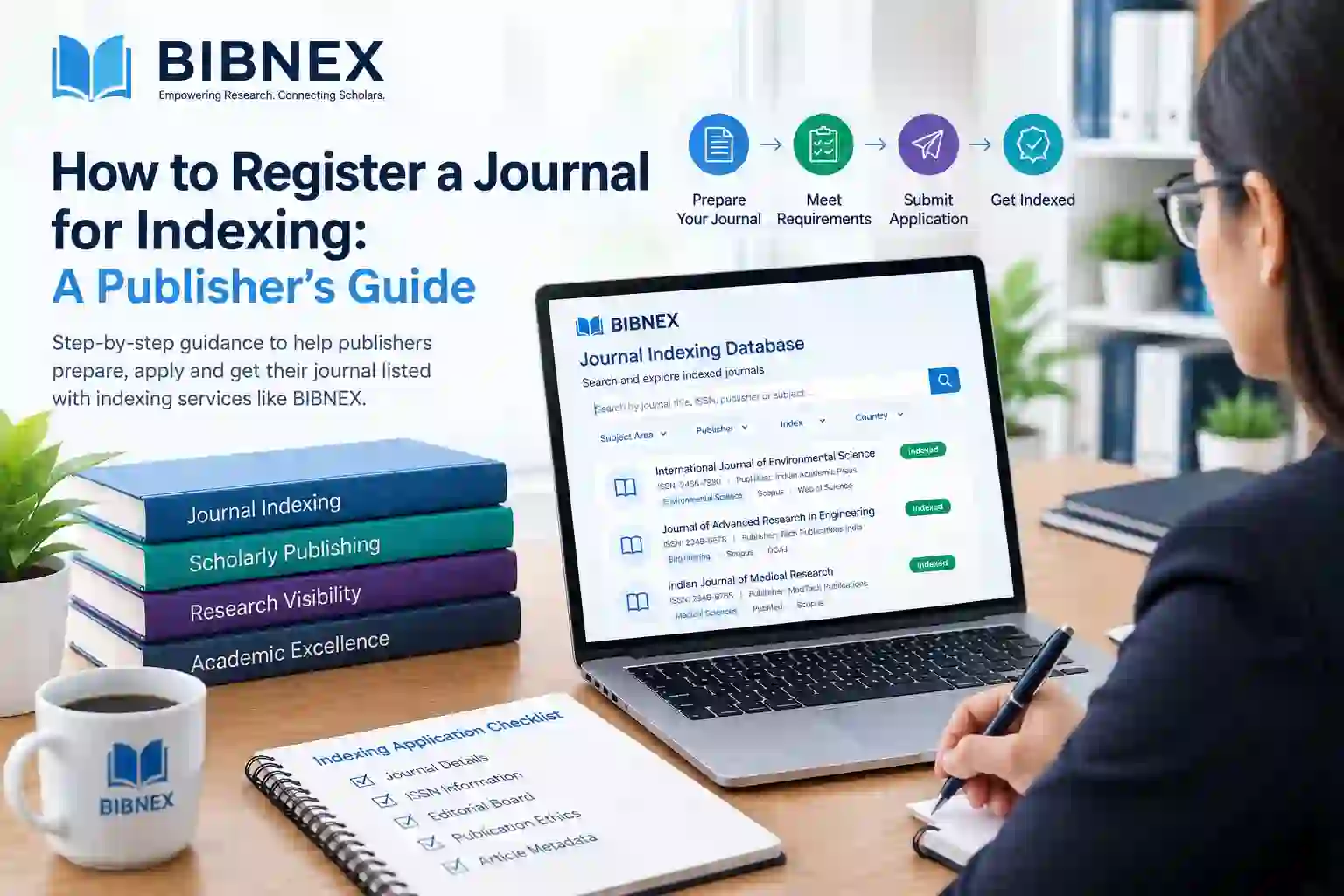
How to Register a Journal for Indexing: A Publisher's Guide
Launching an academic journal is only the beginning of scholarly publishing. Once a journal is established, publishers often want researchers to discover its articles more easily through academic databases, bibliographic services, and journal discovery platforms. This is where journal indexing becomes an important part of a publisher's long-term strategy.
However, registering a journal for indexing is not simply a matter of filling out a form and receiving an automatic approval. Every indexing or bibliographic service has its own purpose, requirements, evaluation approach, and coverage. Publishers therefore need to understand what they are applying for, prepare accurate journal information, and verify that the publication is ready for evaluation.
This publisher's guide explains how to prepare a journal, how the indexing application process generally works, what information publishers should organize, common mistakes to avoid, and how BIBNEX journal indexing can fit into a broader journal discoverability strategy.
What Does It Mean to Register a Journal for Indexing?
When publishers talk about registering a journal for indexing, they generally mean submitting a journal to an indexing, bibliographic, or scholarly discovery service for consideration.
The terminology can sometimes create confusion. Journal registration, ISSN registration, DOI registration, and journal indexing are different processes.
- An ISSN identifies a continuing publication.
- A DOI provides a persistent identifier for digital scholarly objects such as articles.
- Journal indexing involves inclusion in a particular database or indexing/discovery service.
- Bibliographic discovery helps users locate information about journals, articles, authors, and related scholarly records.
Having an ISSN or DOI infrastructure does not automatically mean that a journal is included in every academic index. Publishers should keep these concepts separate when preparing applications and communicating with authors.
Why Should Publishers Consider Journal Indexing?
One major reason publishers pursue indexing is discoverability. Researchers commonly use specialized databases and scholarly search systems to locate literature relevant to their work.
When journal and article information is accurately represented in appropriate discovery systems, researchers have additional opportunities to find that content.
Indexing can therefore form one part of a journal's broader visibility strategy. It should not, however, be presented as a guarantee of article citations, submissions, acceptance rates, or journal quality.
A sustainable publishing strategy combines discoverability with strong editorial practices, relevant content, reliable metadata, transparent policies, ethical publishing, and consistent publication activity.
Before You Apply: Is Your Journal Ready?
One of the most common mistakes publishers make is applying before the journal's basic information is properly organized.
Before starting a BIBNEX indexing application or an application to another service, review your journal as if you were an external evaluator.
Check the Journal Identity
Make sure the journal has a clearly stated title and that the same title is used consistently across:
- The journal website
- Article pages
- PDF files
- Issue pages
- Metadata records
- Publisher information
- Journal identifiers
Inconsistent information can make a journal difficult to identify and may create unnecessary questions during verification.
Review Your ISSN Information
Keep your ISSN information accurate and clearly displayed. If the journal has separate print and electronic editions, make sure the relevant identifiers are presented correctly.
Do not use an ISSN as evidence that a journal is indexed. The identifier and indexing status serve different purposes.
Review Your Publisher Information
The publisher should be clearly identifiable. Provide appropriate contact information and make it easy for readers and evaluators to understand who is responsible for the publication.
Check Your Journal Website
A publisher should not expect an indexing service to discover essential information hidden across multiple pages.
Important journal information should be easy to locate, including:
- Aims and scope
- Editorial board
- Author guidelines
- Peer-review policy
- Publication ethics
- Copyright information
- Licensing information
- Publication frequency
- Article processing charges, where applicable
- Publisher and contact information
- Published issues and articles
Step-by-Step: How to Register a Journal for Indexing
Although the exact procedure varies between indexing services, publishers can use the following general workflow.
Step 1: Define the Purpose of the Application
Start by identifying why you want the journal to be indexed.
Are you trying to improve bibliographic discoverability? Are you looking for subject-specific visibility? Are you preparing the journal for inclusion in a particular database? Or do you want to make journal and article information easier for researchers to find?
Answering this question first helps you identify the services that are relevant to your publication.
Step 2: Research the Indexing Service
Do not assume that all indexing databases operate in the same way.
Review:
- The service's scope
- Subject coverage
- Geographic coverage
- Journal eligibility requirements
- Application process
- Evaluation procedure
- Metadata requirements
- Publisher responsibilities
This is particularly important when a publisher is searching for an indexing service for publishers. The service should be relevant to the journal's actual publishing model and objectives.
Step 3: Prepare Your Journal Information
Before opening an application form, create a single internal checklist containing all important journal information.
At minimum, organize:
- Journal title
- ISSN/eISSN, where applicable
- Publisher name
- Publisher address and contact details
- Journal website
- Aims and scope
- Subject classification
- Editorial board
- Peer-review method
- Publication frequency
- Publication ethics information
- Copyright and licensing information
- Article processing charges
- Recent issues
- Article metadata
Step 4: Review Your Published Content
Look at several recently published articles rather than only reviewing the journal homepage.
Check whether article pages consistently display information such as:
- Article title
- Author names
- Author affiliations
- Abstract
- Keywords
- Publication date
- Volume and issue
- Page information where applicable
- DOI where applicable
- References
Consistent article metadata contributes to better scholarly discoverability and makes your publishing infrastructure easier to maintain.
Step 5: Complete the Application
When you reach the journal indexing application stage, answer each question accurately.
Do not copy generic descriptions from another journal. The information should describe your actual publication.
If an application asks about peer review, publication frequency, editorial structure, or fees, provide information that matches what readers can find on the journal's website.
Step 6: Review Before Submission
Before you click submit, compare the application against your journal website.
Look for:
- Spelling differences in the journal title
- Incorrect ISSN information
- Outdated publisher details
- Different publication frequency descriptions
- Missing editorial information
- Broken website links
- Incomplete policy information
A final quality-control review can prevent avoidable errors.
Step 7: Submit and Monitor
After submission, retain a copy of the application and any supporting information.
If the service requests clarification or additional information, respond using accurate documentation rather than making unsupported claims.
Publishers should also understand that submitting an application and being accepted are two different stages. An application is a request for evaluation, not a guarantee of inclusion.
How BIBNEX Journal Submission Fits Into the Process
For publishers interested in adding their publication to the BIBNEX ecosystem, the BIBNEX journal submission process should be approached as a structured journal-information submission.
The goal is not simply to enter a journal name. Accurate information helps create a useful record for journal discovery and verification.
Publishers should therefore make sure that the information they provide is current, consistent, and representative of the actual journal.
For a practical publisher walkthrough, see Submit Your Journal to BIBNEX: Complete Publisher Guide.
You can also review How to Submit a Journal for Indexing: Publisher Guide for additional preparation guidance.
Understanding BIBNEX Journal Evaluation
Publishers should distinguish between submitting journal information and completing an evaluation process.
A journal record needs to represent the publication accurately. The publisher should therefore provide complete information and ensure that the journal website and publication records support the information submitted.
When preparing for BIBNEX journal evaluation, publishers can review their publication infrastructure from a reader's perspective:
- Can someone clearly identify the journal?
- Can they find the publisher's identity?
- Is the journal's scope easy to understand?
- Are editorial responsibilities clearly presented?
- Can readers find published issues and articles?
- Is publication information current?
- Is article metadata consistently presented?
- Are publishing policies accessible?
For more detail about BIBNEX's journal evaluation approach, read How BIBNEX Evaluates Journals for Indexing: Complete Guide.
What Is the BIBNEX Journal Database?
The BIBNEX journal database is part of BIBNEX's broader bibliographic discovery approach, helping users search and explore scholarly journal information.
For publishers, the practical objective is to maintain accurate journal information. For researchers, structured journal records can make journal discovery easier.
This creates two sides of the same publishing ecosystem:
- Publishers provide accurate journal and publication information.
- Researchers use discovery systems to find and investigate journals.
- Bibliographic services organize publication information to support discovery.
Researchers can explore the BIBNEX Journals: Search and Explore Indexed Journals guide to understand the discovery side of this process.
Common Mistakes Publishers Should Avoid
1. Applying Too Early
A new journal may still have incomplete policies, limited published content, or inconsistent information. Before applying, review the publication as a complete scholarly product.
2. Treating Every Index as the Same
Different services have different purposes. A bibliographic discovery service should not automatically be described as equivalent to a selective citation index.
3. Using Unsupported Indexing Claims
Publishers should only claim indexing that can be supported by reliable evidence. Avoid displaying database logos or statements without confirming the journal's actual status.
4. Ignoring Metadata
A visually attractive journal website does not compensate for incomplete or inconsistent article metadata.
5. Providing Different Information in Different Places
If the journal website says that the journal publishes quarterly but the application says it publishes monthly, the inconsistency creates unnecessary uncertainty.
6. Expecting Guaranteed Acceptance
No responsible indexing process should be treated as an automatic approval mechanism. Publishers should expect evaluation according to the applicable service's requirements.
How to Improve a Journal Before Applying
If your journal is not ready for an indexing application, use the preparation period productively.
Improve Metadata Quality
Make article information complete and consistent across the journal website and publishing system.
Improve Editorial Transparency
Clearly explain who manages the journal and how manuscripts are reviewed.
Improve Website Navigation
Readers should be able to move easily between the journal homepage, current issue, archives, article pages, author guidelines, and editorial information.
Maintain Publication Consistency
Keep issue and article information organized and ensure that the publication schedule presented to readers reflects the journal's actual practices.
Document Your Policies
Keep publication ethics, peer review, copyright, licensing, corrections, and related policies accessible and understandable.
Indexing Application Checklist for Publishers
Use this checklist before you submit journal to BIBNEX or apply to another relevant indexing service.
| Area | Publisher Checklist |
|---|---|
| Journal Identity | Title and identifiers are accurate and consistent |
| Publisher | Publisher identity and contact information are clear |
| Scope | Aims and subject coverage are clearly explained |
| Editorial Board | Editorial roles and affiliations are presented clearly |
| Peer Review | The review process is documented |
| Ethics | Publication ethics policies are accessible |
| Fees | Applicable charges are clearly disclosed |
| Articles | Published content is accessible and organized |
| Metadata | Article metadata is complete and consistent |
| Website | Important journal information is easy to find |
| Application | Submitted information matches the journal website |
How Indexing Supports Long-Term Journal Discoverability
Indexing should be viewed as part of a long-term publishing strategy rather than a one-time SEO activity.
A journal can continue improving its discoverability by maintaining accurate metadata, publishing relevant research, keeping its website accessible, improving article pages, and ensuring that information supplied to bibliographic services remains current.
This is also why BIBNEX indexing should be considered within the larger context of journal discovery. A publisher's responsibility does not end when an application is submitted. Journal information needs to remain useful and accurate over time.
For a broader discussion of publisher visibility, read Journal Indexing for Publishers: How BIBNEX Can Help Improve Journal Visibility.
What Researchers Should Look for After a Journal Is Indexed
Publishers are not the only stakeholders. Authors also need to understand what indexing means when evaluating a journal.
A researcher should still check:
- The journal's scope
- ISSN
- Publisher
- Editorial board
- Peer-review process
- Publication ethics
- Fees
- Recent articles
- Indexing claims
- Institutional publication requirements
Being listed in a database does not remove the need for normal journal due diligence.
Researchers can also use BIBNEX Journal Verification: Check Before Publishing when reviewing a journal before submission.
BIBNEX and the Global Bibliographic Network
BIBNEX is positioned around bibliographic discovery, connecting journal and scholarly publication information in a searchable environment.
The BIBNEX Bibliographic Network concept is particularly relevant to publishers because discoverability depends not only on publishing articles but also on making reliable publication information available to systems and researchers.
Whether a publisher operates a university journal, society journal, independent academic publication, or multidisciplinary journal, maintaining structured and accurate journal information can support a stronger scholarly discovery workflow.
Publishers interested in the broader BIBNEX process can also review Journal Indexing Application Requirements, Process and Checklist.
Frequently Asked Questions
How do I register a journal for indexing?
First identify an indexing or bibliographic service that is relevant to your journal. Review its requirements, prepare accurate journal and publisher information, organize your metadata and policies, complete the applicable application, and submit it for evaluation.
Is registering a journal the same as getting it indexed?
No. Registration or submission is the beginning of an application process. Indexing generally requires the journal to meet the relevant service's requirements and complete its evaluation process.
Can I submit my journal to BIBNEX?
Publishers can use the applicable BIBNEX journal submission process to provide journal information for consideration. Before submitting, publishers should ensure that their journal details, website information, metadata, and publication policies are accurate and current.
What information should I prepare before applying for indexing?
Prepare the journal title, ISSN or eISSN where applicable, publisher information, website, aims and scope, editorial board, peer-review policy, publication ethics, publication frequency, fees, recent issues, article information, and other details requested by the specific service.
Does having an ISSN mean that my journal is indexed?
No. An ISSN identifies a serial publication. It does not automatically establish inclusion in an indexing database.
Does DOI registration automatically index my journal?
No. DOI registration and journal indexing are separate processes. DOI metadata can support article identification and scholarly discovery, but it does not automatically place a journal in every indexing service.
How long does journal indexing take?
There is no universal timeframe. Processing depends on the specific service, its evaluation process, application completeness, and other factors.
What happens if my journal indexing application is rejected?
Review the reasons or feedback provided by the relevant service. Correct genuine gaps in the journal's information, publishing practices, metadata, or eligibility before considering another application.
Can indexing guarantee more citations?
No. Indexing can contribute to discoverability, but citation activity depends on many factors, including research relevance, article quality, subject interest, readership, and how researchers use and cite the published work.
Conclusion: Prepare Before You Apply
To register a journal for indexing successfully, publishers should think beyond the application form. A strong application begins with a well-organized journal, accurate metadata, transparent editorial information, accessible policies, and a clearly maintained publishing website.
The process is also easier to manage when publishers understand the difference between ISSN registration, DOI registration, bibliographic discovery, and indexing. Each serves a different purpose within scholarly communication.
For publishers, BIBNEX journal indexing can be approached as part of a broader discoverability strategy. Preparing accurate journal information before submission can help create a clearer record for researchers who are searching for journals and scholarly publications.
If your journal is ready for evaluation, review your information carefully, confirm that your website and metadata are consistent, and then follow the relevant submission process.
Explore the BIBNEX Journal Database and learn more about BIBNEX indexing as part of your journal's scholarly discoverability strategy.
Related BIBNEX Resources
- Submit Your Journal to BIBNEX: Complete Publisher Guide
- How to Submit a Journal for Indexing: Publisher Guide
- Journal Indexing for Publishers: Complete Guide to Getting Your Journal Listed
- Journal Indexing Application Requirements, Process and Checklist
- Step-by-Step Guide to Applying for Journal Indexing
- Submit Journal for Indexing: Complete Guide for Publishers
- How BIBNEX Evaluates Journals for Indexing: Complete Guide
- BIBNEX Journal Indexing, Verification, Article Search and Monitoring
- BIBNEX Journal Database: How to Find and Verify Indexed Journals
- Indexed Journals: Complete Guide to Finding and Verifying Indexed Journals