
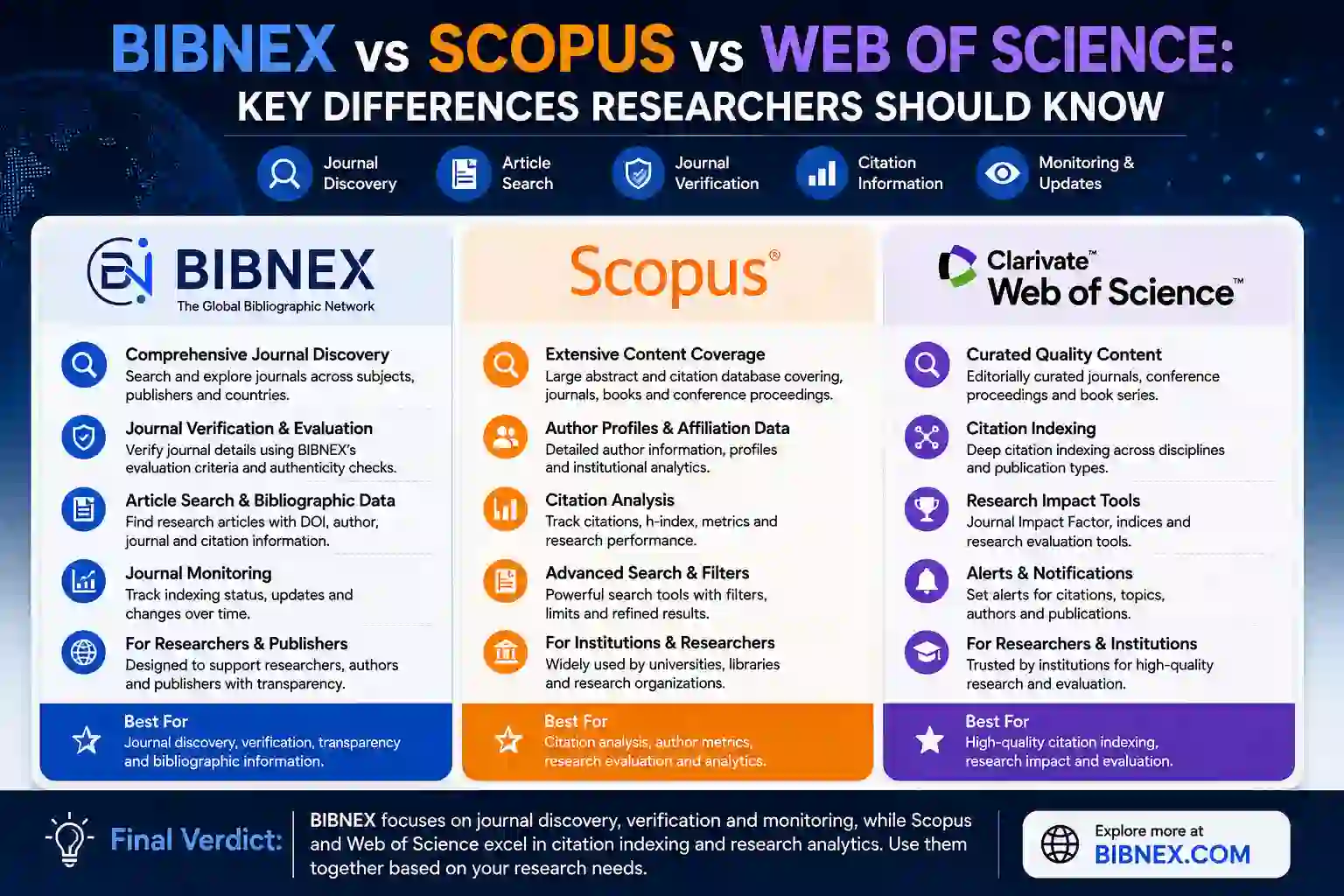
BIBNEX vs Scopus vs Web of Science: Key Differences Researchers Should Know
Researchers, students, authors, librarians and journal publishers often come across three different names when searching for scholarly information: BIBNEX, Scopus and Web of Science. Although all three can support academic discovery, they are not identical platforms and should not be treated as interchangeable.
Each platform has a different purpose, coverage model, evaluation approach and set of features. Understanding those differences can help researchers decide where to search, how to verify journal information and which database is appropriate for a particular research task.
In this guide, we compare BIBNEX vs Scopus vs Web of Science across journal discovery, article search, indexing, journal evaluation, citation information, monitoring, accessibility, pricing and common use cases.
We will also explain where a platform such as BIBNEX journal database can fit into a research workflow alongside established citation databases such as Scopus and Web of Science.
Quick Answer: BIBNEX vs Scopus vs Web of Science
The simplest way to understand the three platforms is to look at their primary strengths.
- BIBNEX: Focuses on journal discovery, bibliographic information, article discovery, journal evaluation, indexing within the BIBNEX network and ongoing journal monitoring.
- Scopus: A large abstract and citation database with curated scholarly content, author profiles, citation information and research metrics.
- Web of Science: A curated citation database platform with the Web of Science Core Collection covering journals, conference proceedings and scholarly books, together with citation and research-impact tools.
The best choice depends on what you are trying to accomplish. A researcher checking citation information may prioritize Scopus or Web of Science. Someone looking for structured journal information, journal discovery and BIBNEX-specific journal records may find BIBNEX useful as part of that workflow.
What Is BIBNEX?
BIBNEX is a bibliographic and scholarly discovery platform designed to organize information about academic journals, research articles, DOI metadata, citation-related information and journal-monitoring indicators.
Its platform combines several functions, including:
- Journal discovery
- Article discovery
- Journal indexing within the BIBNEX network
- Journal evaluation
- Bibliographic metadata
- DOI and article metadata workflows
- Journal monitoring
- Citation-related information
BIBNEX also describes a staged workflow for submitted journals: registration, application, evaluation, indexing decision, metadata import, bibliographic indexing and continuous monitoring.
Importantly, BIBNEX inclusion is specific to the BIBNEX bibliographic network. It should not be interpreted as indexing or endorsement by Scopus, Web of Science or another external indexing or accreditation organization. This distinction is important when researchers evaluate journal claims.
For researchers who want to explore journals and articles using structured bibliographic information, the BIBNEX journal discovery platform can be one component of a broader research workflow.
What Is Scopus?
Scopus is Elsevier's abstract and citation database. It provides access to curated scholarly content and supports literature discovery, author information, citation analysis and research metrics.
Elsevier states that Scopus content is reviewed and selected through its independent Content Selection and Advisory Board (CSAB). Its coverage includes journals, books and conference materials, among other content types. :contentReference[oaicite:2]{index=2}
Scopus can be particularly useful when researchers need to:
- Search a large scholarly database
- Track citations
- Review author profiles
- Explore research output
- Analyze citation-related metrics
- Discover literature across multiple disciplines
Scopus also provides journal-level metrics such as CiteScore, which can support research evaluation and journal analysis. :contentReference[oaicite:3]{index=3}
What Is Web of Science?
Web of Science is a research discovery and citation database platform operated by Clarivate. Its Web of Science Core Collection includes journals, conference proceedings and scholarly books.
Clarivate describes the Web of Science Core Collection as a curated resource based on an editorial selection process. For journals, it uses 28 evaluation criteria consisting of 24 quality criteria and four impact criteria. :contentReference[oaicite:4]{index=4}
Web of Science is especially useful for:
- Literature discovery
- Citation tracking
- Research-impact analysis
- Journal discovery
- Institutional research analysis
- Tracking relationships between scholarly publications
Clarivate also provides the Master Journal List as a resource for checking Web of Science coverage. :contentReference[oaicite:5]{index=5}
BIBNEX vs Scopus vs Web of Science: Comparison Table
| Feature | BIBNEX | Scopus | Web of Science |
|---|---|---|---|
| Primary purpose | Bibliographic discovery, journal information, article discovery and journal monitoring | Abstract and citation database with research discovery and analytics | Research discovery, citation indexing and research-impact analysis |
| Journal discovery | Yes | Yes | Yes |
| Article discovery | Yes | Yes | Yes |
| Journal evaluation | Yes, according to BIBNEX criteria | Yes, through its content selection process | Yes, through editorial selection criteria |
| Citation information | Available citation-related information for applicable records | Extensive citation data and analytics | Extensive citation data and analytics |
| Author information | Available through applicable bibliographic records | Author profiles and research metrics | Researcher and citation-related information |
| Journal monitoring | Yes, selected journal indicators | Content and citation-related monitoring features | Research and citation monitoring features |
| Journal indexing | Inclusion in the BIBNEX network | Inclusion after Scopus selection | Inclusion in applicable Web of Science collections |
| Publisher submission | Journal submission and evaluation workflow | Titles can be suggested for evaluation | Publishers can submit journals for evaluation |
| Access model | Public-facing discovery platform with applicable publisher services | Primarily subscription/institutional access | Primarily subscription/institutional access |
| Public journal information | Yes | Selected public information and title resources | Master Journal List provides journal coverage information |
| Best known for | Journal discovery, bibliographic information and monitoring | Large-scale citation and abstract discovery | Curated citation indexing and research-impact analysis |
Note: Features and access can change over time. Researchers should check the current official documentation of each service for the latest coverage and access conditions.
BIBNEX vs Scopus: Key Differences
1. Different platform positioning
The most important difference is that BIBNEX and Scopus are not designed as identical services.
BIBNEX combines journal discovery, article discovery, bibliographic information and journal monitoring within its own network. Scopus is an established abstract and citation database with broad scholarly coverage and research analytics.
Therefore, it is more accurate to think of BIBNEX as a complementary scholarly discovery resource rather than automatically treating it as a replacement for Scopus.
2. Journal evaluation
BIBNEX uses its own journal evaluation framework covering areas such as journal identity, editorial transparency, publication practices, metadata, technical accessibility and transparency.
Scopus uses its own technical and content selection criteria. Elsevier states that journals must first meet technical requirements and are then evaluated through the Content Selection and Advisory Board. :contentReference[oaicite:6]{index=6}
Therefore, a journal being included in BIBNEX does not mean that it is included in Scopus.
3. Research metrics
Scopus has a strong emphasis on citation information, author profiles and research metrics. BIBNEX focuses more broadly on bibliographic discovery and journal-level information while also providing applicable citation-related information and monitoring indicators.
Researchers comparing citation metrics should therefore use the relevant database directly rather than assuming that figures from different databases will match.
BIBNEX vs Web of Science: Key Differences
1. Editorial selection model
BIBNEX evaluates journals according to its own published criteria.
Web of Science Core Collection uses a highly selective editorial process. Clarivate states that its journal evaluation framework contains 28 criteria, divided into 24 quality criteria and four impact criteria. :contentReference[oaicite:7]{index=7}
This makes it important for researchers to distinguish between BIBNEX inclusion and Web of Science Core Collection coverage.
2. Citation and impact analysis
Web of Science has a major focus on citation relationships and research-impact analysis. Its Core Collection connects journal, conference and book records through cited references. :contentReference[oaicite:8]{index=8}
BIBNEX can provide citation-related information for applicable records, but it should not be presented as equivalent to the citation coverage or research-evaluation ecosystem of Web of Science.
3. Journal verification
BIBNEX is designed to make journal information easier to discover and review within its own network. This can be useful when researchers are collecting basic information about a journal before submission.
However, if a university, funding body or promotion policy specifically requires a journal to be indexed in Web of Science, researchers should verify that requirement directly against the relevant Web of Science collection.
How Is BIBNEX Different From Scopus and Web of Science?
A useful way to understand the difference is to look at the research workflow.
- Discover: Find journals and articles relevant to your research.
- Review: Examine journal scope, publisher, ISSN and publication information.
- Verify: Check whether the journal meets the requirements of the database or institution you care about.
- Compare: Compare journals based on relevant criteria.
- Analyze: Use citation and research metrics where appropriate.
- Monitor: Track relevant changes over time.
BIBNEX is particularly positioned around the discover, review, verify and monitor parts of this workflow, while Scopus and Web of Science provide extensive discovery, citation and analytical capabilities within their respective ecosystems.
This means that a researcher does not necessarily need to choose only one platform. Depending on the research task, using more than one source can provide a broader view.
Pricing: BIBNEX vs Scopus vs Web of Science
Pricing is difficult to compare directly because the three services do not use exactly the same commercial model.
BIBNEX pricing
BIBNEX provides a public-facing scholarly discovery platform. It also offers an optional Premium Listing service for eligible journals. The current Premium Listing information states that pricing and promotional duration depend on the selected placement, visibility period and available promotional inventory, with pricing details to be added once BIBNEX plans are finalized. :contentReference[oaicite:9]{index=9}
Most importantly, BIBNEX states that Premium Listing is promotional and does not guarantee indexing, influence evaluation outcomes or change monitoring results. :contentReference[oaicite:10]{index=10}
Scopus pricing
Scopus access is generally provided through subscription arrangements, particularly for institutions, libraries and organizations. Public pricing can vary based on the institution, access arrangement and products or services involved.
For that reason, researchers should contact Elsevier or their institution's library for current pricing rather than relying on an old third-party price.
Web of Science pricing
Web of Science Core Collection access is also generally provided through institutional subscription arrangements. Clarivate states that access to Web of Science Core Collection is available to institutions with a subscription. :contentReference[oaicite:11]{index=11}
Pricing can vary according to institutional arrangements and product configuration, so there is no single universal price that can be fairly compared with BIBNEX Premium Listing.
Which Is Best for Researchers?
There is no single winner for every researcher.
Choose BIBNEX when you want:
- Journal discovery
- Structured journal information
- Article discovery
- ISSN and publisher information
- BIBNEX journal records
- Journal evaluation information
- Journal monitoring information
- A public-facing bibliographic discovery environment
The BIBNEX journal search and discovery guide can help researchers understand how journal records can be explored.
Choose Scopus when you need:
- Large-scale scholarly discovery
- Abstract and citation information
- Author profiles
- Citation analysis
- Scopus-specific research metrics
- Broad multidisciplinary coverage
Choose Web of Science when you need:
- Web of Science Core Collection coverage
- Citation tracking
- Research-impact analysis
- Highly curated citation indexing
- Journal, conference and book discovery
- Institutional research analysis
Which Is Best for Authors Looking for a Journal?
Authors should begin with their research question and publication requirements rather than choosing a database simply because it is popular.
For example, an author preparing a manuscript could use a journal finder tool to identify journals that appear relevant to the manuscript's subject, scope and audience.
The author should then verify:
- Journal scope
- ISSN
- Publisher
- Peer-review policy
- Publication frequency
- Article processing charges
- Copyright and licensing terms
- Editorial information
- Indexing requirements relevant to the author's institution
If a university or funding organization specifically requires Scopus or Web of Science indexing, the author should verify the journal's status directly in the relevant official database.
For a general journal verification workflow, the BIBNEX journal verification guide provides additional practical considerations.
Which Is Best for Journal Publishers?
Publishers should distinguish between journal discovery, indexing, evaluation and promotional visibility.
A publisher interested in BIBNEX can review the step-by-step journal indexing submission guide before applying.
BIBNEX also provides information about its evaluation process and criteria. Publishers should understand that submission does not automatically result in inclusion.
The complete publisher guide to getting a journal listed explains the broader preparation process.
For publishers that want to understand BIBNEX's approach to evaluation, the BIBNEX journal evaluation guide is also useful.
Why Journal Verification Matters
One of the biggest mistakes authors can make is assuming that a journal's own website claim is enough to prove database coverage.
For example, a journal may state that it is "indexed internationally." That statement is too broad to answer the important question:
Indexed where?
Researchers should identify the exact database and verify the journal against that database's current records.
This is especially important for Scopus and Web of Science because their coverage is based on their respective selection and evaluation processes. Scopus publishes its selection policies and criteria, while Web of Science publishes its editorial evaluation framework. :contentReference[oaicite:12]{index=12}
BIBNEX can provide another source of structured journal information, but BIBNEX inclusion should be understood specifically as inclusion in the BIBNEX network.
How Researchers Can Use All Three Platforms Together
Instead of thinking of BIBNEX, Scopus and Web of Science as competing tools where only one must be selected, researchers can use them for different stages of research.
Example workflow
- Use BIBNEX to discover relevant journals and article records.
- Review the journal's scope, publisher, ISSN and available bibliographic information.
- Use a journal finder workflow to create a shortlist.
- Check whether shortlisted journals are covered by Scopus if that is required.
- Check Web of Science coverage if your institution or research policy requires it.
- Compare journal requirements, publication policies and suitability.
- Choose the journal that best fits the manuscript and your institutional requirements.
This approach is safer than assuming that inclusion in one database automatically means inclusion in another.
Important Difference: Indexing Is Database-Specific
The word "indexed" can cause confusion in academic publishing.
If a journal is indexed in BIBNEX, that means it has been included in the BIBNEX bibliographic network according to applicable BIBNEX policies.
If a journal is indexed in Scopus, that means it has been selected and covered according to Scopus policies.
If a journal is covered by Web of Science Core Collection, that means it has passed the applicable Web of Science selection process for its relevant collection.
Therefore:
| Statement | Correct interpretation |
|---|---|
| Indexed in BIBNEX | Included in the BIBNEX bibliographic network |
| Indexed in Scopus | Covered by Scopus according to its selection policies |
| Indexed in Web of Science | Covered by the applicable Web of Science collection |
This distinction should always be preserved when evaluating a journal.
Other Useful BIBNEX Resources
Researchers and publishers who want to learn more about BIBNEX can explore the following resources:
- BIBNEX journal indexing, verification, article search and monitoring
- Journal indexing for publishers and BIBNEX visibility
- BIBNEX journal database: finding and verifying journals
- Submit your journal to BIBNEX: publisher guide
- Journal indexing application requirements and checklist
- Step-by-step journal indexing application guide
- Complete guide for publishers submitting a journal for indexing
- Top journal indexing databases in 2026
Frequently Asked Questions
Is BIBNEX the same as Scopus?
No. BIBNEX and Scopus are different platforms with different coverage, policies and functions. BIBNEX focuses on bibliographic discovery, journal information, article discovery and monitoring within its network, while Scopus is a large abstract and citation database with research analytics.
Is BIBNEX the same as Web of Science?
No. BIBNEX and Web of Science are separate platforms. Web of Science Core Collection uses its own editorial selection process and collection structure. BIBNEX has its own journal evaluation and inclusion framework.
Does BIBNEX indexing mean a journal is Scopus indexed?
No. BIBNEX inclusion does not automatically mean that a journal is indexed in Scopus. Scopus coverage must be verified separately using Scopus's current sources and coverage information.
Does BIBNEX indexing mean a journal is indexed in Web of Science?
No. Inclusion in BIBNEX does not mean inclusion in Web of Science. Researchers should verify Web of Science coverage independently.
Which is better: Scopus or Web of Science?
Neither is universally better for every research task. The appropriate choice depends on the required coverage, citation analysis, institutional requirements, discipline and research objective.
Can researchers use BIBNEX and Scopus together?
Yes. Researchers can use different databases for different purposes. BIBNEX can support journal and article discovery, while Scopus can be used for its citation and research analytics when access is available.
Can researchers use BIBNEX and Web of Science together?
Yes. A researcher can use BIBNEX for bibliographic and journal discovery and Web of Science for citation discovery and research-impact analysis where appropriate.
Is BIBNEX free?
BIBNEX provides a public-facing discovery platform. BIBNEX also has optional promotional services for eligible journals. Current Premium Listing information indicates that promotional pricing depends on the selected placement and duration, with final pricing to be added when plans are finalized.
Does paying for BIBNEX Premium Listing guarantee indexing?
No. BIBNEX explicitly separates promotional visibility from journal evaluation and indexing decisions. Premium Listing does not guarantee indexing or influence evaluation results.
How can I check whether a journal is indexed?
First identify the exact database you need. Then check the journal using that database's official coverage or title-list resource. Do not rely only on claims displayed on the journal's own website.
Final Verdict: BIBNEX vs Scopus vs Web of Science
BIBNEX, Scopus and Web of Science serve different purposes.
Scopus is particularly strong for large-scale scholarly discovery, citation information, author profiles and research metrics. Web of Science is highly focused on curated citation indexing, research discovery and research-impact analysis.
BIBNEX takes a different approach by bringing together journal discovery, bibliographic information, article discovery, journal evaluation and journal monitoring within its own scholarly network.
For researchers, the best choice depends on the task:
- For journal and article discovery: BIBNEX can be useful alongside other research databases.
- For Scopus-specific coverage and citation analysis: use Scopus.
- For Web of Science-specific coverage and citation analysis: use Web of Science.
- For journal selection: compare scope, quality, policies, indexing requirements and suitability rather than relying on one database alone.
- For journal verification: verify the exact database coverage required by your university, funder or research policy.
The most important lesson is simple: do not treat BIBNEX, Scopus and Web of Science as identical indexes. They have different purposes, selection processes and coverage.
For researchers building a reliable publication workflow, using the right database for the right task can make journal discovery and verification much more effective.
Explore the BIBNEX journal database to discover journals and scholarly articles and review available bibliographic information.