
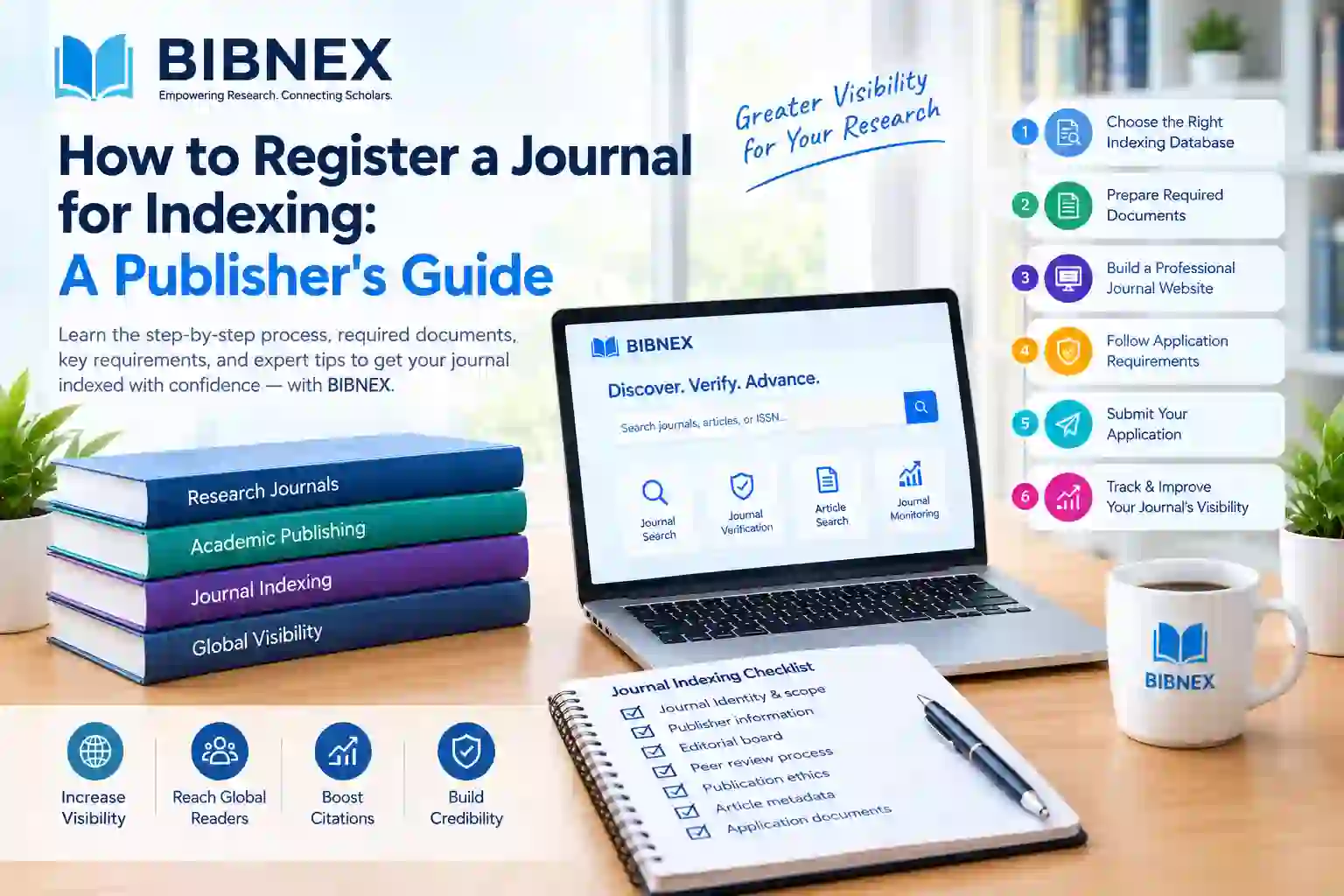
How to Register a Journal for Indexing: A Publisher's Guide
Registering an academic journal for indexing is an important step toward improving its visibility, helping researchers discover published articles, and building a stronger presence in the scholarly publishing community. However, the process involves more than completing an application form. Publishers need to maintain accurate journal information, establish transparent editorial policies, publish research consistently, and understand the requirements of the indexing service they want to join.
For publishers looking to register a journal for indexing, the first step is to understand that different indexing databases have different purposes and eligibility criteria. An ISSN identifies a serial publication, but it does not automatically mean that the journal is indexed. Similarly, submitting a journal application does not guarantee acceptance.
BIBNEX provides a bibliographic discovery environment focused on journal discovery, journal verification, article search, and journal monitoring. Publishers can explore the BIBNEX journal indexing database as part of their efforts to improve journal discoverability and make scholarly information easier to find.
This guide explains the journal indexing application process, the information publishers should prepare, common application mistakes, and practical steps for improving a journal's readiness for evaluation.
What Does It Mean to Register a Journal for Indexing?
Registering a journal for indexing generally means submitting information about a scholarly publication to a database or discovery service for consideration or inclusion. The exact meaning depends on the service involved.
Some services focus on bibliographic discovery, while others apply subject-specific selection criteria, evaluate journal quality, or provide citation-related information. Publishers should understand these differences before choosing where to apply.
Journal indexing can help researchers discover relevant publications through journal records, article titles, author information, abstracts, keywords, and other bibliographic metadata. However, the benefits depend on the service, the accuracy of the information supplied, and how researchers use that service.
Before starting an application, distinguish between these related activities:
- ISSN identification: Assigning an identifier to a continuing publication through the relevant ISSN process.
- Journal registration: Recording journal or publisher information with an appropriate organization or service.
- Journal indexing: Inclusion in a specific indexing or bibliographic database according to its applicable process.
- Article metadata registration: Depositing or maintaining bibliographic information about individual articles with an appropriate service.
These activities may support one another, but they are not interchangeable. Publishers should make claims about indexing only when they can verify the journal's status in the relevant service.
Why Is Journal Indexing Important for Publishers?
Academic publishers compete for the attention of researchers, authors, librarians, and institutions. A journal that is difficult to discover may struggle to reach its intended audience, even when it publishes relevant research.
Appropriate indexing and bibliographic discovery services can help publishers address this challenge.
1. Improve Journal Visibility
Inclusion in a relevant discovery service can make a journal easier to find when researchers search for a subject, publication title, or related scholarly material. This can complement the journal's own website, institutional partnerships, and other outreach activities.
2. Support Research Article Discoverability
Researchers often look for individual articles rather than browsing journal websites directly. Accurate article titles, abstracts, keywords, author names, and publication details help communicate what a paper contains and who produced it.
3. Help Readers Verify Journal Information
Clear journal records make it easier to identify a publication and review its available information. Publishers should ensure that the title, publisher, ISSN details, website, and publication history are consistent across relevant sources.
4. Strengthen Publishing Transparency
Preparing a journal for evaluation encourages publishers to review editorial policies, peer-review practices, publication ethics, and metadata quality. These practices are valuable even before a journal applies for indexing.
5. Support Long-Term Discoverability
Journal indexing should be part of a continuing publishing strategy. Accurate metadata, accessible archives, regular monitoring, and consistent editorial practices help maintain reliable publication information over time.
Step 1: Identify the Right Indexing Database
Before you apply for journal indexing, identify the service that best matches your journal's subject, publication model, and objectives.
Not every database serves the same purpose. Some focus on broad bibliographic discovery, some specialize in particular academic disciplines, and others emphasize citation information or specific types of scholarly content.
Consider the following questions when evaluating a service:
- Does the service cover your journal's academic discipline?
- Does it accept applications from journals with your publishing model?
- Does it have published eligibility or selection requirements?
- Does it explain how journal information is evaluated?
- Can users search for journals, articles, or bibliographic records?
- Does it clearly communicate the status of listed journals?
- Are its policies, contact information, and procedures transparent?
Do not choose an indexing service only because it is popular or because another journal claims to be included. First verify the service's scope and the type of visibility it can provide.
For a broader comparison, read Top Journal Indexing Databases for Journals in 2026. Use that guide as a starting point, then confirm the current requirements directly with each database.
Step 2: Confirm the Journal's Basic Information
One of the most important parts of a journal indexing application is the consistency of its publication information.
Prepare the following details before starting an application:
- Official journal title
- ISSN and eISSN information, where applicable
- Publisher or sponsoring institution
- Country of publication
- Official journal website
- Academic subject and aims
- Publication frequency
- Publishing language or languages
- Editor-in-Chief and editorial board details
- Publication history and accessible issues
- Contact information for the editorial office
Check that these details agree across the journal website, article PDFs, issue pages, publisher records, and application documents.
For example, if the journal homepage uses one title while its article PDFs use a different title, evaluators may need clarification. Likewise, an outdated publisher address or incorrect ISSN can create unnecessary administrative problems.
If the journal publishes both print and online editions, confirm which identifiers apply to each edition and follow the relevant ISSN guidance.
Step 3: Build a Professional Journal Website
A journal website should help authors, reviewers, readers, and evaluators understand how the publication operates.
Publishers should make essential information easy to locate rather than hiding it in unrelated pages or downloadable files.
A useful journal website generally includes:
- Journal homepage and description
- Aims and scope
- Editorial board
- Peer-review policy
- Publication ethics policy
- Author submission guidelines
- Copyright and licensing information
- Publication fees, if any
- Contact details
- Current and previous issues
- Individual article pages
Publishers should test the website on mobile devices and ensure that important pages are accessible without unnecessary barriers. Article links should work, and archived issues should remain available wherever possible.
A professional appearance alone does not establish journal quality. The website must accurately reflect the journal's actual editorial and publishing practices.
Step 4: Establish Transparent Editorial and Peer-Review Policies
Indexing preparation should include a careful review of the journal's editorial process.
Publishers should explain how manuscripts are assessed, who makes editorial decisions, and how conflicts of interest or publication concerns are handled.
Depending on the journal's model, relevant information may include:
- Type of peer review
- Manuscript screening procedure
- Reviewer selection and responsibilities
- Editorial decision process
- Confidentiality requirements
- Conflict-of-interest procedures
- Corrections and retractions policy
- Plagiarism and research misconduct procedures
Policies should be specific enough to explain the journal's real workflow. Copying another publication's policies without adapting them can create a gap between published promises and actual editorial practice.
Publishers should also ensure that editorial board members are genuine, appropriately identified, and aware of their listed roles.
Step 5: Maintain a Consistent Publication Record
Some indexing services consider a journal's publication history when evaluating an application. The exact expectations vary, so publishers must consult the current criteria of their chosen service.
Maintaining a reliable publication record is a sensible preparation step regardless of the database.
For each issue, maintain records of:
- Volume and issue number
- Publication date
- Article titles
- Author names and affiliations
- Abstracts and keywords
- Page numbers or article identifiers, where applicable
- DOIs, where assigned
- References and other bibliographic details
Publish according to the frequency stated on the journal website. If a delay occurs, communicate accurately rather than displaying publication dates that do not reflect the actual publication record.
Do not publish low-quality or unsuitable material simply to increase the number of articles or issues. Editorial integrity should remain central to the journal's development.
Step 6: Prepare Accurate Article Metadata
Journal-level information is only part of the indexing process. Article-level metadata also matters because researchers frequently search for specific topics, authors, or papers.
Publishers should check that every article has consistent information, including:
- Article title
- Author names
- Author affiliations
- Abstract
- Keywords
- Publication date
- Journal title
- Volume and issue, where applicable
- Page range or article number, where applicable
- DOI, where applicable
- References
Use clear, descriptive article titles and abstracts that accurately represent the research. Avoid adding unrelated keywords to article metadata merely to attract search traffic.
Publishers should also check that metadata on the website matches the information in article PDFs and any external registration or discovery services they use.
Step 7: Review the Journal Indexing Application Requirements
Before completing a journal indexing application, create a checklist based on the target service's official requirements.
There is no universal document list that applies to every indexing database. Depending on the service, a publisher may be asked for information such as:
- Journal title and ISSN details
- Publisher information
- Official website URL
- Aims and scope
- Editorial board information
- Peer-review and publication ethics policies
- Publication frequency
- Links to current and previous issues
- Examples of published articles
- Article metadata
- Information about the publishing model
Additional documentation may be required by a particular service. Do not assume that a document accepted by one database will automatically satisfy another database's requirements.
For a more detailed preparation checklist, read Journal Indexing Application: Requirements, Process and Checklist.
Step 8: Submit the Journal Application Correctly
Once the journal is ready, follow the official application instructions of the selected indexing service.
A careful submission process generally involves the following steps:
- Read the current requirements. Confirm eligibility, application procedures, and any publication-history expectations.
- Collect the required information. Prepare journal details, policy links, issue archives, and requested supporting documents.
- Check consistency. Compare the application with the journal website and publication records.
- Complete the application. Use accurate information and answer the questions according to the service's instructions.
- Submit through the appropriate channel. Use the official submission page or contact specified by the service.
- Save the confirmation. Keep a copy of the application, submission date, and any reference number.
- Monitor communications. Respond to requests for clarification using accurate supporting information.
- Verify the final status. Do not announce inclusion until the relevant service confirms it or provides a verifiable record.
Publishers should avoid submitting incomplete or contradictory information just to meet a target date. Accuracy is more useful than rushing an application that needs substantial correction.
Step 9: Understand Evaluation, Approval, and Rejection
Submitting an application does not guarantee that a journal will be accepted. Each service determines its own evaluation process and selection criteria.
Possible reasons for an unsuccessful or delayed application may include incomplete information, inconsistent journal details, unsuitable subject coverage, inaccessible archives, or failure to meet a service's stated criteria. These are examples, not a universal list of rejection rules.
If an application is rejected or returned for clarification:
- Read the explanation carefully.
- Identify which requirements were not met.
- Correct factual errors and incomplete information.
- Improve the relevant publishing processes where necessary.
- Check whether the service permits resubmission and whether a waiting period applies.
- Reapply only when the journal is ready and the applicable rules permit it.
Do not assume that paying a fee or hiring a third party guarantees approval. Publishers should be cautious about services that promise guaranteed inclusion without a transparent, verifiable evaluation process.
How BIBNEX Supports Journal Discovery and Verification
BIBNEX is a bibliographic discovery network focused on journal search, journal verification, article search, and journal monitoring. It is designed to help users explore scholarly publication information in one discovery environment.
For publishers, discoverability is not only about submitting an application. It also involves maintaining accurate journal information, providing accessible article records, and ensuring that readers can identify the publication and its content.
Publishers interested in BIBNEX can explore the BIBNEX journal indexing database and review the available journal submission resources.
Before applying, publishers should understand the applicable submission and evaluation process rather than assuming that inclusion is automatic. Information about the platform's current criteria and submission procedures should be checked directly through BIBNEX.
Useful resources include:
- Submit Your Journal to BIBNEX: Complete Publisher Guide
- How BIBNEX Evaluates Journals for Indexing
- Journal Indexing for Publishers: How BIBNEX Can Help Improve Journal Visibility
- BIBNEX Journal Indexing, Verification, Article Search and Monitoring
How to Verify a Journal's Indexing Status
Publishers and researchers should distinguish between a journal appearing on a website and its verified inclusion in a particular database.
To check a journal's status:
- Identify the exact indexing service mentioned by the publisher.
- Search the service's official journal directory or record system, where available.
- Compare the journal title and ISSN with the publication you are checking.
- Review any available status details and coverage dates.
- Check whether the listing refers to the journal itself or only to selected articles.
- Record the date of verification because database coverage can change.
BIBNEX offers resources for exploring and verifying journal information. You can read how to find and verify indexed journals using a journal database for additional guidance.
Remember that a journal's inclusion in one service does not establish its inclusion in every other service. Always verify the specific database relevant to your claim.
Common Mistakes Publishers Should Avoid
Confusing ISSN with Indexing
An ISSN identifies a serial publication. It does not independently certify journal quality or establish inclusion in an indexing database.
Applying Without Checking Eligibility
Different services have different scopes and requirements. Review the current criteria before investing time in an application.
Publishing Inaccurate Information
Incorrect titles, inconsistent ISSN details, outdated editorial boards, and broken article links can make the journal harder to evaluate and discover.
Ignoring Article Metadata
A journal homepage alone is not enough. Accurate metadata and accessible article pages help users understand and locate individual research outputs.
Making Unsupported Indexing Claims
Do not use claims such as "indexed internationally" without identifying and verifying the relevant service. Be specific about the journal's actual status.
Expecting Immediate Results
Evaluation timelines vary. Do not promise a fixed approval date unless the service explicitly provides one for the relevant process.
Practical Checklist: Is Your Journal Ready for Indexing?
Use this checklist before submitting your application.
- Official journal title and publication details are consistent.
- Applicable ISSN information has been checked.
- Publisher information is accurate and transparent.
- The journal website is accessible and up to date.
- Aims and scope are clearly explained.
- Editorial board details are genuine and current.
- Peer-review procedures are documented.
- Publication ethics policies are publicly available.
- Author guidelines are complete.
- Published issues and articles are accessible.
- Article metadata is accurate and consistent.
- Publication frequency is represented honestly.
- The target database's current criteria have been reviewed.
- All requested documents and links are ready.
- Indexing claims can be independently verified.
Frequently Asked Questions
How do I register a journal for indexing?
Identify an appropriate indexing service, review its current eligibility criteria, prepare accurate journal information and required documents, submit through the official channel, and monitor the evaluation process. Requirements vary by service, and submission does not guarantee acceptance.
Can I apply for journal indexing without an ISSN?
Requirements vary by indexing service. Some may require an ISSN, while others may have different procedures. Check the current rules of the service you intend to use and follow the relevant ISSN process where applicable.
What documents are required for journal indexing?
Commonly requested information may include journal title, ISSN details, publisher information, website, editorial board, aims and scope, peer-review policy, publication ethics, issue archives, and article metadata. The exact requirements depend on the database.
How long does journal indexing take?
There is no universal timeline. Processing depends on the service's workflow, application completeness, eligibility checks, and any additional evaluation. Consult the target service for its current guidance and avoid relying on unsupported approval promises.
Does journal registration guarantee indexing?
No. Journal registration, ISSN identification, and indexing are different activities. Inclusion depends on the relevant database's process and requirements.
How can I submit my journal to BIBNEX?
Visit the BIBNEX website and review the available publisher submission information. Check the current submission requirements and evaluation procedure before applying.
How can BIBNEX help publishers improve journal visibility?
BIBNEX focuses on journal discovery, verification, article search, bibliographic information, and monitoring. Publishers can explore its resources while maintaining accurate journal information and accessible article metadata.
Can a new journal apply for indexing?
That depends on the selected service. Some databases may expect an established publication history, while others may have different requirements. Review the applicable criteria before applying.
Conclusion: Build a Strong Foundation Before Applying
Learning how to register a journal for indexing begins with choosing the right service and preparing the journal carefully. Publishers should maintain accurate publication information, transparent editorial policies, accessible archives, reliable article metadata, and a clear understanding of the selected database's requirements.
Indexing is not simply a certificate or a form. It is part of a wider effort to make scholarly information easier to discover, identify, and evaluate.
For publishers seeking to strengthen journal discoverability, BIBNEX offers a platform focused on journal discovery, verification, article search, and monitoring. Explore the BIBNEX journal indexing database to learn more about the available resources and publisher submission options.
Next step: Review your journal's readiness, check the current requirements of your target database, and prepare a complete, accurate application before submission.
Related Resources
- BIBNEX Journals: Search and Explore Indexed Journals
- Journal Finder Tool: Find the Right Journal for Your Research
- How to Submit a Journal for Indexing: Publisher Guide
- Journal Indexing for Publishers: Complete Guide
- BIBNEX Journal Verification: Checks Before Publishing
- Step-by-Step Guide to Applying for Journal Indexing
- Submit a Journal for Indexing: Complete Publisher Guide
- Indian Indexed Journals: How to Find and Verify Indexed Journals
- Indexed Journals: Complete Guide to Finding and Verifying Indexed Journals